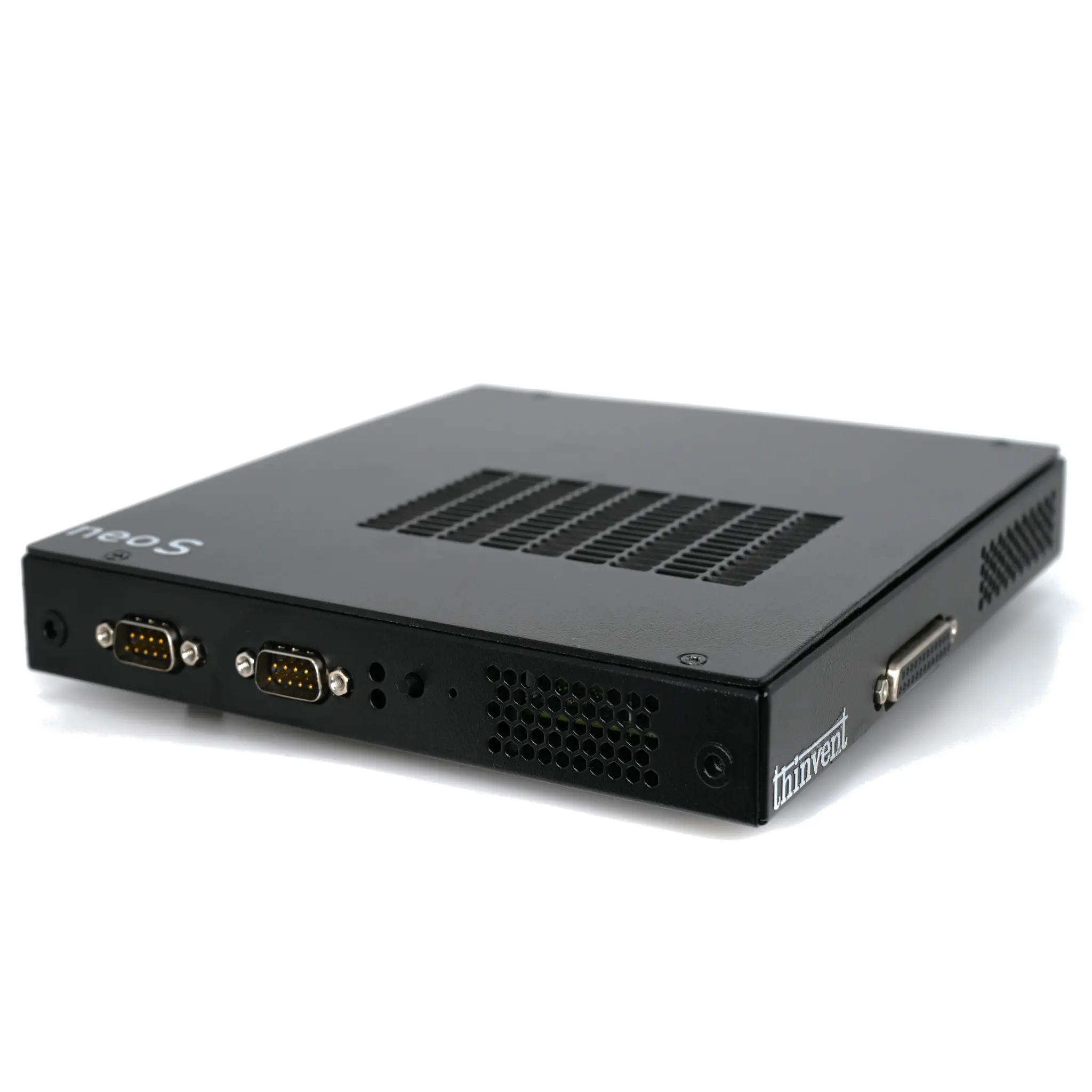
What is a Thin Client with Windows Embedded?
A thin client with Windows Embedded, now evolved into Windows IoT Enterprise or Windows 11 IoT Enterprise, is a streamlined computing device designed to connect to a centralized server or cloud environment. Unlike a traditional PC, it has minimal local processing, storage, and applications, relying instead on a network connection to access virtual desktops, applications, and data. This architecture centralizes management, enhances security, and reduces total cost of ownership. The "embedded" or IoT version of Windows provides a locked-down, componentized operating system optimized for dedicated use, offering long-term servicing and enhanced stability for commercial deployments.
Key Specifications and Technical Details
Modern thin clients, like the Thinvent Neo S series, balance efficient performance with robust connectivity. Key specifications typically include:
-
Processors: Energy-efficient Intel processors like the quad-core N100 (up to 3.4 GHz) or J4125 (up to 2.7 GHz).
-
Memory: Configurable DDR4 RAM, ranging from 4GB to 64GB to suit different workload demands.
-
Storage: A combination of SSDs for the OS and MLC (Multi-Level Cell) SSDs for enhanced reliability and write endurance, with capacities from 32GB to 256GB.
-
Connectivity: Options for Dual-Band Wi-Fi and wired Ethernet for network access.
-
Power: Low-power adapters (e.g., 12V or 19V) contributing to energy savings.
-
OS: Windows 11 Pro or IoT Enterprise, providing a familiar interface with centralized management capabilities.
Use Cases and Applications
Thin clients are ideal for environments requiring secure, manageable, and consistent user experiences. Primary applications include:
-
Virtual Desktop Infrastructure (VDI): Accessing virtual desktops from Citrix, VMware, or Microsoft RDS.
-
Call Centers & Office Workstations: Providing standardized desktops for task workers handling CRM, ERP, and communication software.
-
Digital Signage & Kiosks: Running interactive displays or point-of-sale systems with a locked-down OS.
-
Healthcare & Banking: Delivering secure access to sensitive applications and patient/financial records from a centralized server.
-
Industrial & Manufacturing: Operating in harsh environments to interface with SCADA and MES systems on the factory floor.
Processor Comparison: Intel N100 vs. J4125
When selecting a thin client, the processor is a critical choice affecting performance and power efficiency. Below is a comparison of two common options in Thinvent's lineup.
| Feature | Intel Processor N100 (Alder Lake-N) | Intel Celeron J4125 (Gemini Lake) |
|---|---|---|
| Generation | 12th Gen | 10th Gen |
| Cores/Threads | 4 Cores, 4 Threads | 4 Cores, 4 Threads |
| Max Turbo Frequency | Up to 3.4 GHz | Up to 2.7 GHz |
| Cache | 6 MB Intel Smart Cache | 4 MB Cache |
| Graphics | Intel UHD Graphics (16 EUs) | Intel UHD Graphics 600 |
| Typical Use Case | Modern VDI, multi-monitor support, lighter multimedia | Legacy VDI, basic office tasks, single-display setups |
| Power Efficiency | More modern architecture, typically lower TDP | Efficient, but older 14nm process |
The Intel N100 offers more modern architecture, better graphics performance, and higher clock speeds, making it suitable for more demanding virtualized environments. The J4125 remains a capable and cost-effective option for standard task-based workloads.
Thinvent Neo S Thin Client Series
Thinvent's Neo S series exemplifies modern thin client design, offering a wide range of configurations to meet diverse global enterprise needs. Built around efficient Intel processors, these devices provide the reliability and performance required for seamless access to centralized computing resources. The series is highly configurable, with options for RAM (4GB to 64GB), storage types (standard SSD or reliable MLC SSD), and connectivity (with or without Wi-Fi). Pre-loaded with Windows 11 Pro, they are ready for integration into major VDI and cloud platforms. Thinvent's commitment to robust construction and global support ensures these thin clients deliver secure, manageable, and energy-efficient endpoints for any digital workspace, from standard office environments to specialized industrial settings.