
Simulated thermal performance and sustained processor power of the fanless Thinvent IPC5 and IPC3 industrial PCs
Will the IPC5 or IPC3 run cool enough for your site?
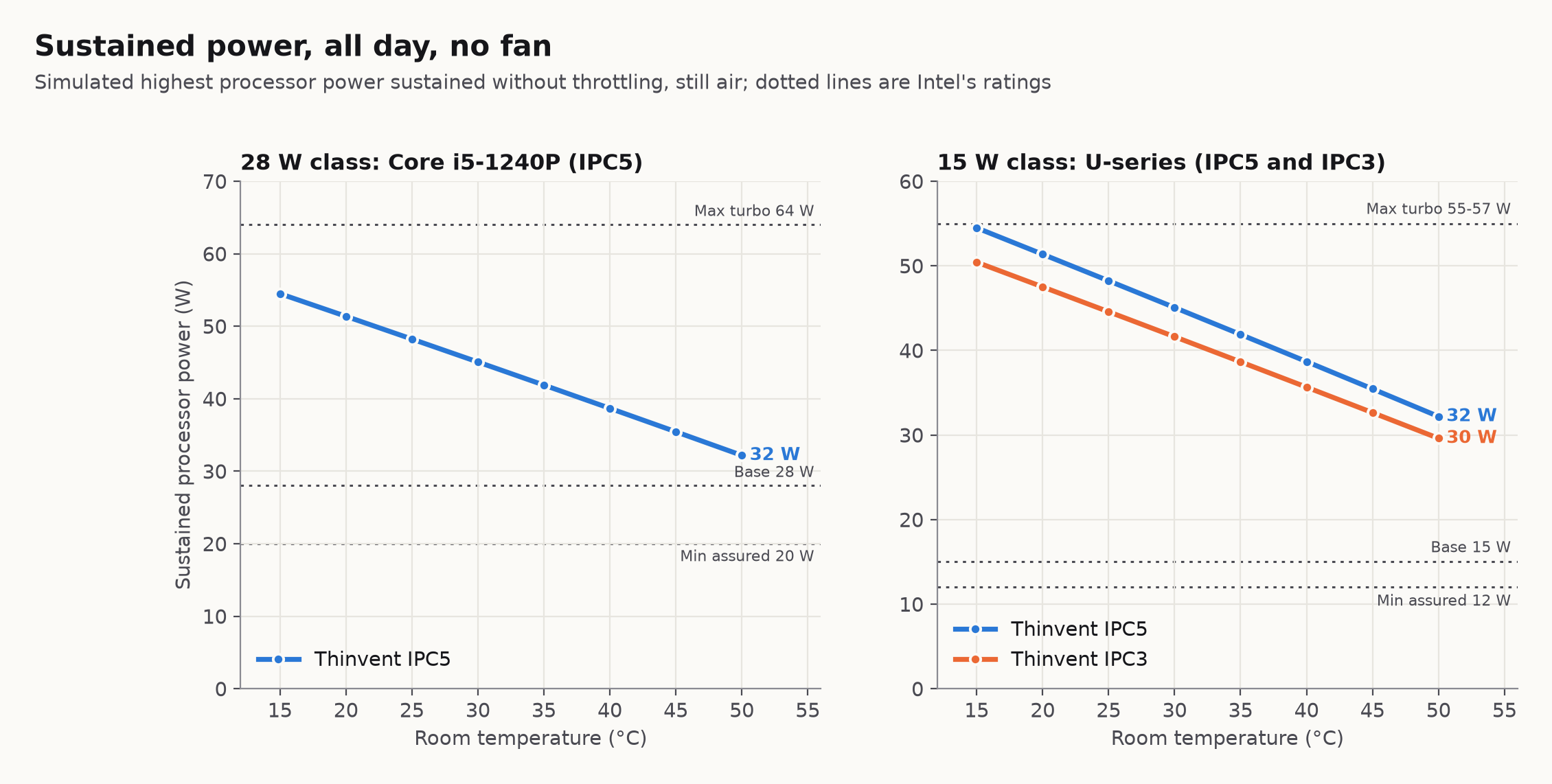
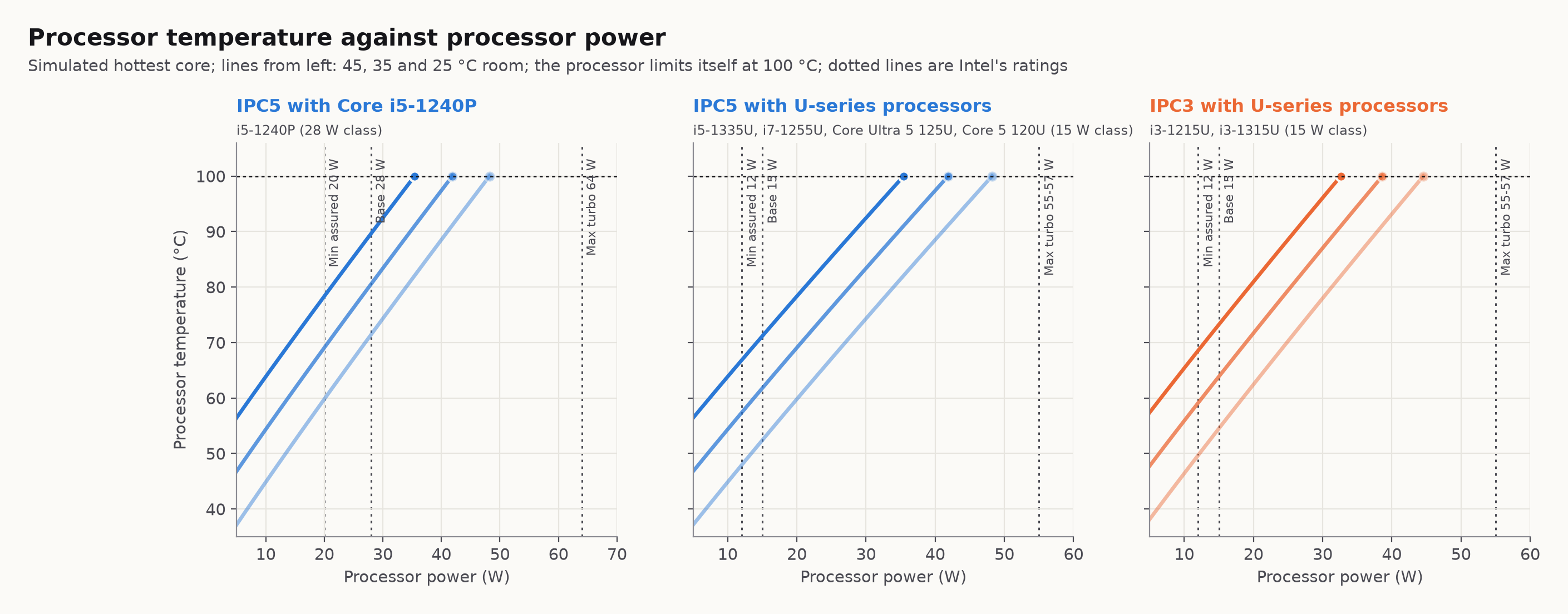
- Continuous fanless running: In simulated still air, both the IPC5 and IPC3 run all day at their processor's base power (the power it is designed to run at continuously) across the full 0 to 50 °C operating range without throttling (when a processor reaches its 100 °C limit and slows itself down to stay safe). Simulated sustained limits in a 50 °C room are 32 W for the IPC5 and 30 W for the IPC3 (rising to 48 W and 45 W in a 25 °C room), leaving headroom above every shipped processor's 15 W or 28 W base rating.
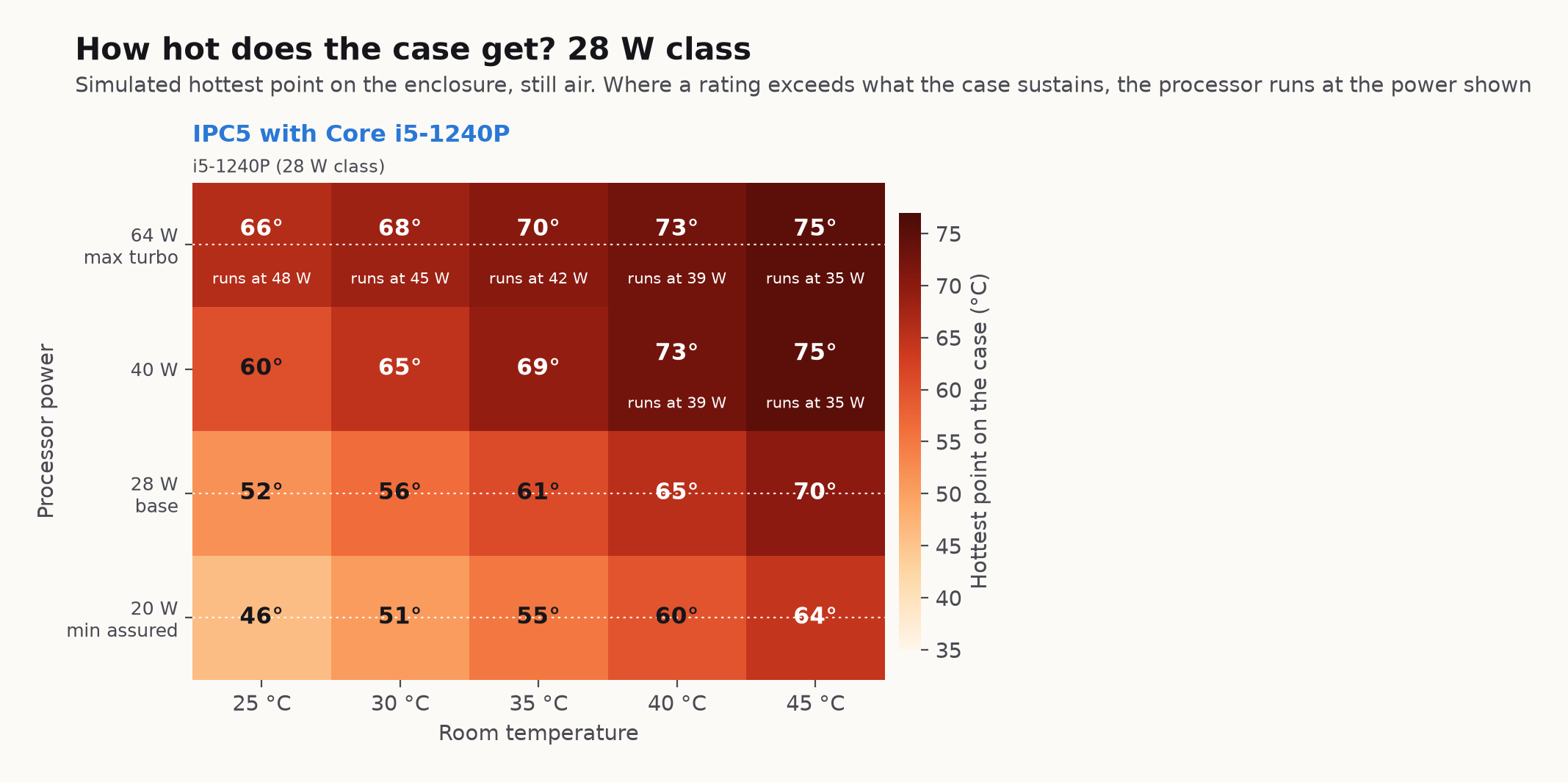
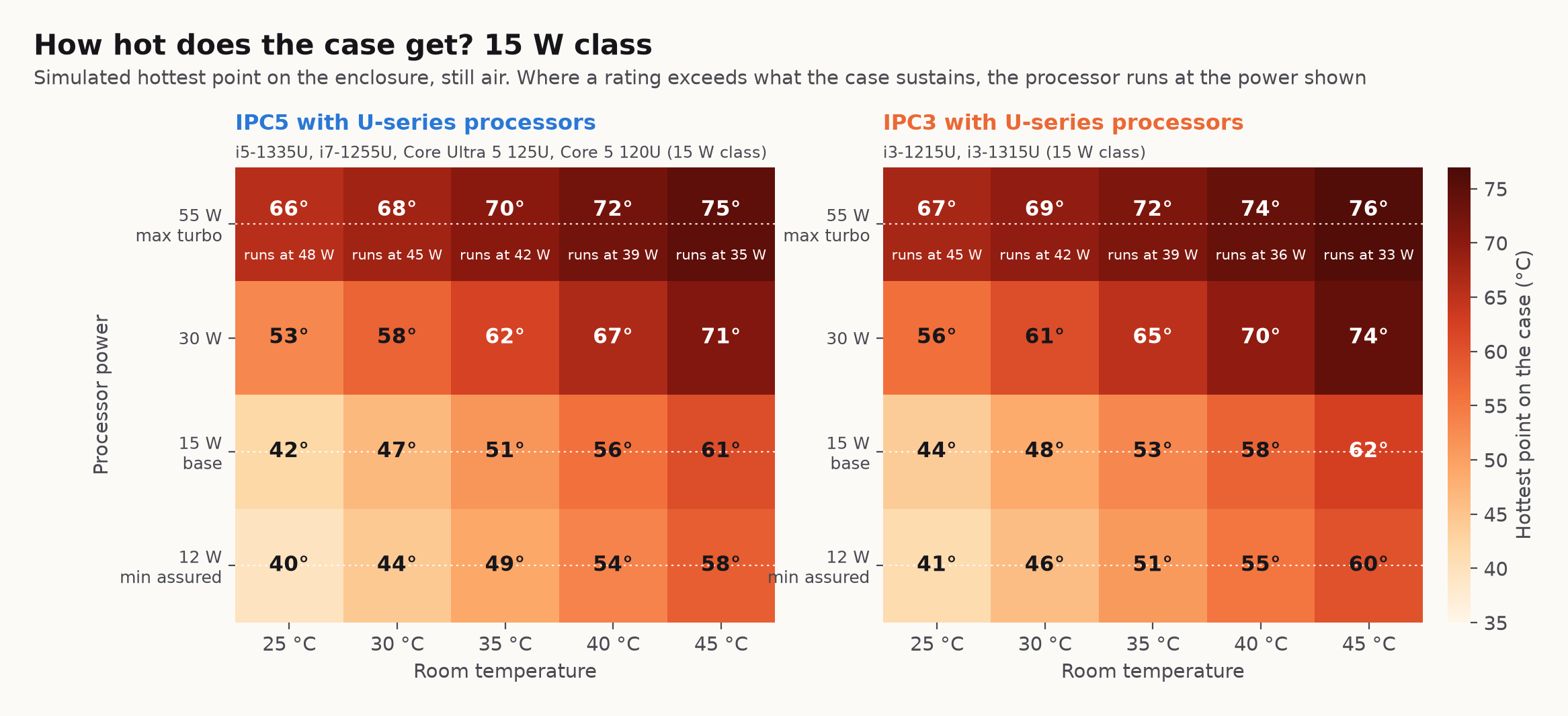
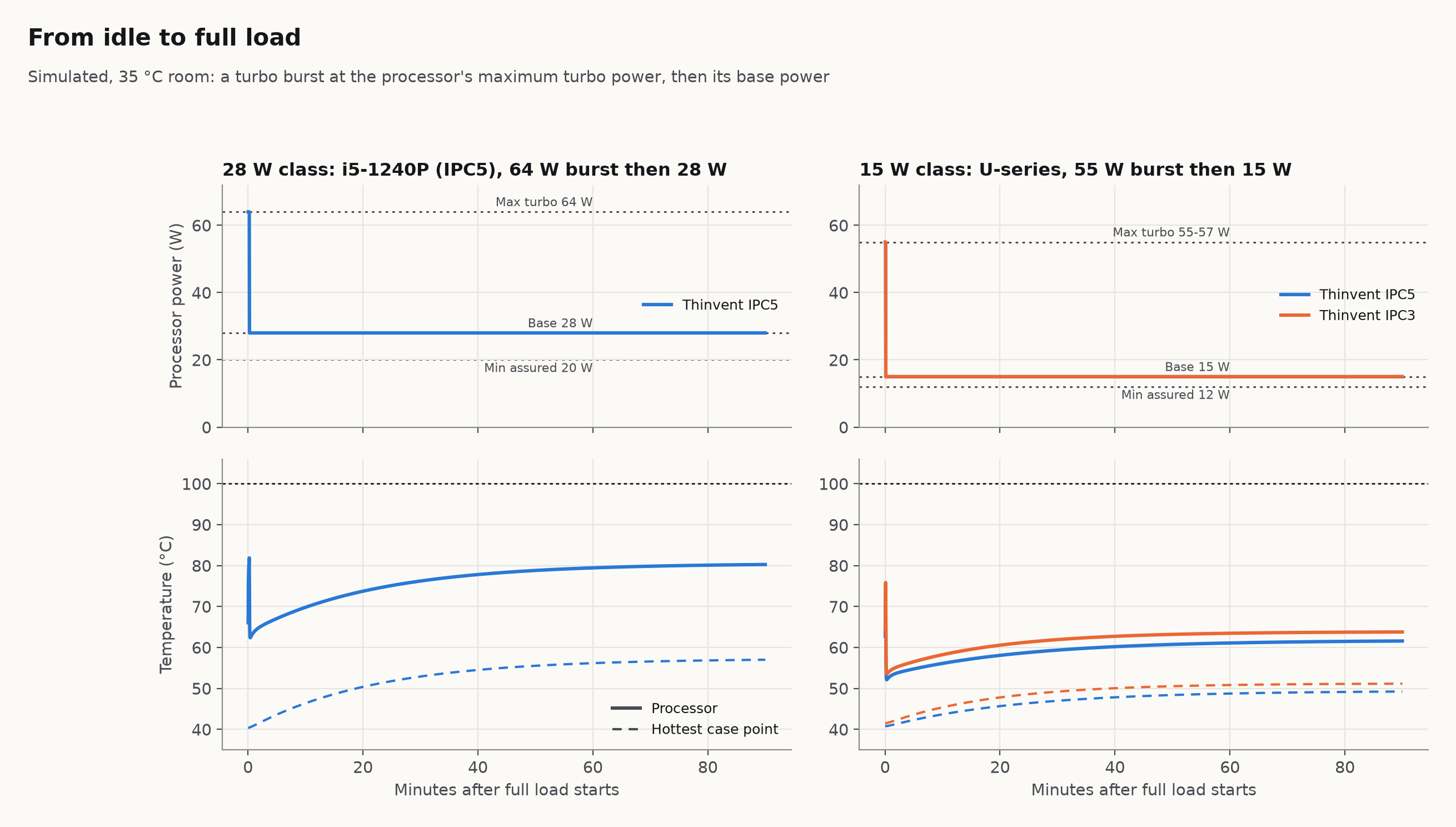
- Short speed bursts (turbo): Processors briefly draw 55 to 64 W for short bursts of extra speed before settling back to base power. Neither unit sustains maximum turbo continuously, which is normal for fanless PCs. In a simulated 35 °C room, a maximum turbo burst peaks the processor at about 82 °C (28 W class) or 73 to 76 °C (15 W class), well below the 100 °C throttling limit.
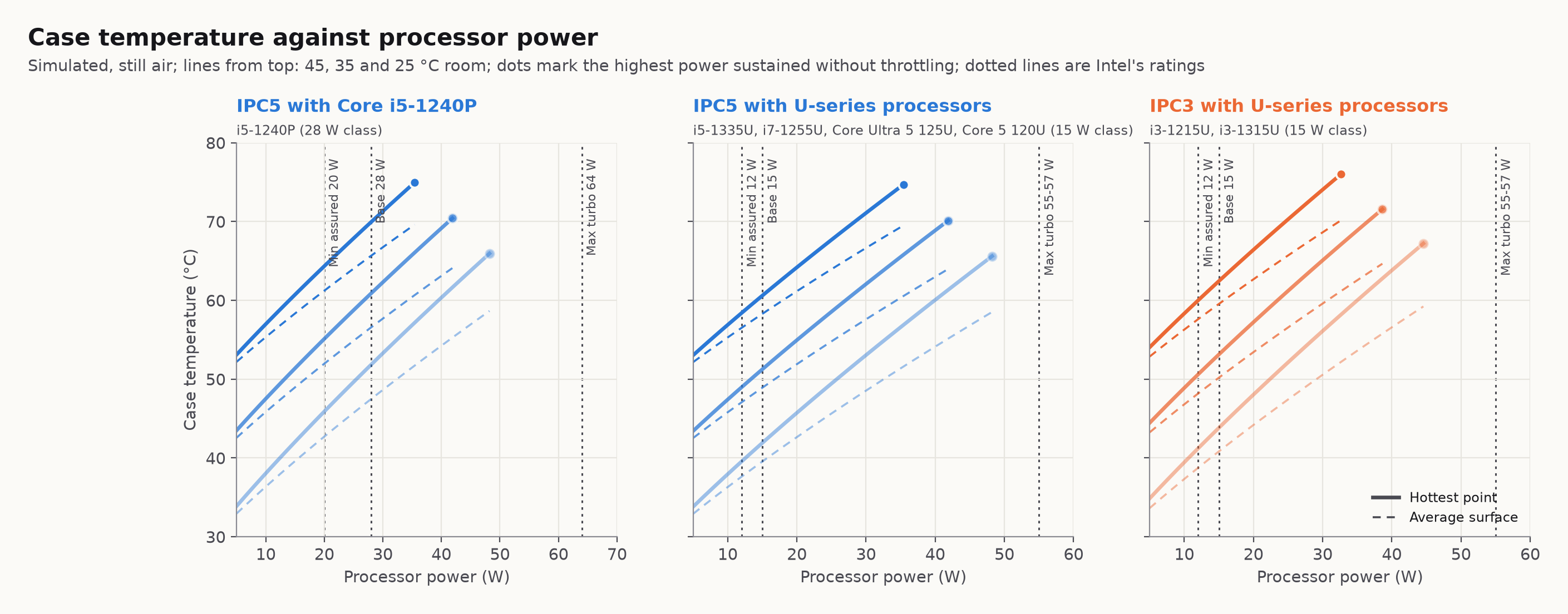
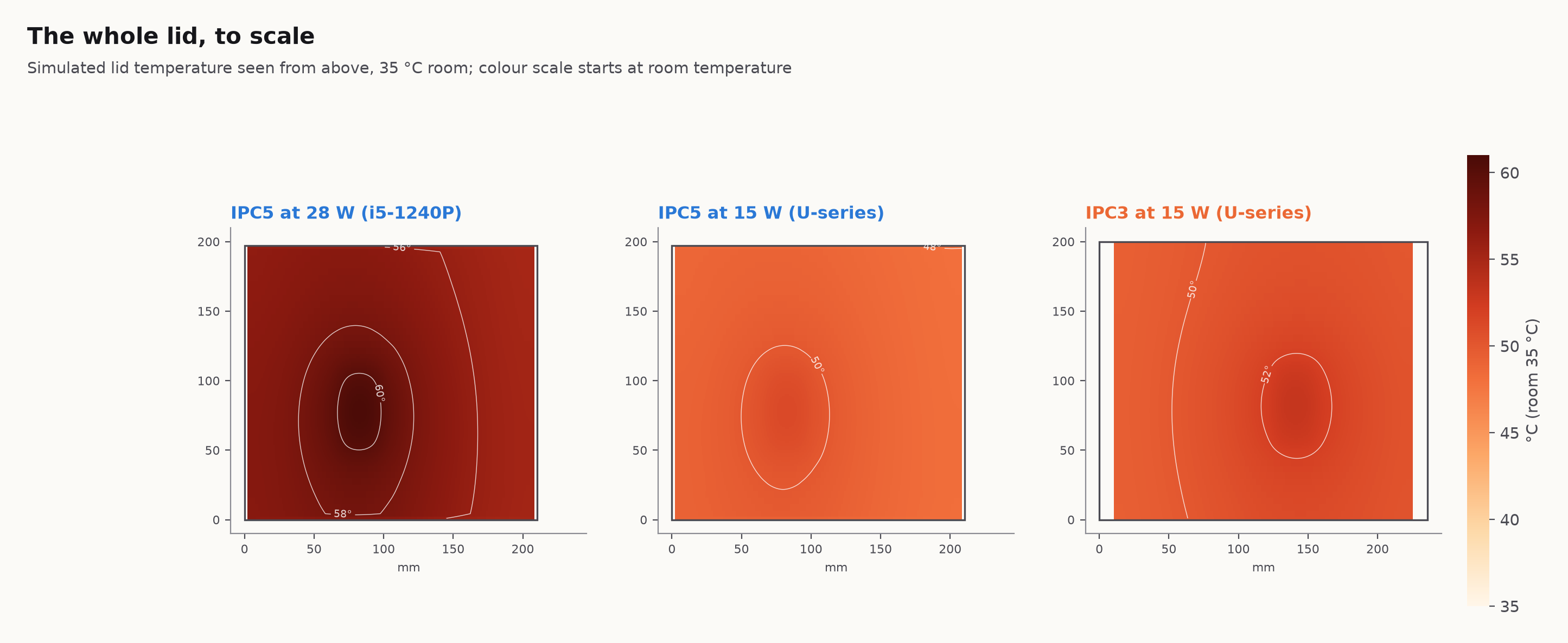
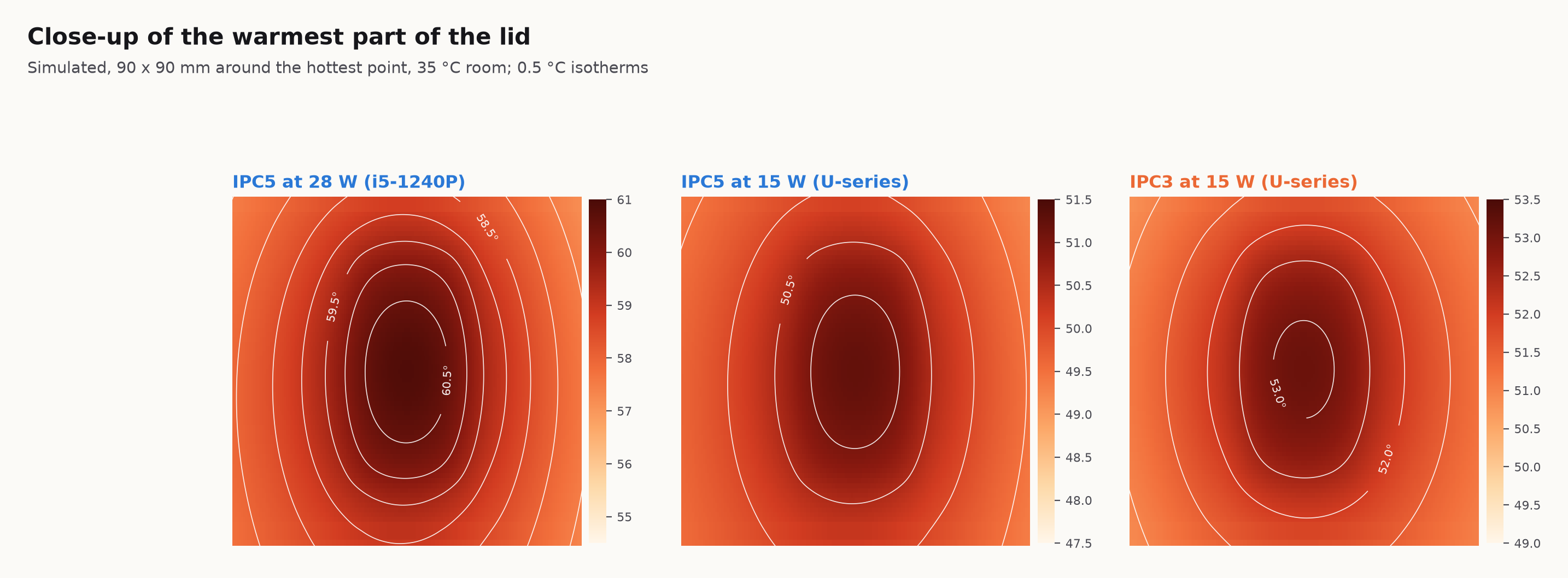
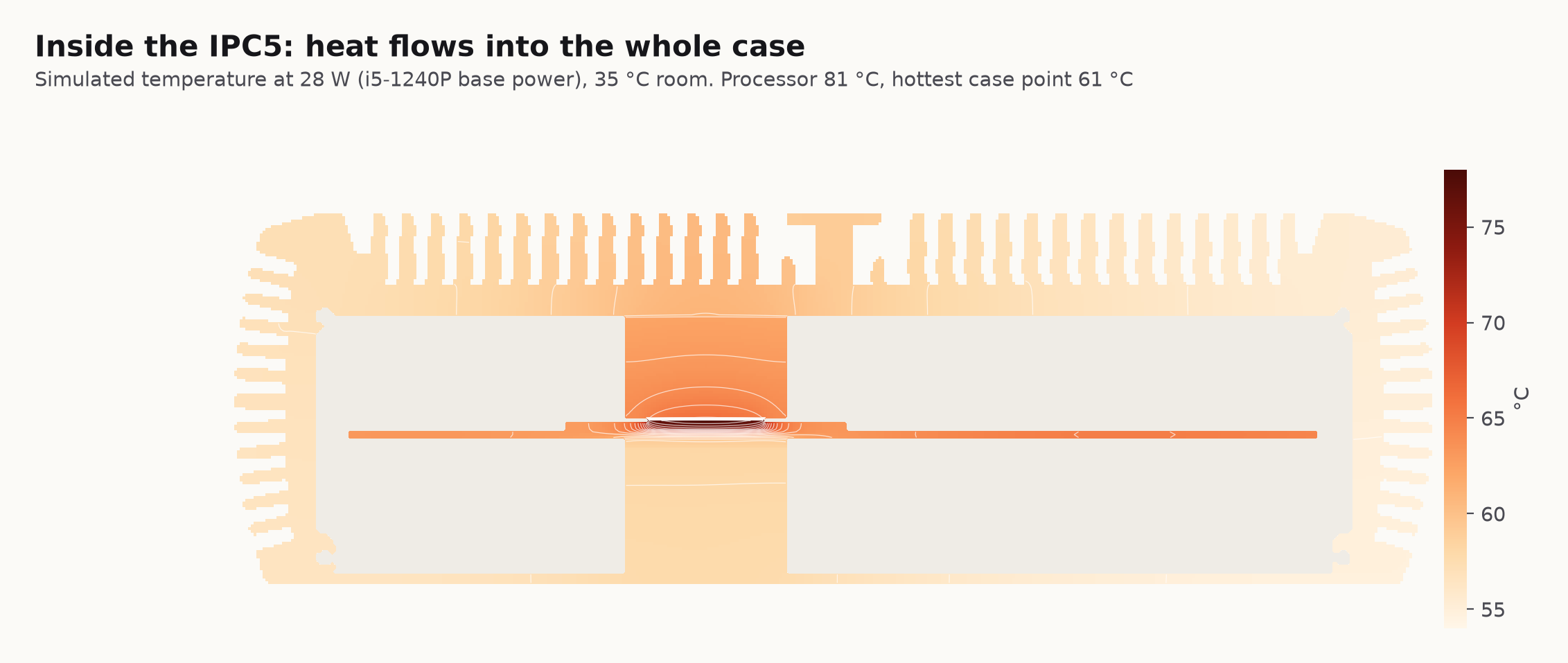
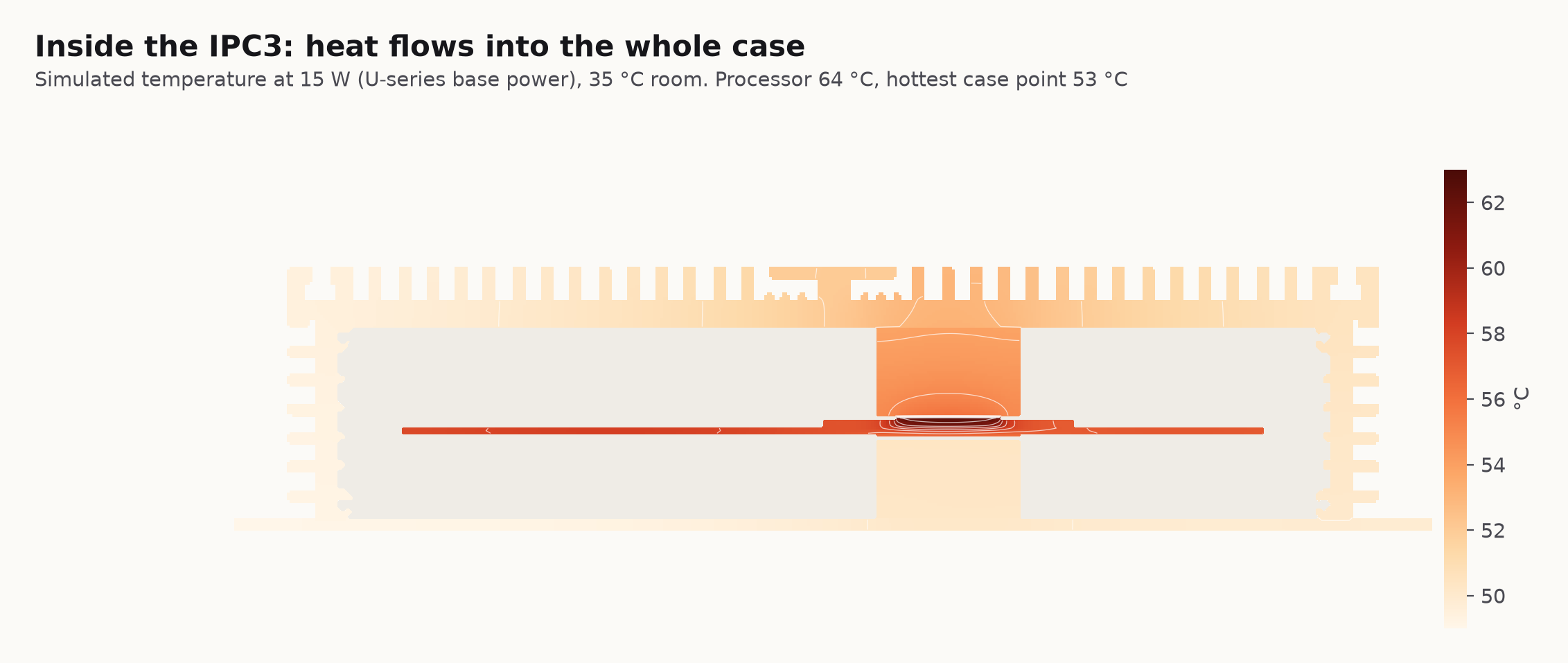
- How warm the case gets: The aluminium case acts as the heatsink and gets noticeably warm. At continuous base power in a 25, 35 and 45 °C room, the simulated hottest spot on the lid reaches 52, 61 and 70 °C on the IPC5 with the 28 W Core i5-1240P; 42, 51 and 61 °C on the IPC5 with a 15 W processor; and 44, 53 and 62 °C on the IPC3 with a 15 W processor. The average case surface is a few degrees cooler.
- Which model to choose: Choose the IPC5 (210 x 197 x 65 mm, black anodised aluminium) if you need the higher-power 28 W Intel Core i5-1240P, or a 15 W Core i5, i7, Core 5 or Core Ultra 5 processor with maximum cooling headroom. Choose the IPC3 (231 x 200 x 52 mm, silver anodised aluminium) if a 15 W Core i3 processor meets your needs and you want a slimmer case with side mounting flanges.
- Where you install it matters: All figures are simulated with the unit lying flat in open, still air (calibrated against one laboratory test on an IPC5-profile unit at 24.9 W in a 26 °C room: 75 °C processor, 52 °C case; simulation uncertainty is a few degrees). "Room temperature" means the air immediately around the PC: putting it inside a closed cabinet heats up that trapped air, so keep the cabinet ventilated or allow airflow over the fins, which lowers temperatures below these still-air figures.
Sustained processor power across room temperatures
Hottest case point by processor power and room temperature (28 W class)
Hottest case point by processor power and room temperature (15 W class)
Hottest and average case temperature against processor power
Processor junction temperature against processor power
Ninety-minute response from idle to a maximum turbo burst and base load
Whole lid surface temperature to scale at base power
Close-up of the warmest part of each lid at base power
Cross-section of the Thinvent IPC5 at 28 W base power
Cross-section of the Thinvent IPC3 at 15 W base power
How we simulated
Each complete enclosure was modelled from its design CAD in a three-dimensional heat-flow simulation of about 4 million cells, lying flat in still air with natural convection and radiation, plus 5 W from the rest of the board added to processor power.
Surface emissivity was set to handbook values of 0.88 for the black anodised IPC5 and 0.80 for the clear anodised IPC3.
One laboratory measurement on an IPC5-profile enclosure at 24.9 W in a 26 °C room (75 °C processor, 52 °C case) matches the simulation, which was set to match that reading; every other result on this page, including all IPC3 figures, is simulated.
Modelled temperatures carry an uncertainty of a few degrees, and fitting a unit inside a closed cabinet will raise the air temperature around it.