What is the Best CPU for Hacking?
The best CPU for hacking, penetration testing, and cybersecurity tasks is one that balances high single-core performance for running complex scripts and tools, with sufficient multi-core capability for virtualization, data processing, and running multiple applications simultaneously. Modern Intel Core i5 and i7 processors from the 12th generation and newer are typically recommended due to their hybrid architecture, which provides excellent performance-per-watt and strong multi-threading capabilities essential for security workloads.
Key Specifications and Technical Details
For a dedicated hacking or security research machine, key CPU specifications to prioritize include:
-
High Core/Thread Count: Essential for running virtual machines (VMs), password cracking, network traffic analysis, and parallelized security scans. A minimum of 6 cores (12 threads) is recommended.
-
High Clock Speeds: Single-threaded performance is critical for many security tools and scripts. Look for processors with high base and turbo frequencies.
-
Large Cache: A larger CPU cache (L3) improves the speed of data access for repetitive tasks common in cryptography and code analysis.
-
Support for Virtualization: Technologies like Intel VT-x are non-negotiable for running isolated lab environments in VMs.
-
Integrated Graphics: While a discrete GPU can aid in specific tasks like password cracking, a capable integrated GPU allows for a compact, fanless system ideal for portable or embedded security applications.
Use Cases and Applications
The right CPU powers a wide range of cybersecurity activities:
-
Penetration Testing: Running suites like Metasploit, Burp Suite, and Nmap, which benefit from fast processing.
-
Digital Forensics & Incident Response (DFIR): Analyzing disk images, memory dumps, and log files, which are computationally intensive.
-
Malware Analysis: Safely executing and monitoring malware in isolated virtual environments.
-
Cryptography & Password Cracking: Utilizing CPU power (and optionally GPU) for hash computation and decryption tasks.
-
Security Research & Development: Compiling code, running simulations, and testing exploits.
Processor Comparison for Security Workloads
| Use Case | Recommended Series | Ideal Generation | Key Rationale |
|---|---|---|---|
| Portable / Low-Power Lab | Intel Core i3 / Intel N-series | 12th Gen+ | Efficient performance for light VM work and toolkits in a fanless, compact form factor. |
| General Penetration Testing | Intel Core i5 | 12th / 13th / 14th Gen | Excellent balance of 6+ cores, high clock speeds, and integrated graphics for most security tasks. |
| Advanced Research & Virtualization | Intel Core i7 / i9 | 13th / 14th Gen | Maximum core count and thread performance for running multiple VMs, heavy data analysis, and complex simulations. |
Thinvent Industrial Computers for Cybersecurity
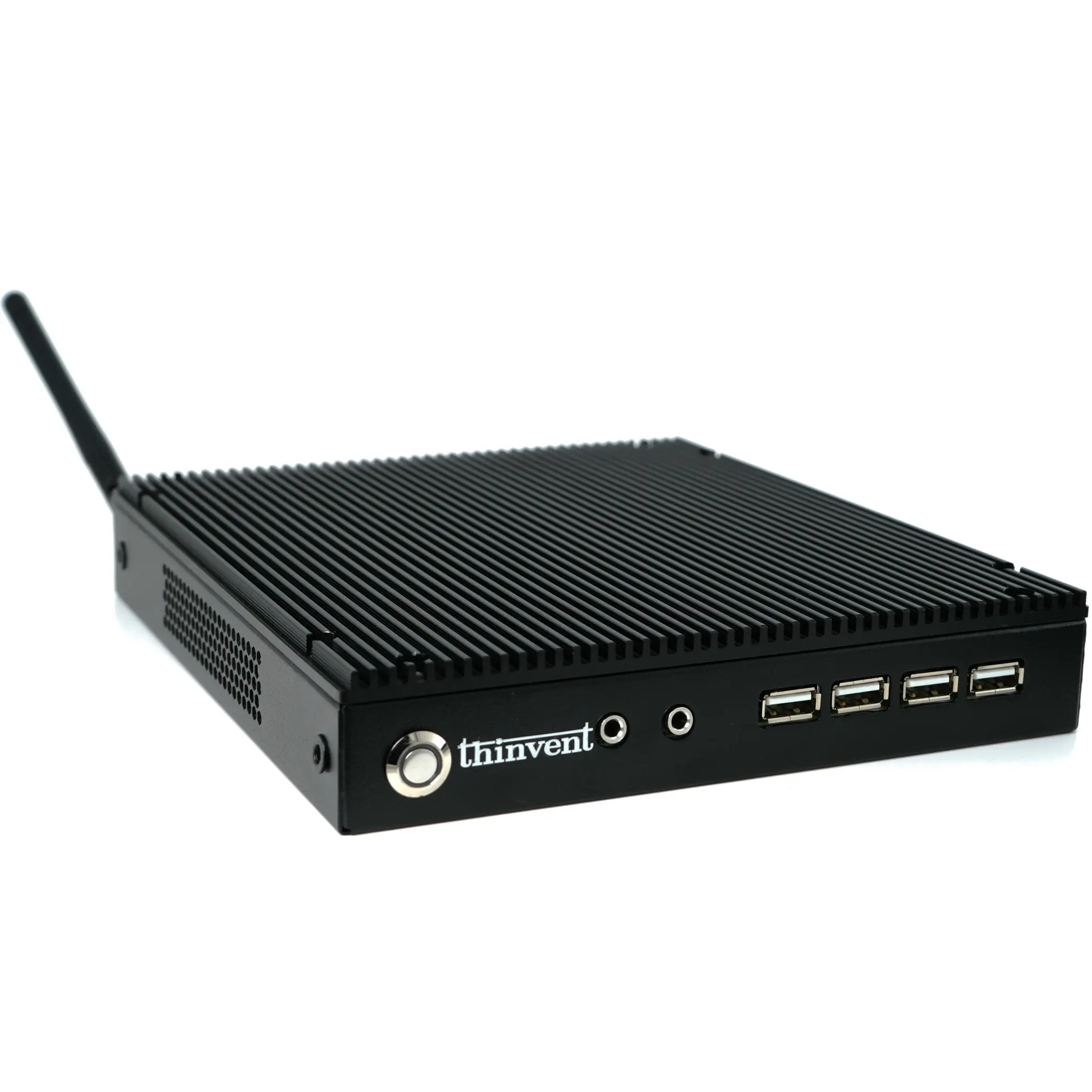
Thinvent offers a range of robust, reliable industrial computing solutions perfectly suited for building dedicated security workstations and portable testing labs. Our systems feature the latest Intel processors, from efficient N-series chips for compact toolkits to powerful Core i5 and i7 CPUs for desktop-grade performance. Built with fanless designs for silent, dust-resistant operation and wide voltage input for stability in various environments, Thinvent PCs provide a dependable hardware foundation for security professionals. Explore our mini PCs and industrial systems, configurable with ample RAM, fast SSD storage, and a choice of operating systems including Windows 11 Pro and Ubuntu Linux, to build your ideal security research platform.