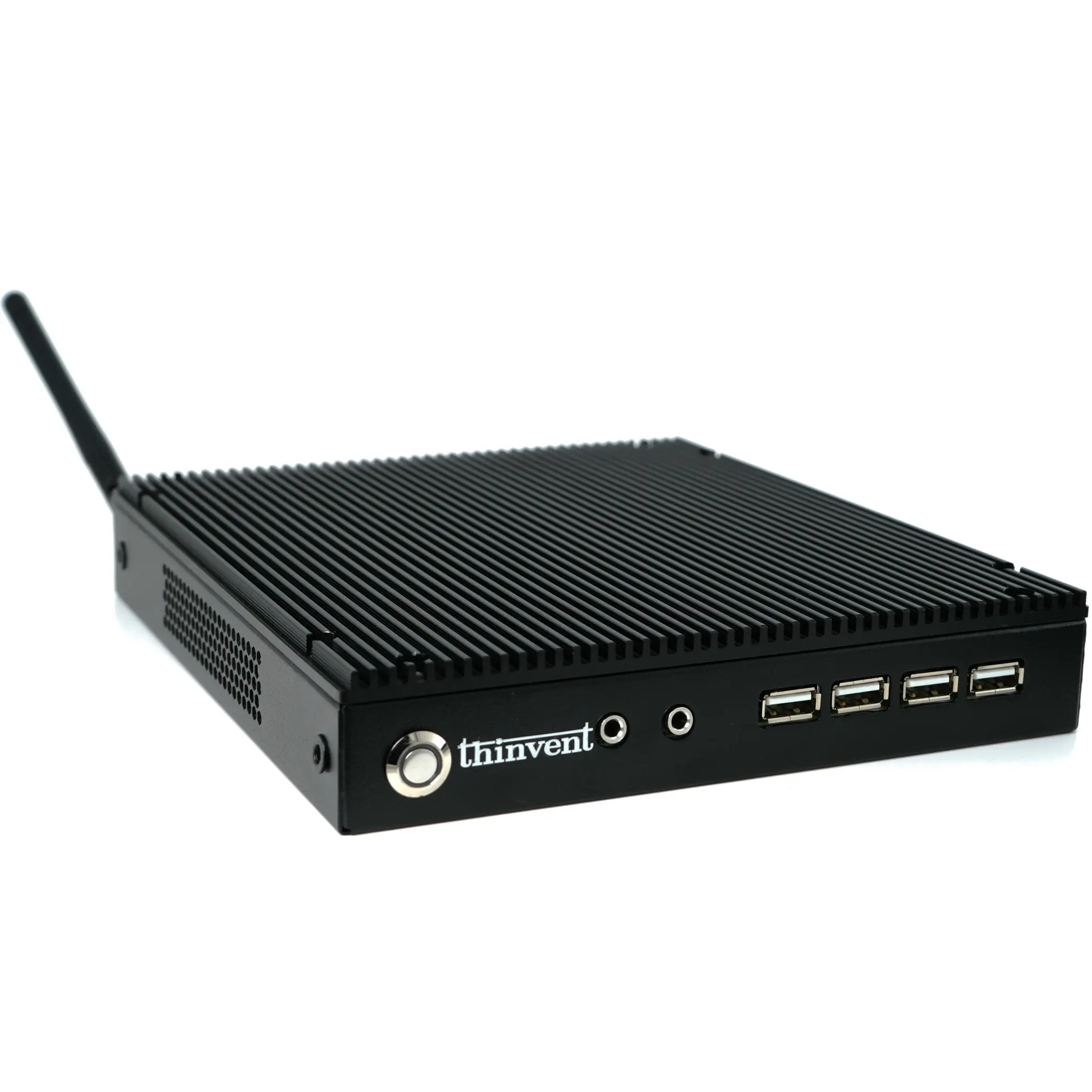
What is a Thin Client?
A Thin Client is a lightweight, compact computing device designed to connect to a central server or cloud environment where the primary processing and data storage occur. Unlike traditional desktop PCs, thin clients have minimal local hardware, focusing on network connectivity, security, and energy efficiency. They are ideal for centralized IT infrastructures, providing a cost-effective and manageable endpoint solution.
Key Specifications and Technical Details
Modern thin clients, like those powered by Intel's efficient processors, offer surprising capability in a small form factor. Key features include:
-
Fanless Design: Silent, reliable operation with no moving parts, ideal for dust-prone or quiet environments.
-
Low-Power Processors: Such as Intel's N-series (e.g., N100), which balance performance with excellent thermal and power efficiency.
-
Adequate Memory and Storage: Typically configured with sufficient RAM (e.g., 8GB or 16GB) and SSD storage (e.g., 128GB or 256GB) for the operating system and local caching.
-
Multiple Connectivity Options: Include Gigabit Ethernet for stable network connections, multiple USB ports for peripherals, and HDMI/DisplayPort for monitor output.
-
Flexible OS Support: Can run specialized thin client OS, lightweight Linux distributions, or even full Windows versions for more demanding local tasks.
Use Cases and Applications
Thin clients are deployed in scenarios where centralized management, security, and lower total cost of ownership are priorities.
-
Virtual Desktop Infrastructure (VDI): The primary use case, providing secure access to virtual desktops hosted on servers.
-
Call Centers & Office Workstations: For tasks like CRM, email, and web applications, ensuring consistent performance and easy software updates.
-
Digital Signage & Kiosks: Reliable, always-on operation for displaying media in retail, hospitality, or public information systems.
-
Healthcare & Education: Secure access to patient records or educational software from multiple locations with simplified IT management.
-
Industrial Environments: Their fanless, rugged nature makes them suitable for factory floors or control rooms.
Comparison: Thin Client vs. Traditional Desktop
| Feature | Thin Client | Traditional Desktop PC |
|---|---|---|
| Primary Processing | Server/Cloud-based | Local |
| Hardware Complexity | Minimal, standardized | Varied, often powerful |
| Management & Updates | Centralized, easy | Individual, complex |
| Security | High (no local data) | Varies, local data at risk |
| Power Consumption | Very Low (10-25W) | Moderate to High (65W+) |
| Initial Cost | Lower | Higher |
| Total Cost of Ownership | Typically Lower | Typically Higher |
| Ideal For | Centralized, task-specific workflows | Graphics, engineering, local applications |
Thinvent Thin Client Solutions
Thinvent offers a range of robust and reliable thin client computers designed for professional and industrial use. Our devices, such as the Aero Mini PC series, feature efficient Intel processors, fanless cooling for silent 24/7 operation, and support for various operating systems including Windows IoT, Windows Pro, and Linux. Built for durability and ease of deployment, Thinvent thin clients provide a secure and manageable endpoint solution for businesses worldwide looking to streamline their IT infrastructure.