Understanding the Difference Between SSD and NVMe
When comparing SSD (Solid State Drive) vs NVMe (Non-Volatile Memory Express), it's important to understand that NVMe is not a different type of drive—it's a faster interface protocol for SSDs. Traditional SSDs often use the SATA interface, which was originally designed for mechanical hard drives and has a maximum throughput of about 550 MB/s. NVMe SSDs, on the other hand, connect directly to the PCIe (Peripheral Component Interconnect Express) bus, eliminating the bottleneck of SATA and achieving sequential read speeds of 3,000–7,000 MB/s depending on the PCIe generation (Gen3, Gen4, or Gen5). This makes NVMe up to 10 times faster than SATA SSDs in real-world scenarios.
Key Specifications and Technical Details
The primary differences come down to interface, speed, and use case. SATA SSDs are widely compatible with older systems and are sufficient for everyday tasks like web browsing, office applications, and media playback. NVMe drives excel in workloads that demand rapid data access, such as video editing, 3D rendering, virtualization, and database management. NVMe also supports higher IOPS (Input/Output Operations Per Second), making it ideal for multitasking and heavy server loads. However, NVMe drives can run hotter than SATA SSDs, so proper thermal management is essential in compact systems like mini PCs and thin clients.
| Feature | SATA SSD | NVMe SSD |
|---|---|---|
| Interface | SATA III (6 Gbps) | PCIe (Gen3/Gen4/Gen5) |
| Max Sequential Read | ~550 MB/s | 3,000–7,000 MB/s |
| Max Sequential Write | ~520 MB/s | 2,500–6,000 MB/s |
| Random IOPS (4K) | ~100,000 | 500,000–1,000,000+ |
| Form Factor | 2.5-inch, mSATA | M.2 (2280, 2242) |
| Power Consumption | Lower (2–5W) | Moderate (3–8W) |
| Typical Use Cases | Office, media, legacy systems | Gaming, editing, servers, industrial |
Use Cases and Applications
For industrial and embedded computing, the choice between SATA SSD and NVMe depends on the workload. SATA SSDs are cost-effective and offer sufficient performance for point-of-sale systems, digital signage, thin clients, and basic data logging. They also consume less power and generate less heat, which is beneficial in fanless designs. NVMe SSDs are preferred for high-performance applications such as edge computing, AI inference, real-time data processing, and virtualization hosts where low latency and high throughput are critical. In mini PCs and industrial PCs with limited internal space, the compact M.2 form factor of NVMe drives is a major advantage.
Thinvent Products Featuring This Technology
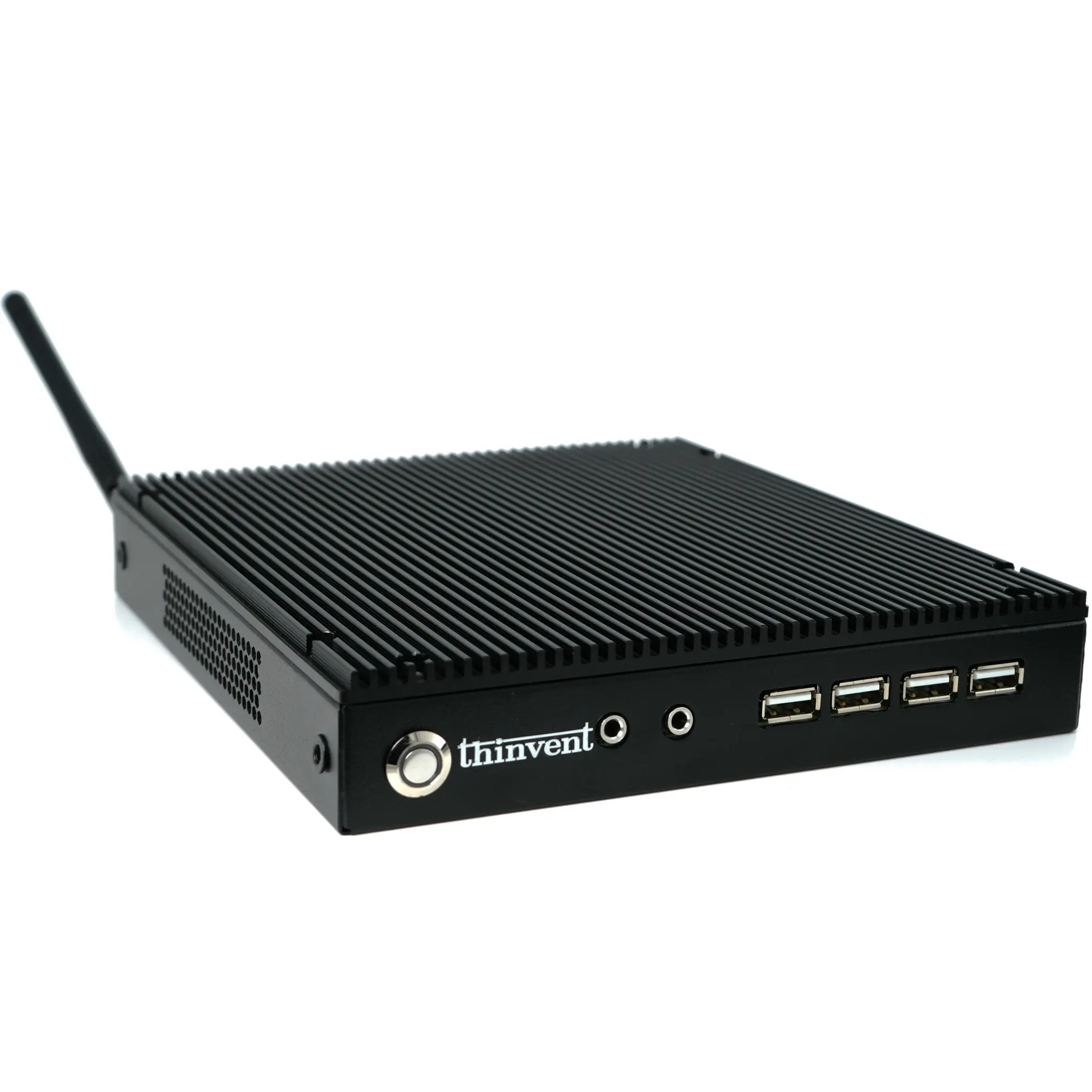
Thinvent offers a range of industrial computers, mini PCs, and thin clients that support both SATA SSD and NVMe storage options. Our Aero Mini PC series (featuring Intel N100 processors) comes standard with a 128GB SSD, and many models include an M.2 slot for NVMe upgrades. For demanding applications, our higher-performance systems support PCIe Gen3 and Gen4 NVMe drives, delivering the speed required for data-intensive industrial and commercial tasks. Whether you need the reliability of SATA for legacy systems or the blazing speed of NVMe for modern workloads, Thinvent provides flexible storage configurations to match your requirements.