Building a Silent, High-Quality Roon Server on a Fanless Mini PC
A Roon Core (Roon Server) is the brain of a Roon music system: it manages your library, performs DSP and upsampling, and streams audio to networked endpoints. Because the Core runs continuously and often sits near your listening room, noise and electrical interference matter as much as raw processing power. A fanless mini PC is an ideal foundation, since it removes the moving parts that generate both acoustic noise and vibration, while still delivering enough CPU headroom for demanding DSP tasks such as DSD upsampling, convolution filters and multi-zone streaming.
Why Fanless Matters for Audio
Mechanical fans and spinning hard disks are the two main sources of audible noise in a typical music server. A fanless (passively cooled) chassis conducts heat to an aluminium heatsink and relies on natural convection, so there are no bearings to whine and no vibration to couple into nearby equipment. Solid-state storage removes the second noise source. The result is a completely silent machine that can live on a shelf or in a rack beside your DAC or amplifier without adding hiss or hum to a quiet listening room. Passive cooling also avoids drawing a stream of dust-laden air through the enclosure, which improves long-term reliability in homes and studios alike.
How Much Processing Power Does a Roon Core Need?
Roon's own guidance places the Core requirement in a moderate range: a modern multi-core x86 processor with at least 8 GB of RAM is comfortable for most libraries, while larger libraries, heavy DSP or DSD256 upsampling benefit from more cores, more memory and faster SSD storage. Intel's 12th-generation mobile and embedded processors, such as the Core i3-1215U, pair a hybrid core layout with low power draw, giving strong single-thread performance for library browsing and enough multi-core throughput for DSP. The table below summarises a practical specification envelope.
| Component | Practical recommendation | Why it matters for Roon |
|---|---|---|
| Processor | Intel 12th gen or newer, 4–10 cores | Handles DSP, upsampling and multi-zone streams |
| Memory | 8–16 GB DDR4 | Smooth library indexing and large databases |
| Storage | 256 GB–1 TB NVMe SSD | Fast library scans, silent operation |
| Cooling | Fanless passive heatsink | Zero acoustic noise, no vibration |
| Network | Gigabit Ethernet | Stable, low-latency RAAT streaming |
| OS | Linux (Roon OS / Ubuntu) or Windows 11 | Flexible Core deployment options |
Deployment Options and Networking
Roon Server can run on Windows, macOS or Linux, and many enthusiasts prefer a minimal Linux install because it keeps background activity low and the system predictable. A fanless mini PC with a Gigabit Ethernet port is the cleanest choice: wired networking avoids Wi-Fi jitter and keeps RAAT (Roon Advanced Audio Transport) traffic steady to each endpoint. Placing the Core in a different room from the listening area, connected over Ethernet or a network switch, further isolates it from sensitive analogue electronics. Where the Core must sit in the listening room, a fanless chassis with no spinning disks is the quietest practical option, and a linear or low-noise power supply can be added if desired.
Choosing Hardware for a Music Server
When specifying a machine for audio, prioritise silence, stable networking and low, consistent power draw over peak benchmark scores. A compact industrial-grade PC with a passively cooled chassis, solid-state storage and dual display outputs gives you a platform that can double as a media library host or control interface. Ample USB ports allow direct connection of a DAC, while serial or GPIO options support integration with home-automation controllers. Because these systems are built for continuous 24/7 duty, they tolerate the always-on workload that a Roon Core represents far better than a consumer laptop.
Thinvent Products for Silent Roon Server Builds
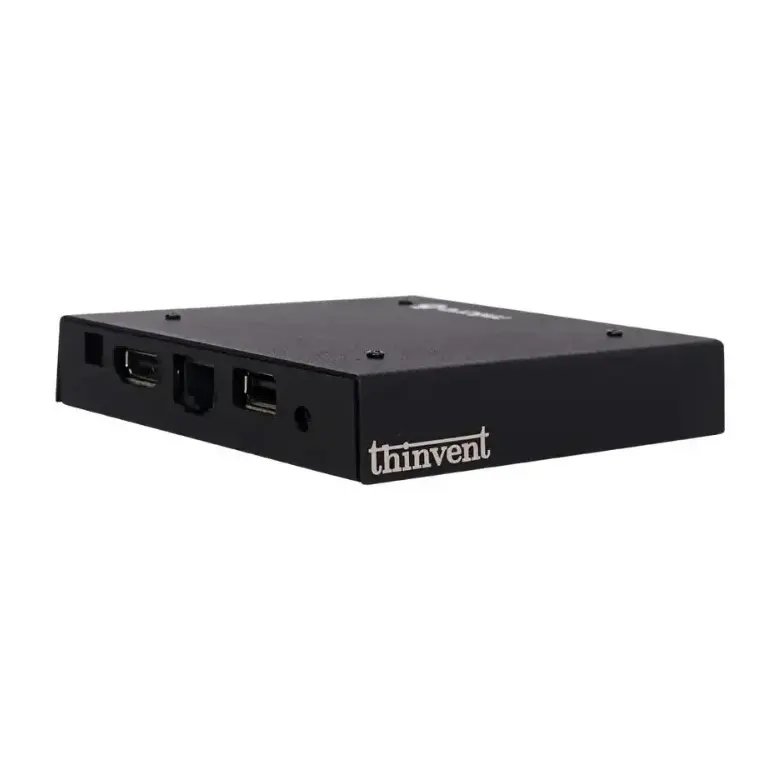
Thinvent's fanless Industrial PC and Mini PC range is well suited to Roon Core duty. The IPC3 series, for example, pairs an Intel Core i3-1215U processor (6 cores, up to 4.4 GHz, 10 MB cache) with 16 GB DDR4 RAM and a 1 TB SSD in a passively cooled chassis, and is available with Windows 11 Pro, Windows 11 IoT, DOS or Thinux Embedded Linux — so you can deploy a minimal Linux Core or a familiar Windows setup. With Gigabit Ethernet for stable RAAT streaming, multiple USB ports for direct DAC connection, and fanless operation for a completely silent listening room, Thinvent mini and industrial PCs provide a dependable, low-maintenance foundation for a high-quality Roon server.