What Is a "2 Monitor in 1 CPU" Computer?
A "2 monitor in 1 CPU" setup means a single compact computer driving two independent displays at the same time — one processor, one chassis, two screens. This is the core of a dual-monitor workstation: instead of buying two machines, you connect two monitors to one small PC and spread your work across both screens. The result is a cleaner desk, lower power draw, fewer points of failure, and a noticeable jump in productivity, since users can keep reference material, dashboards, chat windows or code on one screen while working on the other.
The key requirement is display output capacity. A computer must expose at least two video outputs (commonly HDMI plus DisplayPort, or dual HDMI) and its integrated graphics must support simultaneous multi-display operation. Modern Intel® processors handle this natively, driving two displays at Full HD or higher without a discrete graphics card, which keeps the system small, silent and energy-efficient.
Key Specifications to Look For
| Feature | What Matters | Typical Compact PC Capability |
|---|---|---|
| Display outputs | Two independent ports (HDMI, DisplayPort, USB-C/DP Alt Mode) | 2 × HDMI or HDMI + DP |
| GPU | Integrated graphics with multi-display support | Intel® UHD Graphics |
| Resolution per screen | Full HD (1920×1080) minimum; 4K on newer chips | 2 × 1080p or 1 × 4K + 1 × 1080p |
| Processor | 4 cores and up for smooth multitasking | Intel® Celeron®, N-series, Core™ i3/i5 |
| Memory | 8–16 GB for office multitasking | 8 GB / 16 GB DDR4 |
| Storage | 128 GB SSD and above | 128 GB – 1 TB SSD |
| Form factor | Small enough to mount behind a monitor | Mini PC / VESA-mountable |
| Cooling | Fanless or quiet operation for desk use | Fanless industrial-grade designs |
For everyday dual-screen work — browsing, spreadsheets, ERP or CRM software, video calls, POS and CCTV monitoring — a 4-core processor with 8–16 GB RAM is more than sufficient. Heavier workloads such as software development, CAD previews, or many browser tabs benefit from 6–12 core Intel® Core™ i3/i5 class processors and 16–32 GB memory.
Why One CPU With Two Monitors Beats Two Computers
Running two monitors from a single CPU cuts hardware cost, desk clutter and power consumption roughly in half compared with two separate machines. It also simplifies IT management: one operating system to patch, one asset to track, one warranty to maintain. For hot-desking, control rooms, trading desks, reception counters, and engineering workstations, a compact dual-display PC delivers the screen real estate users need while keeping the footprint minimal — many models can even be VESA-mounted on the back of a monitor so the desk stays completely clear.
Use Cases for Compact Dual-Monitor Computers
-
Office productivity: Email and documents on one screen, ERP/CRM on the other.
-
Surveillance and control rooms: Live camera feeds alongside monitoring dashboards.
-
Retail and POS: Billing on one display, customer-facing screen on the second.
-
Software development: Code editor and terminal/browser side by side.
-
Financial and data desks: Spreadsheets and analytics dashboards in parallel.
-
Education and training: Presentation on one screen, notes on the other.
Thinvent's Compact Dual-Display Range
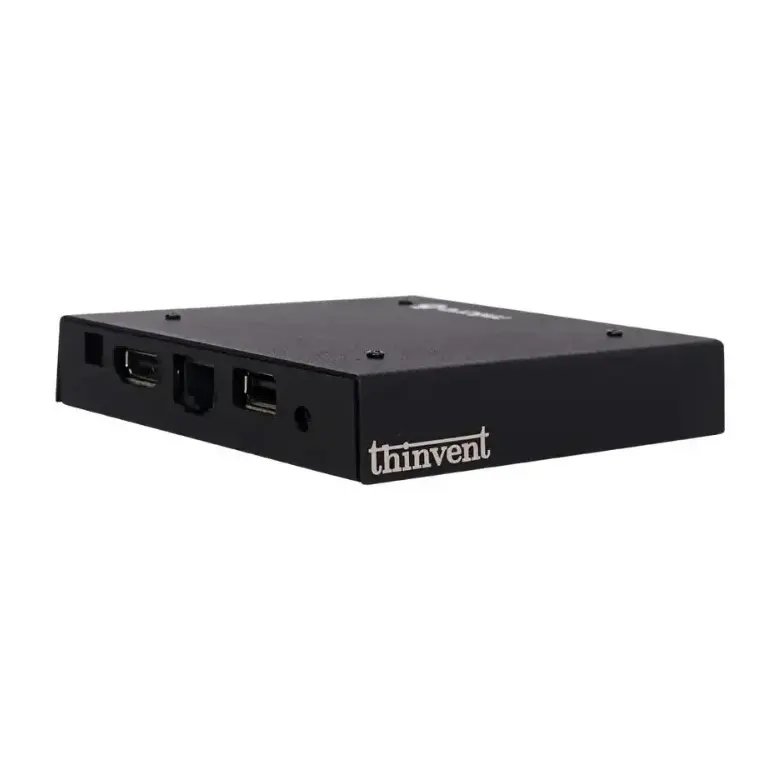
Thinvent builds mini PCs, thin clients, industrial computers and all-in-one PCs designed for exactly this kind of workspace efficiency. Our compact systems pair Intel® processors with dual display outputs, fanless or low-noise cooling, and durable metal chassis suited to continuous operation in offices, shops and industrial environments. Whether you need a space-saving mini PC for a two-screen desk, a thin client for virtual desktop infrastructure with dual monitors, or a rugged industrial unit for a control room, Thinvent's range offers configurations in memory, SSD storage and operating system (Windows 11 Pro, Ubuntu Linux, or without OS) to match your deployment.