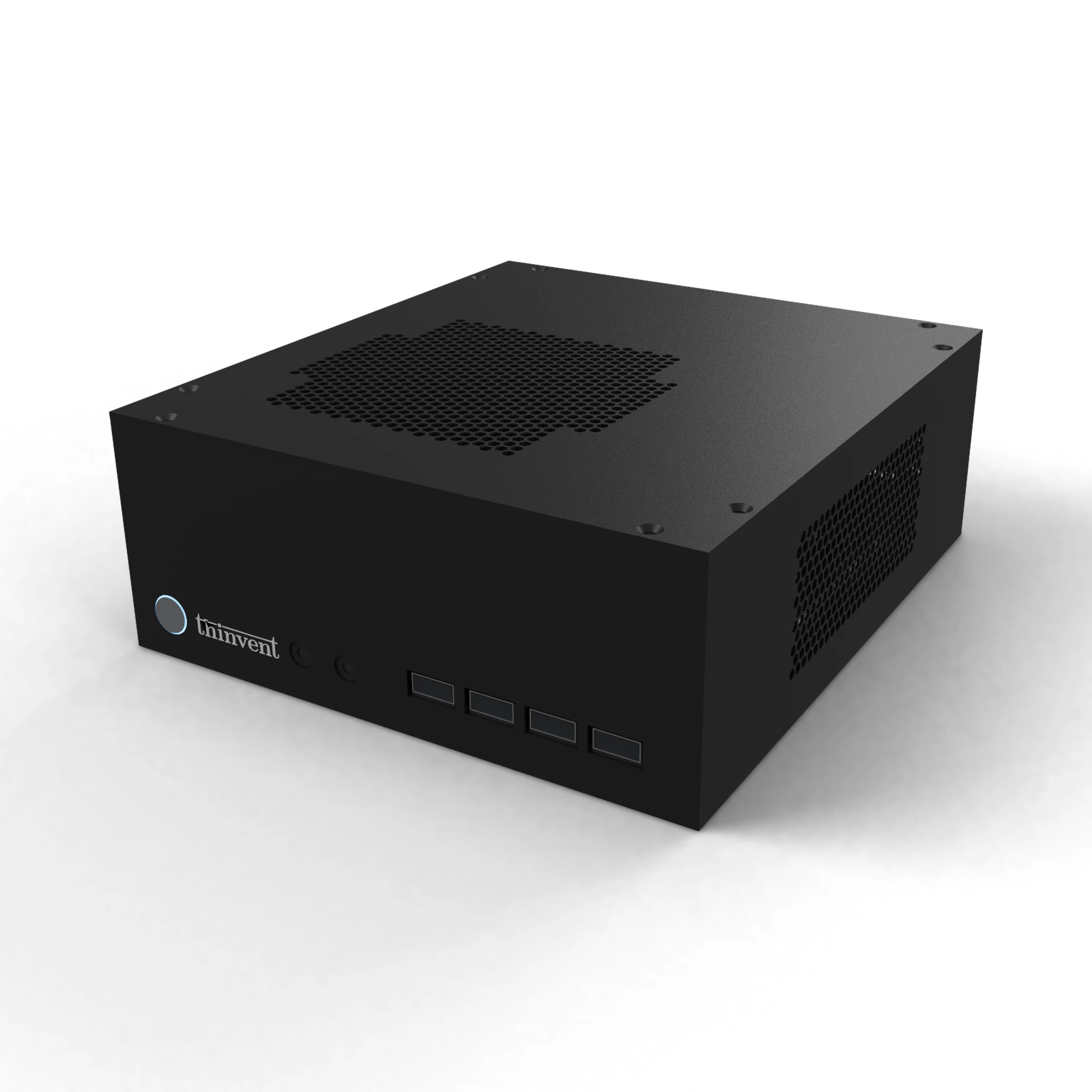
A fanless industrial mini PC is a compact, ventless computer that cools its processor through a passive heatsink and the chassis body instead of a spinning fan. Because there are no moving parts in the cooling path, these systems tolerate dust, grease, vibration and wide temperature swings far better than conventional desktop PCs, while drawing very little power. They are typically rated for continuous 24/7 duty and are mounted behind displays, inside kiosks, on DIN rails or in sealed cabinets where a fan would quickly clog or fail.
The defining technical choices in this class of machine are the processor and the thermal design. Low-power Intel® processors such as the Celeron® and N-series (for example the N5095A, N100 or N150) run at roughly 6–15 W TDP, which is low enough to dissipate passively. A typical configuration pairs 4 to 16 GB of DDR4 memory with 128 GB to 1 TB of SSD storage, dual display outputs over HDMI, Gigabit Ethernet, and multiple USB 3.2 ports. Storage is solid-state, so there are no spinning disks to shock-damage, and many units accept a 12 V DC adapter or wide-range DC input for vehicle and industrial power.
| Attribute | Fanless industrial mini PC | Standard desktop PC |
|---|---|---|
| Cooling | Passive heatsink, no fan | CPU and case fans |
| Dust and particulate tolerance | High — no intake airflow | Low — fans pull in dust |
| Moving parts | None in cooling path | Fans and often HDD |
| Typical power draw | 10–25 W | 100–300 W |
| Duty cycle | 24/7 continuous | Usually intermittent |
| Mounting | VESA, DIN rail, cabinet | Desk only |
| Service life in harsh sites | Long, minimal maintenance | Frequent cleaning needed |
Typical applications include digital signage and menu boards, point-of-sale and ticketing counters, factory HMI and SCADA terminals, warehouse and logistics stations, self-service kiosks, medical and laboratory benches, and thin-client or VDI desktops in offices and call centres. In each case the appeal is the same: a small, silent, low-maintenance box that keeps running in a hot, dusty or space-constrained location, and that can be swapped or re-imaged without disrupting the surrounding installation.
When specifying one, match the processor to the workload (N-series for kiosks, signage and thin clients; Core i3 or i5 for multi-application or light analytics work), size memory to the operating system and number of concurrent applications, and choose SSD capacity with headroom for logs and local caching. Check the operating temperature range, mounting options, and whether you need dual Ethernet, dual HDMI, or a serial port for legacy equipment. Fanless does not mean slow — it means the thermal budget is fixed, so pick a model whose sustained performance matches your software.
Thinvent's Fanless Mini PCs and Industrial Computers
Thinvent builds a range of passively cooled systems for exactly these environments, including the Aero Mini PC series with Intel® Celeron® and N-series processors, 4 to 16 GB DDR4 memory and SSD storage, offered with Windows 11 Pro, Windows 11 IoT, embedded Linux or no operating system. For deployments that need more I/O, dual displays, dual Gigabit Ethernet or DIN-rail mounting, Thinvent's industrial PC and thin client lines extend the same fanless, low-power design philosophy to factory floors, kiosks and enterprise desktop virtualisation.