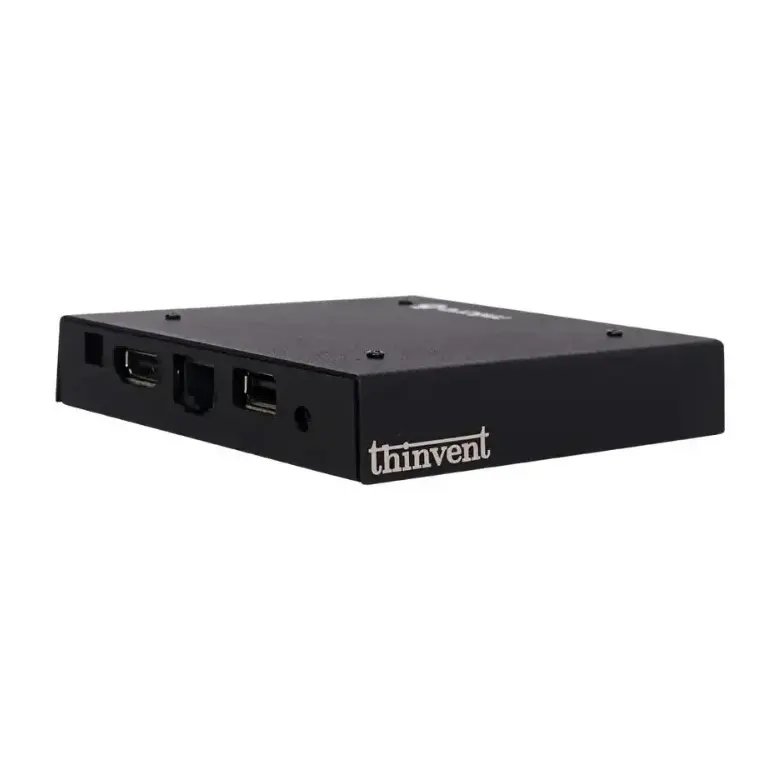
What Is a Fanless Industrial PC?
A fanless industrial PC is a computer designed for continuous operation in environments where dust, vibration, temperature swings, and airborne contaminants would quickly damage a conventional office desktop. Instead of a spinning fan, these systems rely on passive cooling: heat from the processor is conducted into a heavy aluminium chassis through thermal pads and heat pipes, then radiated away by the case surface itself. Removing the fan removes the single most common point of mechanical failure, along with the airflow path that pulls dust into the enclosure.
This design choice matters most where maintenance access is difficult or expensive — a production floor, a remote telecom cabinet, a kiosk, or a vehicle-mounted installation. A fan-cooled unit in these settings typically needs periodic cleaning and eventual fan replacement; a passively cooled unit, correctly specified for its thermal load, can run for years with no moving parts to service.
Key Specifications to Consider
When selecting an industrial computer, the specification sheet should be read against the actual workload rather than peak numbers alone.
| Specification | What It Affects | Typical Industrial Requirement |
|---|---|---|
| Processor (e.g. Intel® Core™ i3-1215U, 6 cores, up to 4.4 GHz, 10 MB cache) | Application responsiveness, multi-tasking, virtualisation | 6–10 cores for HMI + database + gateway roles |
| Memory (8–64 GB DDR4) | Number of concurrent applications, VM headroom | 16 GB as a practical baseline |
| Storage (128 GB – 1 TB SSD) | Log retention, local databases, imaging | 256 GB+ for data-logging workloads |
| Serial ports (DB9 RS-232/RS-485) | PLC, VFD, weighbridge, legacy instrument links | Often 2–4 ports |
| Ethernet (dual Gigabit) | Network segmentation, redundancy, SCADA links | 2 ports for separate control/IT networks |
| Power input (12 V DC) | Compatibility with battery, DIN-rail or vehicle supply | Wide-input DC preferred |
| Operating system | Application compatibility and licensing | Windows 11 Pro, Linux, or no OS for custom images |
Wide-temperature operation, DIN-rail or VESA mounting, watchdog timers, and isolated I/O are further differentiators between a consumer mini PC and a genuine industrial unit.
Where Fanless Industrial PCs Are Used
Common deployments include factory automation and machine control, where the PC sits beside PLCs and drives and communicates over RS-232/RS-485; SCADA and HMI terminals on production lines; digital signage and self-service kiosks in uncontrolled environments; warehouse and logistics systems mounted on forklifts or conveyors; utility and telecom cabinets; and laboratory or medical equipment where fan-driven airflow would compromise cleanliness.
Edge computing has added another category: running analytics, vision pre-processing, or protocol conversion close to the machines that generate the data, rather than sending everything to a central server. These workloads benefit from a compact, sealed, always-on computer with enough cores and memory to run containerised services.
Choosing Between Mini PC, Thin Client and Industrial PC
A mini PC is compact and efficient but usually assumes a clean office environment. A thin client is optimised for centralised virtual desktop delivery, with minimal local storage. An industrial PC combines the compact footprint of the former with the ruggedness, mounting options, and I/O of automation hardware. If the deployment involves heat, dust, vibration, 24/7 duty, or legacy serial devices, the industrial form factor is the appropriate choice; if it is a climate-controlled office running VDI, a thin client is more cost-effective.
Thinvent's Products Featuring This Technology
Thinvent builds fanless industrial computers, mini PCs, thin clients and all-in-one PCs for deployment worldwide. The Thinvent® Industrial PC IPC3 series pairs Intel® Core™ i3-1215U processors (6 cores, up to 4.4 GHz, 10 MB cache) with up to 16 GB DDR4 memory and 1 TB SSD storage, in a passively cooled chassis with 12 V DC input. Configurations are available with quad DB9 serial ports for PLC and instrumentation connectivity, and with Windows 11 Pro, Windows 11 IoT, DOS, or Thinux™ Embedded Linux pre-installed — or with no operating system for customers who deploy their own image.