What Is a 395-Series Industrial PC?
The query "395" points to industrial computer platforms built around the Intel Core i3-1215U processor — a 12th generation mobile chip that has become a popular choice for fanless industrial PCs, edge controllers and always-on automation hardware. The i3-1215U is a 6-core processor (2 performance cores + 4 efficient cores) with a maximum turbo frequency of 4.4 GHz and 10 MB of Intel Smart Cache, built on Intel's hybrid architecture. It pairs strong single-thread responsiveness with low power draw, which is exactly what industrial deployments need: a machine that boots fast, handles HMI and SCADA software smoothly, and keeps running in a sealed, dust-resistant chassis without a fan.
Key Specifications and Technical Details
An industrial PC in this class typically ships with 16 GB DDR4 memory and a 1 TB SSD, giving enough headroom for databases, logging, vision software or multiple virtualised workloads. Connectivity is where these systems earn their keep — dual Gigabit Ethernet ports for separating OT and IT networks, multiple HDMI outputs for dual-display control rooms, USB 3.2 Gen 2 ports for fast peripherals, and optional RS-232/RS-485 serial ports for legacy PLCs, weighbridges, barcode scanners and CNC controllers. Power is usually supplied through a 12V DC adapter or a wide-range DC input for factory floor conditions.
| Feature | Typical Specification |
|---|---|
| Processor | Intel Core i3-1215U, 6 cores, up to 4.4 GHz, 10 MB cache |
| Memory | 16 GB DDR4 (configurable) |
| Storage | 1 TB SSD (configurable) |
| Graphics | Intel UHD integrated |
| Networking | Dual Gigabit Ethernet |
| Display | 1–2 × HDMI |
| Serial | Optional quad DB9 (RS-232/485) |
| Cooling | Fanless, passive heatsink |
| OS Options | Windows 11 Pro, Windows 11 IoT, Linux, DOS |
Use Cases and Applications
These systems are deployed in manufacturing cells for machine control and data acquisition, in warehouses for WMS terminals and barcode stations, in utility substations for protocol gateways, and in retail or logistics hubs as kiosk and signage controllers. The fanless design matters in environments with dust, lint, oil mist or vibration, where a fan would clog or fail. The serial-port variants are especially useful where older equipment must talk to modern software — a common requirement in retrofit projects.
How to Choose the Right Configuration
Start with the software stack: Windows 11 Pro for standard industrial applications, Windows 11 IoT for long-term servicing and lockdown, or Linux for headless edge gateways. Then size memory and storage against your workload — 16 GB and 1 TB covers most HMI, SCADA and logging roles, while lighter kiosk tasks can run on less. Finally, match the I/O: count how many serial devices, displays and network segments you need before ordering, since port layout is fixed at build time.
Thinvent Industrial PCs Featuring This Platform
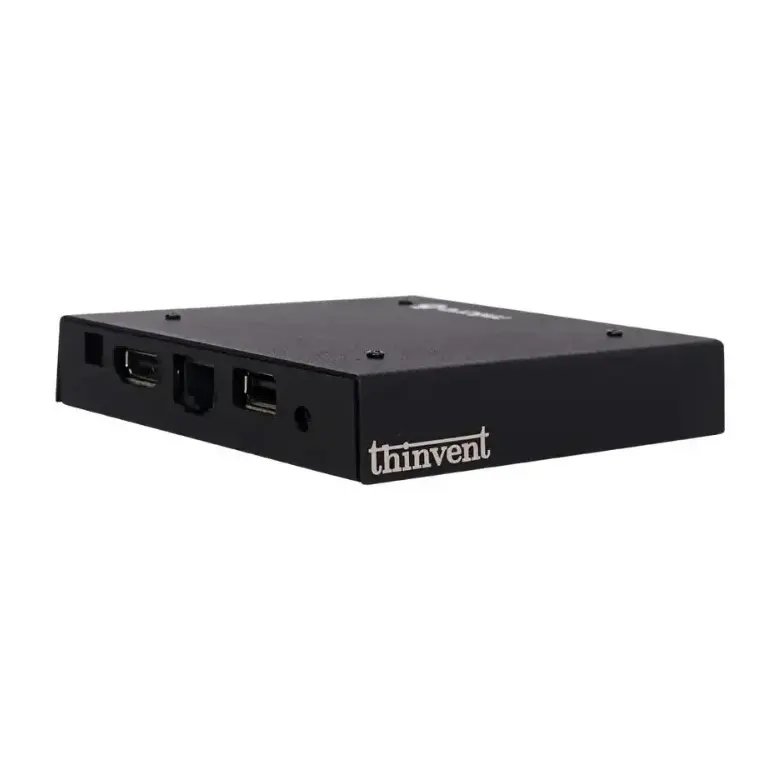
Thinvent's IPC3 industrial computers are built around the Intel Core i3-1215U processor, combining 6 cores and up to 4.4 GHz performance with fanless, ruggedised construction. Configurations include 16 GB DDR4 RAM and 1 TB SSD, dual Gigabit Ethernet, HDMI output, and optional quad DB9 serial ports for legacy device integration. Operating system choices span Windows 11 Pro, Windows 11 IoT Value, DOS and Thinux™ Embedded Linux, so the same hardware platform can be tailored to automation, edge computing, kiosk and gateway deployments worldwide.