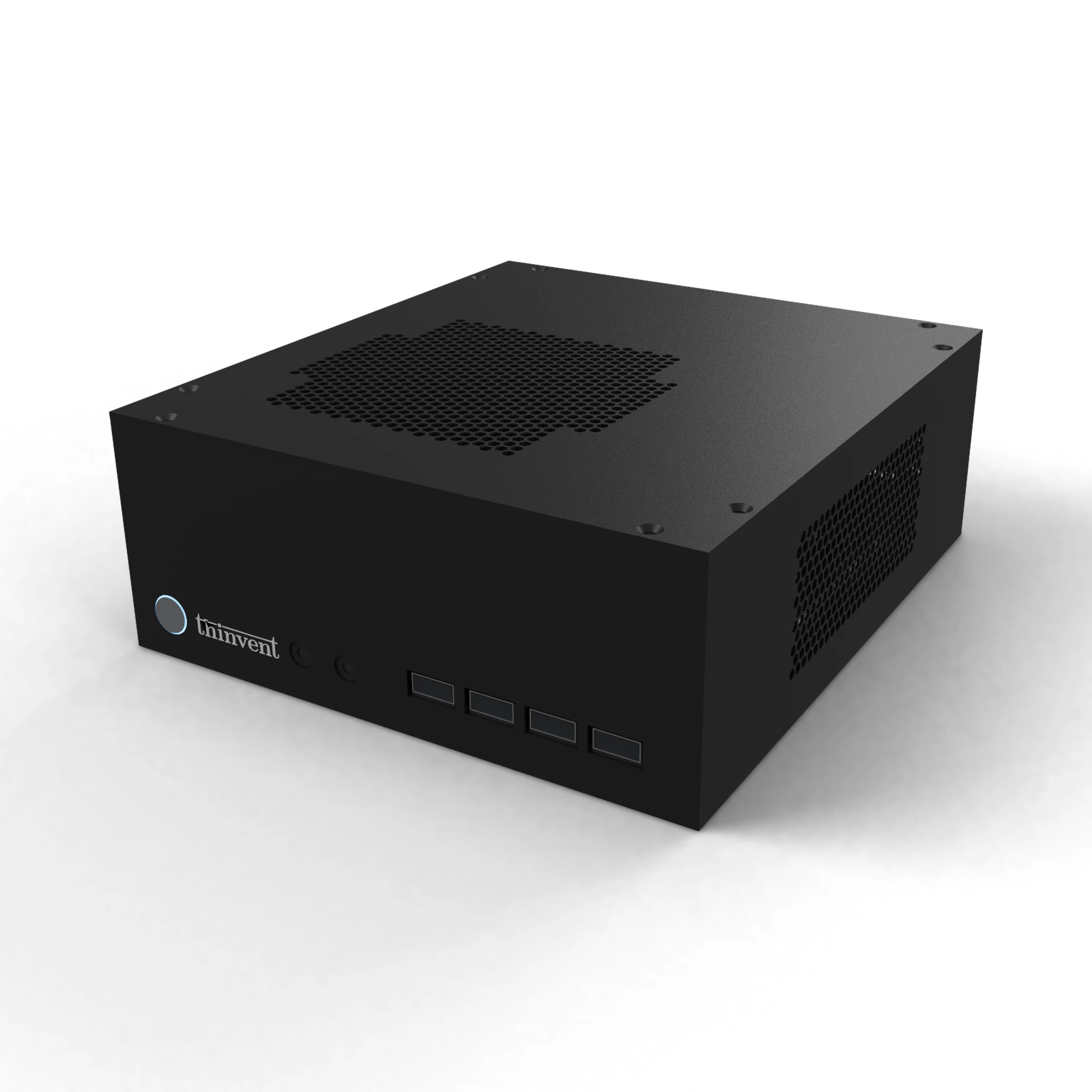
What Is an ARM Desktop Computer with PCIe Expansion?
An ARM desktop computer with PCIe expansion is a compact computing platform built around an ARM-based processor (rather than x86) that includes one or more PCI Express slots. Those slots let you add standard expansion cards — multi-port Ethernet, serial/industrial I/O, RAID controllers, frame grabbers, or NVMe storage — so the machine can be tailored to a specific industrial job instead of being locked to fixed onboard I/O.
The Ampere® Altra® family is a well-known example of a 64-bit ARM server-class processor line. According to Ampere's product brief, Altra processors are offered in 32, 64, 80, 96 and 128-core versions, with single-threaded cores running at a consistent frequency up to 3.0 GHz, 1 MB of L2 cache per core, eight 72-bit DDR4-3200 ECC memory channels supporting up to 4 TB of RAM, and 128 lanes of PCIe Gen4 (with optional CCIX for multi-socket designs). Ampere positions the family for cloud-native, edge and embedded workloads where predictable per-core performance and power efficiency matter.
ARM Desktop vs. PCIe Single Board Computer (SBC)
These two form factors overlap but serve different integration styles:
| Aspect | ARM Desktop Computer | PCIe Single Board Computer (SBC) |
|---|---|---|
| Form factor | Enclosed chassis, ready to deploy | Open board, mounted inside a customer enclosure |
| Expansion | PCIe slots accessible from the rear | PCIe slot(s) on-board, often via riser |
| Power | Internal PSU or external adapter | Typically DC input, wide-voltage options |
| Cooling | Active or fanless chassis design | Depends on host enclosure and airflow |
| Best for | Workstations, kiosks, control rooms, lab benches | OEM machines, embedded systems, custom cabinets |
| Serviceability | Swap the whole unit | Swap the board inside existing housing |
Both approaches give you the same core benefit: an ARM compute platform plus PCIe flexibility, so you can attach the exact I/O your application needs.
Key Specifications to Evaluate
When comparing ARM industrial desktops and PCIe SBCs, check these parameters:
-
Core count and clock behaviour — many-core ARM designs with consistent (non-boosting) frequency give predictable latency, which matters for real-time and multi-tenant workloads.
-
Memory — ECC DDR4 support and channel count determine bandwidth and reliability; capacity ranges from a few GB on compact boards to terabytes on server-class platforms.
-
PCIe lanes and bifurcation — how many lanes are exposed, and whether they can be split into x4/x2 links for multiple add-in cards.
-
Storage — M.2 NVMe, U.2 NVMe, or SATA bays; RAID options via add-on controllers.
-
I/O — serial RS232/RS485, USB 3.x, Gigabit Ethernet ports, GPIO, I2C, QSPI and watchdog timers for embedded control.
-
Thermal range — industrial deployments often need operation beyond a typical office temperature window, so verify the rated junction or ambient range.
-
Operating system — Linux distributions (Ubuntu, Debian) are the norm for ARM; confirm driver availability for your expansion cards.
Typical Use Cases
ARM desktops and PCIe SBCs are used in network appliances and edge gateways, industrial automation controllers, machine-vision front ends, medical and lab instruments, digital signage and kiosks, telecom edge nodes, and software-development platforms for ARM-native code. In each case, the PCIe slot is what turns a general-purpose ARM computer into an application-specific machine — adding capture cards, extra network ports, or storage controllers without changing the base platform.
Thinvent's Industrial Computers and ARM Platforms
Thinvent builds industrial computers, mini PCs, thin clients and all-in-one PCs for deployment worldwide. Our industrial PC range is designed for continuous operation in factories, control rooms and embedded installations, with fanless and actively cooled options, wide I/O including serial and dual Ethernet, and support for Windows, Linux and embedded operating systems. If your project calls for ARM-based computing with PCIe expansion, our team can advise on the right platform, enclosure and expansion configuration for your application.