Understanding ARM SBCs with PCIe Expansion for Home Servers
Single board computers (SBCs) built on ARM processors have become a popular foundation for home servers because they combine low power draw, quiet fanless operation, and compact footprints. The key enabler for turning an ARM SBC into a genuine home server — rather than a hobby board — is PCIe expansion. A PCIe slot or M.2 PCIe lane lets you attach the hardware that a home server actually needs: multi-port SATA or NVMe controllers for bulk storage, 2.5GbE or 10GbE network cards, or even a discrete GPU for media transcoding.
How PCIe Works on ARM Platforms
PCIe on ARM SBCs is exposed in a few common ways. A full-size or x4 physical slot wired to a limited number of lanes (often x1 or x2) is the most flexible option and accepts standard add-in cards. M.2 M-key slots carry PCIe lanes for NVMe SSDs or adapter cards. Some boards break out PCIe over an edge connector or FPC ribbon, which requires a riser. The number of usable lanes is set by the SoC, so it is worth checking the board's documentation: a slot may be physically x16 but electrically x1, which limits bandwidth-hungry cards such as 10GbE NICs or multi-drive HBAs.
ARM Server Processors and Their Role
ARM server-class SoCs — for example the Ampere Altra family used in data-centre servers, and the high-core-count SoCs used in enthusiast SBCs — bring many cores, ECC memory support in some cases, and integrated PCIe controllers to small form factors. For a home server, the practical benefits are low idle power, passive cooling, and long-term availability of the platform. The trade-off is that driver support and software compatibility vary more than on x86, so it pays to confirm that your chosen operating system and applications run on the specific SoC.
Typical Home Server Use Cases
| Use Case | Why PCIe Expansion Helps |
|---|---|
| NAS / file server | HBA or SATA controller adds drive bays beyond onboard ports |
| Media server | NVMe cache plus optional GPU for hardware transcoding |
| Home automation hub | Reliable wired networking via a dedicated NIC |
| Backup target | Fast NVMe storage for snapshots and replication |
| Network services | 2.5GbE/10GbE card for router, firewall or VPN duties |
Choosing the Right Board
Match the board to the workload: count the PCIe lanes you actually need, check whether the slot is open-ended, and confirm the power budget for add-in cards. For storage-heavy builds, prioritise boards with M.2 PCIe and a physical slot. For networking, verify that the NIC's driver is available for your kernel. Fanless, wide-temperature designs are preferable where the server runs in a cupboard, garage or workshop.
Thinvent's Products for Server and Industrial Workloads
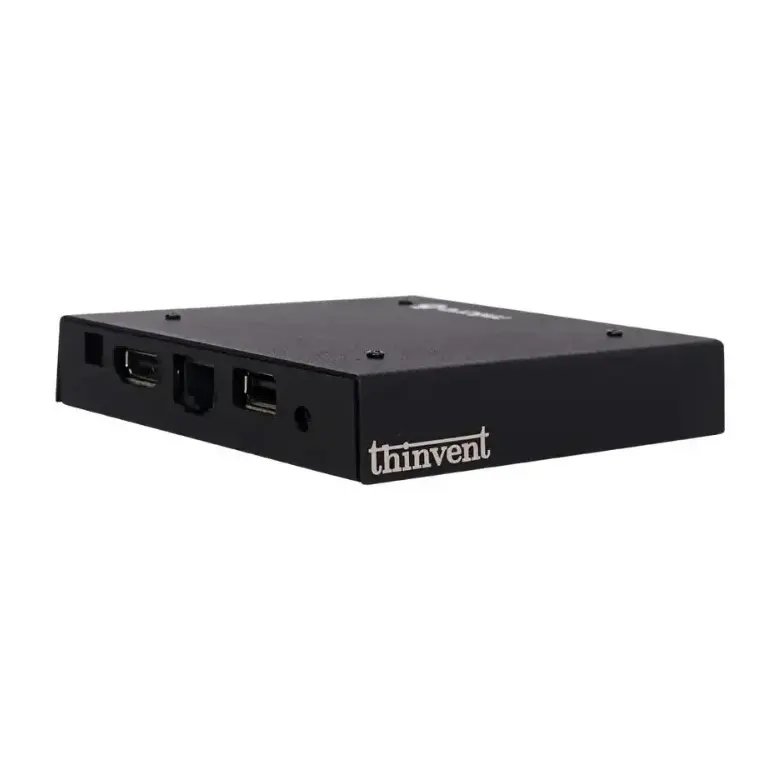
Thinvent builds fanless industrial computers, mini PCs, thin clients and all-in-one PCs engineered for continuous operation in dusty, hot and space-constrained environments. Where a project calls for x86 compatibility, multiple expansion options and long-life supply, Thinvent's IPC series — including configurations based on Intel® Core™ i3-1215U with up to 16GB DDR4, 1TB SSD and dual Gigabit Ethernet — provides a dependable alternative to ARM SBC builds. Contact Thinvent to discuss the right platform for your home server, edge or industrial deployment.