What Makes a Mini PC Right for a Roon Media Server?
Roon is a music library and streaming platform that runs a dedicated server core, indexes large music collections, performs DSP such as upsampling and convolution, and streams audio to network endpoints. A good Roon Core machine needs a quiet, always-on computer with a fast processor, enough RAM for large libraries, and fast SSD storage. Because the machine typically sits in a living room, study or listening room, acoustic noise matters as much as performance — which is why fanless (passively cooled) mini PCs are the preferred choice.
A fanless mini PC has no moving fans and no spinning hard disks, so it produces no audible noise at all. Heat is carried away from the processor by a metal chassis that acts as a heatsink, usually with an aluminium finned body and heat pipes. This design also removes the main failure points of a traditional PC: dust-clogged fans and worn bearings. The result is a machine that can run 24/7 with almost no maintenance.
Key Specifications to Look For
For a Roon Core serving a library of tens of thousands of tracks, these are the components that matter most:
| Component | Recommendation | Why It Matters |
|---|---|---|
| Processor | Intel Core i3 or better, 4–6 cores | Roon core, DSP and upsampling are CPU-intensive |
| RAM | 8 GB minimum, 16 GB comfortable | Large libraries, database and OS caching |
| Storage | 256 GB–1 TB SSD | Fast library database access and OS responsiveness |
| Cooling | Fanless, passive heatsink chassis | Zero acoustic noise, no dust ingress |
| Network | Gigabit Ethernet (1000 Mbps) | Reliable, low-latency streaming to endpoints |
| Form Factor | Mini ITX / compact mini PC | Fits shelves, racks and Hi-Fi furniture |
| OS | Windows, Linux or dedicated appliance OS | Roon Server runs on Windows, macOS and Linux |
A gigabit Ethernet port is strongly preferred over Wi-Fi for Roon, because wired networking gives stable, jitter-free streaming to RAAT endpoints. Some users also want a second Ethernet port to keep the audio network isolated from the home network.
Fanless Mini ITX vs. Traditional Desktop PCs
Conventional desktops and tower servers use active cooling. In a listening room, even a quiet fan becomes audible during quiet passages of music. A fanless mini PC solves this completely. It also tolerates dusty environments better, since there is no airflow drawing dust into the chassis. The trade-off is that passive cooling requires careful thermal design, so choose a unit with a metal body and a processor whose thermal design power matches the chassis, rather than the fastest chip available.
For Roon specifically, Intel Core i3 and i5 class processors with 6 to 12 cores offer an excellent balance: enough headroom for DSP and multi-zone streaming, without excessive heat that a fanless chassis cannot dissipate.
Typical Use Cases
-
Roon Core server in a Hi-Fi rack or living room, streaming to network players and DACs.
-
Home media server running Roon alongside Plex, Jellyfin or DLNA services.
-
Always-on music library host for NAS-attached or internal SSD collections.
-
Multi-room audio distribution with several simultaneous zones and DSP profiles.
-
Quiet study or office machine where fan noise is unacceptable.
Thinvent Products for Silent Roon Media Servers
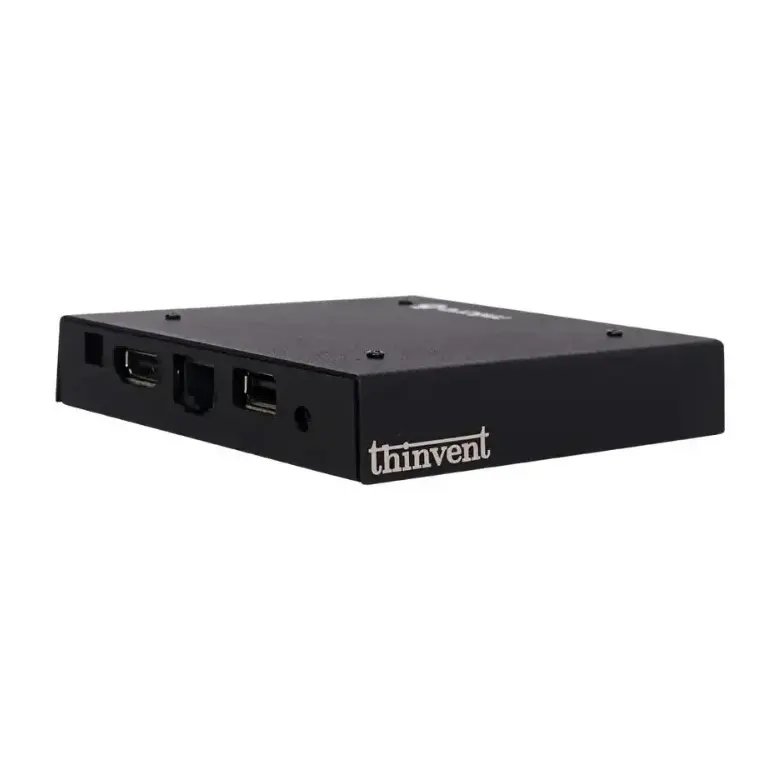
Thinvent builds fanless mini PCs, industrial computers and all-in-one systems designed for continuous, quiet operation. The Thinvent IPC3 series pairs 12th generation Intel Core i3-1215U processors (6 cores, up to 4.4 GHz, 10 MB cache) with up to 16 GB DDR4 RAM and 1 TB SSD storage in a passively cooled chassis — a strong fit for a Roon Core, home media server or always-on music library host. Operating system options include Windows 11 Professional, Windows 11 IoT, DOS and Thinux™ Embedded Linux, so you can deploy a dedicated appliance or a full desktop as you prefer. Thinvent's range also includes compact mini PCs and thin clients for lighter streaming endpoints, all engineered for silent, dependable 24/7 duty.