What Makes the "Best" Desktop Computer?
There is no single best desktop computer on the market — the right choice depends entirely on what the machine has to do, where it has to live, and how long it has to keep running. A gaming tower, an office mini PC and a factory-floor industrial computer are all "desktops," but they are engineered for very different conditions. The most useful question is not "which is fastest?" but "which will still be working reliably in five years, in my environment, doing my workload?"
For buyers who need dependable everyday computing rather than headline benchmark numbers, the practical priorities are a modern, efficient processor, enough memory to avoid swapping to disk, solid-state storage, and a chassis that can handle heat, dust and continuous duty. These factors matter far more in daily use than a few hundred extra megahertz.
Key Specifications to Compare
| Specification | Why It Matters | Typical Good Choice |
|---|---|---|
| Processor | Responsiveness, multitasking, power draw | Intel® Core™ i3 or N-series, 10th–14th gen |
| Cores / Threads | Parallel workloads, virtual machines | 4–12 cores |
| Memory (RAM) | Keeps apps and browser tabs fluid | 8–32 GB DDR4 |
| Storage | Boot speed, data safety | 256 GB – 1 TB SSD |
| Cooling | Dust ingress, noise, service life | Fanless (passive) preferred in industry |
| Connectivity | Peripherals, networking, legacy devices | Dual Gigabit Ethernet, multiple HDMI, USB, serial ports |
| Operating System | Application compatibility | Windows 11 Pro, Linux, or embedded images |
Fanless designs deserve special mention. By removing the moving fan, a passively cooled computer eliminates the single most common mechanical failure point and the main path for dust to enter the enclosure. That is why fanless industrial PCs often outlast conventional desktops in workshops, kiosks and cabinets.
Matching the Machine to the Job
-
Office and knowledge work: a compact mini PC or all-in-one with 8–16 GB RAM and a 256–512 GB SSD handles documents, browsers and video calls comfortably.
-
Industrial control and data collection: an industrial PC with wide-input power, serial (DB9) ports, dual Ethernet and a fanless chassis is the safer choice for PLCs, scales, scanners and legacy equipment.
-
Thin client and VDI deployments: low-power thin clients centralise management and data, reducing cost and risk at each desk.
-
Point-of-sale, kiosk and digital signage: all-in-one PCs with integrated screens simplify installation and reduce cabling.
-
Edge and embedded systems: ARM-based or low-power x86 boards suit always-on, low-thermal applications.
Reliability Beats Raw Speed
The "best" desktop for business is usually the one that never needs attention. Look for wide operating temperature ranges, vibration tolerance, watchdog timers, surge protection on serial and network ports, and long-term component availability. A processor such as the Intel® Core™ i3-1215U — 6 cores, up to 4.4 GHz, 10 MB cache — delivers modern performance at modest power, which keeps enclosures cooler and extends component life. Combined with 16 GB DDR4 and a 1 TB SSD, it is more than enough for the vast majority of commercial and industrial workloads.
Thinvent's Range of Desktops and Industrial Computers
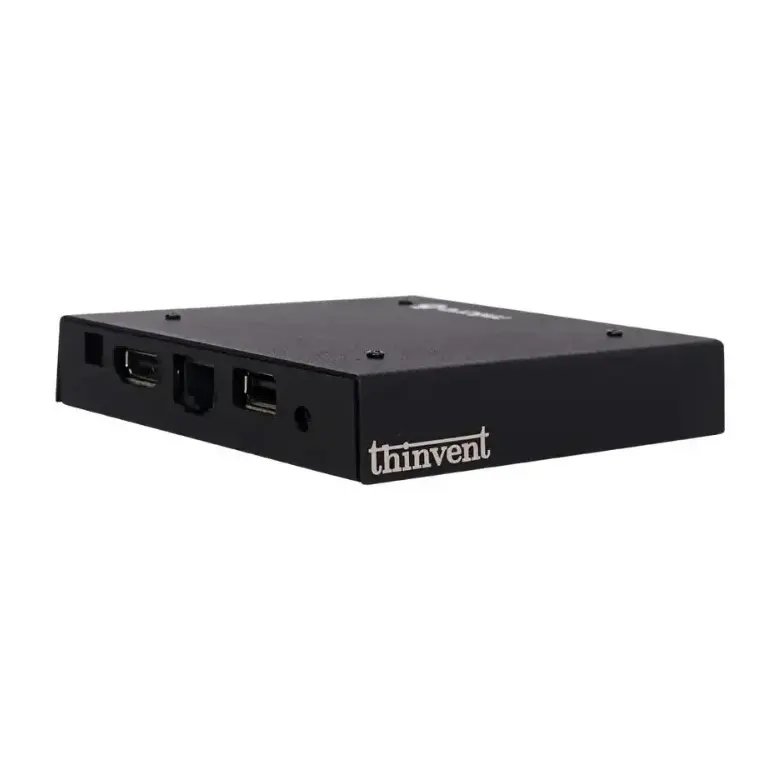
Thinvent builds mini PCs, thin clients, all-in-one PCs and industrial computers designed for continuous, unattended operation. Our industrial PC line pairs efficient Intel® processors with fanless cooling, dual Gigabit Ethernet, multiple display outputs and optional quad DB9 serial ports, and can be supplied with Windows 11 Pro, Linux, embedded images or without an operating system. Whether you need a compact office desktop, a managed thin client fleet or a rugged machine for the factory floor, Thinvent's portfolio covers the full range — so you can standardise on one supplier worldwide.