Best PCs For Coding And Programming: A Technical Overview
The best PC for coding and programming balances processing power, memory, storage, and reliability to handle development environments, compilers, and virtual machines efficiently. For professional developers, industrial-grade PCs offer distinct advantages over consumer hardware, including superior build quality, extended operational life, and stable performance in demanding conditions. Key specifications to prioritize include a multi-core processor (Intel Core i5/i7 or equivalent), at least 8GB of RAM (16GB+ recommended for modern IDEs and containers), and fast SSD storage (256GB+). The choice between x86 (Intel) and ARM architectures also depends on the target deployment platform and specific toolchain requirements.
Key Specifications For Development Workstations
-
Processor (CPU): A modern, multi-core CPU is crucial. High clock speeds (e.g., up to 5.0 GHz) benefit single-threaded tasks, while more cores (e.g., 12 cores) excel in parallel compilation, running multiple services, or virtualization. Intel Core i5/i7 and Core Ultra series processors are ideal for heavy-duty development.
-
Memory (RAM): 8GB is the minimum for basic scripting; 16GB or more is standard for full-stack development, using Docker, or running database servers locally. Industrial PCs often use reliable DDR4 memory.
-
Storage: NVMe or SATA SSDs provide fast boot times and quick access to project files. Capacities of 256GB to 512GB are common, with options for expansion.
-
Operating System & Ecosystem: Support for Windows 11 Pro, Ubuntu Linux, or embedded Linux (like Thinux™) is essential. Linux is preferred for backend, embedded, and open-source development, while Windows supports a broad range of commercial tools and .NET development.
Use Cases And Applications
-
Embedded & IoT Development: ARM-based mini PCs (like those with Cortex-A55) are perfect for developing and testing applications destined for ARM devices, offering a native, low-power development environment.
-
Software & Web Development: Intel-based systems (Core i3/i5, N100) provide the horsepower for IDEs (VS Code, IntelliJ), web servers, containers (Docker), and lightweight databases. The IPC5 with an i5-1240P is excellent for this.
-
AI/ML Prototyping & Data Science: While not for training large models, higher-end industrial PCs with powerful Intel Core processors and ample RAM can handle data preprocessing, running local inferences, and developing scripts using frameworks like TensorFlow or PyTorch.
-
Industrial Automation & PLC Programming: These fanless, rugged PCs are built for 24/7 operation in harsh environments, making them reliable hosts for SCADA systems, HMI development, and PLC programming software.
Comparison: ARM vs. Intel For Development
| Feature | ARM-Based Mini PCs (e.g., Micro 6 Pro) | Intel-Based Industrial PCs (e.g., IPC5, Aero) |
|---|---|---|
| Best For | Embedded Linux apps, IoT prototyping, low-power environments, learning. | General software dev, web dev, Windows/Linux tools, virtualization, heavier workloads. |
| Typical CPU | ARM Cortex A55 (4 cores, up to 1.9 GHz) | Intel Core i5 (12 cores, up to 4.4 GHz) or Core 5 120U (10 cores, up to 5.0 GHz) |
| Power & Thermal | Very low power, fanless, cool operation. | Higher performance, may require active cooling in some models. |
| Software Compatibility | Linux-centric (Thinux™, Ubuntu). Some limitations with proprietary x86-only tools. | Broad compatibility with Windows, Linux, and virtually all x86 development software. |
| Ideal Project Size | Small to medium scripts, web services, embedded systems. | Large codebases, enterprise applications, multiple development tools running concurrently. |
Thinvent Industrial PCs For Developers
Thinvent offers a curated range of industrial computers that cater to diverse programming needs, from lightweight embedded coding to intensive software engineering.
-
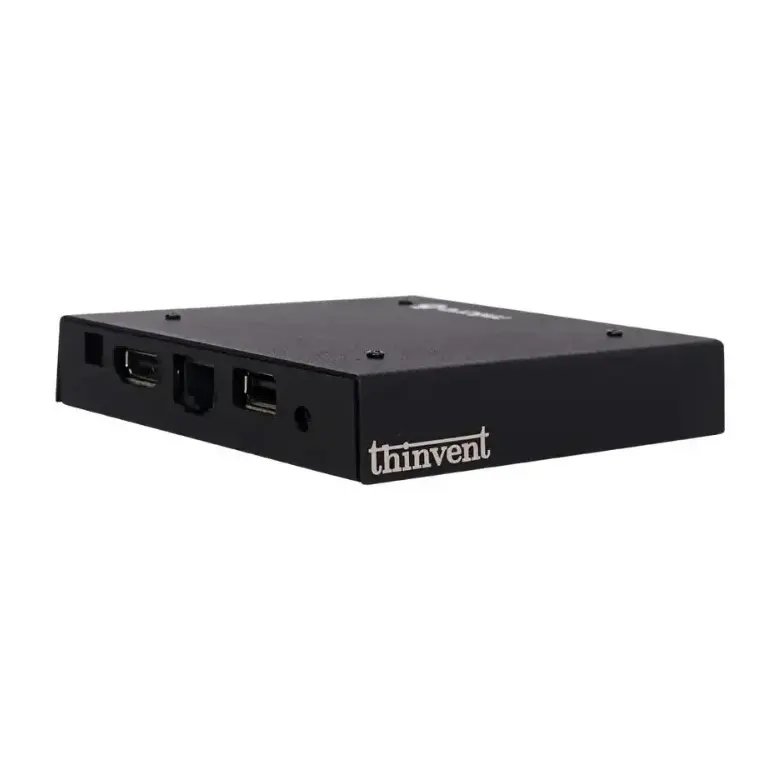
For Lightweight & Embedded Coding: The Thinvent Micro 6 Pro Mini PC features an ARM Cortex-A55 processor with 4GB RAM and 64GB eMMC, running Thinux™. It's a cost-effective, fanless solution for developing IoT and Linux-based applications.
-
For Balanced Performance & Value: The Thinvent Treo Mini PC and IPC1 with the Intel N100 processor (4 cores, up to 3.4 GHz