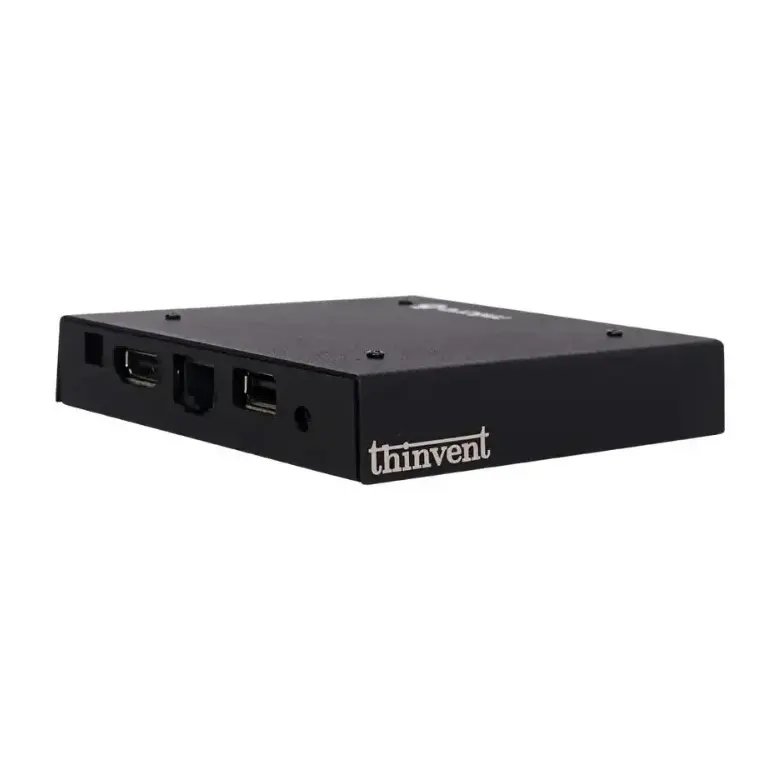
What Makes a PC Ideal for a CSC Center?
A Common Service Centre (CSC) is a digital service delivery point that provides government-to-citizen (G2C) and business-to-citizen (B2C) services in rural and semi-urban areas. The best PC for a CSC center must be compact, energy-efficient, silent, and reliable enough to run continuously for long hours without downtime. It should also support essential peripherals like printers, scanners, and UPS, and handle applications such as Aadhaar enrollment, bill payments, insurance, and form filling with ease.
Key requirements include low power consumption to keep electricity costs down, fanless or near-silent operation for dusty environments, and enough processing power to run multiple applications simultaneously. A mini PC form factor is ideal because it takes up minimal desk space and can be easily mounted behind a monitor or under a counter.
Key Specifications to Look For
For a CSC center PC, the Intel N100 processor is an excellent choice. It features 4 cores and 4 threads with a maximum turbo frequency of 3.4 GHz and a 6 MB cache, providing more than enough performance for office productivity, web browsing, and government portal access. Combined with 16 GB of DDR4 RAM, this configuration allows smooth multitasking—running a browser with multiple tabs, a billing application, and a PDF reader simultaneously without lag.
Storage-wise, a 128 GB SSD is sufficient for the operating system, essential software, and local data caching. The SSD ensures fast boot times and quick application launches, which is critical when serving customers quickly. The system should also include multiple USB ports for connecting a printer, scanner, and UPS, as well as an HDMI port for connecting a monitor or TV.
Use Cases and Applications in a CSC Center
A well-configured mini PC can handle all typical CSC workloads:
-
Aadhaar enrollment and updates – requires stable USB connectivity for fingerprint scanners and iris cameras.
-
Bill payments (electricity, water, mobile recharge) – needs reliable internet and browser performance.
-
Insurance and pension services – involves form filling and document scanning.
-
Digital literacy training – running educational videos and presentations.
-
Printing and photocopying services – connecting to multi-function printers.
The compact size and low heat output make it easy to place in small kiosks or shared office spaces without requiring special ventilation or cooling.
Comparison: Mini PC vs Traditional Desktop for CSC
| Feature | Mini PC (e.g., Thinvent Aero N100) | Traditional Desktop |
|---|---|---|
| Form Factor | Compact, space-saving | Large tower |
| Power Consumption | ~20-30W under load | ~100-200W under load |
| Noise Level | Silent (fanless or near-silent) | Audible fan noise |
| Reliability | Solid-state, no moving parts | Mechanical HDD, fans |
| Portability | Easy to relocate | Heavy and bulky |
| Cost | Lower total cost of ownership | Higher electricity and maintenance |
Thinvent’s Solutions for CSC Centers
Thinvent offers the Aero Mini PC series specifically designed for such environments. Powered by the Intel N100 processor with 16 GB RAM and 128 GB SSD, these systems are available with Windows 11 IoT, Windows 11 Pro, Ubuntu Linux, or DOS. They come with a 12V 10A adapter for energy-efficient operation and can be ordered with or without a keyboard and mouse set. For CSC operators who need a complete, reliable, and low-maintenance computing solution, Thinvent’s Aero Mini PC is an ideal choice.