What are Rugged Handheld Computers?
Rugged handheld computers are specialized mobile devices engineered to withstand harsh environmental conditions such as extreme temperatures, dust, moisture, and drops. Unlike standard consumer tablets or smartphones, these devices are built to MIL-STD-810G standards for durability and feature IP65 or higher ratings for dust and water resistance. They are essential tools for mobile data capture, enabling workers to scan barcodes, collect information, and process transactions directly in the field, warehouse, or on the factory floor. Their primary value lies in improving operational efficiency, data accuracy, and worker productivity in demanding industrial and logistics settings.
Key Specifications and Technical Details
A typical rugged handheld computer, like those in the Chainway C66 category, integrates several critical components for reliable performance. Core specifications include a powerful multi-core processor (often ARM-based for efficiency or x86 for high performance), ample RAM (2GB to 16GB), and solid-state eMMC or SSD storage (16GB to 512GB) for fast data access. They feature high-resolution touchscreens that are readable in sunlight and operable with gloves. The most defining features are the integrated data capture engines: 1D/2D barcode scanners (laser or imager-based), RFID readers (UHF/HF), and often NFC capabilities. Connectivity is robust, with dual-band Wi-Fi, Bluetooth, 4G/5G cellular options, and GPS for real-time location tracking. All this is housed in a shock-absorbent casing.
Applications and Use Cases
These devices are indispensable across numerous verticals. In logistics and warehousing, they are used for inventory management, parcel sorting, and forklift mounting. The retail and field sales sector utilizes them for mobile point-of-sale (mPOS), shelf auditing, and order fulfillment. In manufacturing, they assist in asset tracking, quality control, and shop floor data collection. Field service technicians use them for work order management and parts lookup, while transportation & logistics (T&L) professionals rely on them for proof-of-delivery and route optimization. Their ruggedness ensures continuous operation in environments where consumer devices would fail.
Comparison: Rugged Handhelds vs. Industrial Mini PCs
While both are built for industrial use, they serve different primary functions. The table below highlights key differences:
| Feature | Rugged Handheld Computer | Industrial Mini PC / Thin Client |
|---|---|---|
| Primary Form Factor | Portable, handheld, battery-powered | Stationary or semi-mobile, desk/panel-mounted |
| Core Function | Mobile data capture & field mobility | Edge computing, digital signage, kiosk control |
| Key Input | Integrated barcode scanner, RFID, touch | Standard USB, serial ports, network |
| Environment | IP65+, MIL-STD-810G, for on-the-go use | Fanless, wide temperature, for fixed locations |
| Typical Use Case | Warehouse scanning, field service | Factory automation, thin client, IoT gateway |
Thinvent Solutions for Mobile and Fixed Computing
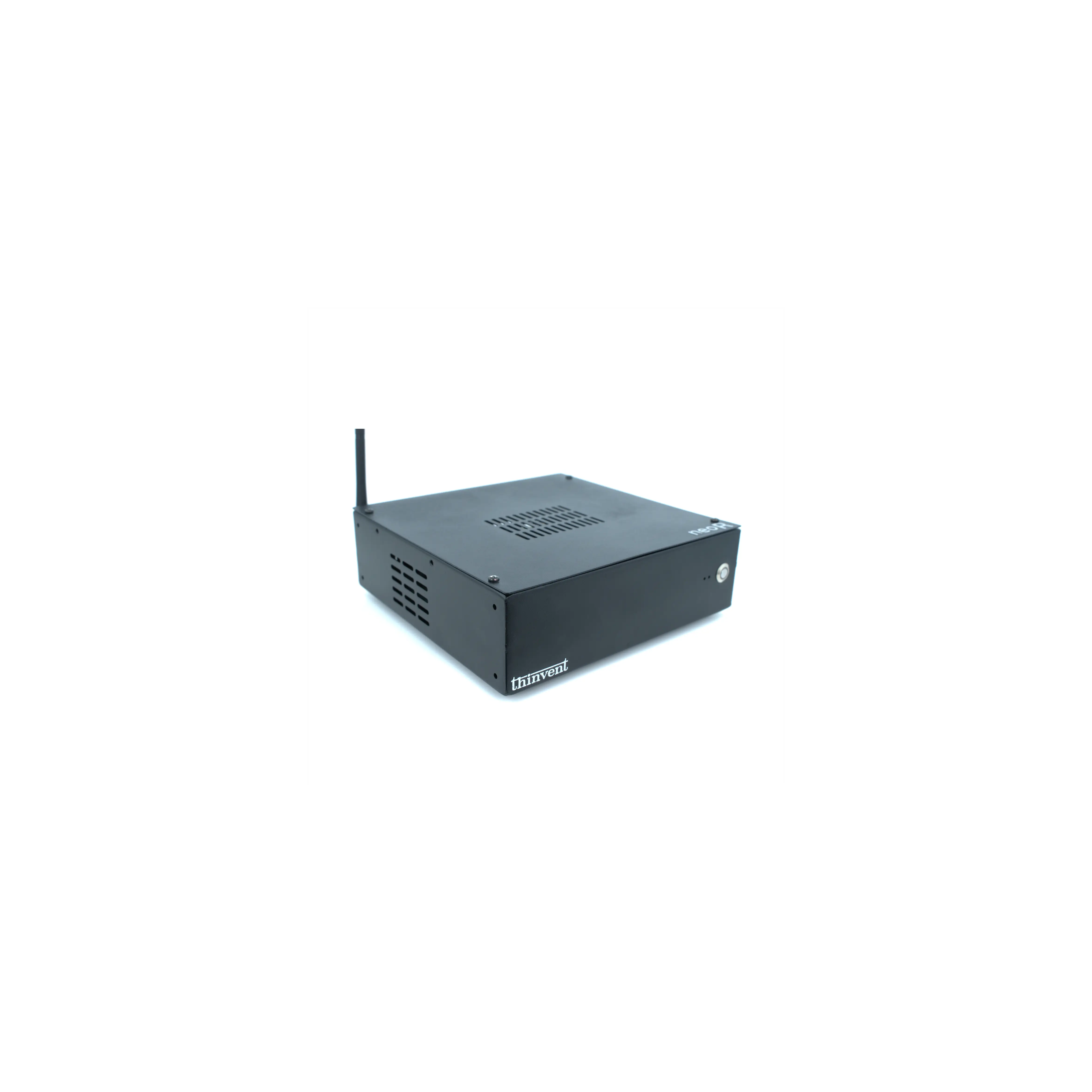
While Thinvent specializes in robust, fanless industrial computers and thin clients for fixed and semi-mobile installations, our product philosophy aligns with the reliability required in rugged environments. Our Micro Series (ARM-based) and Treo/Aero/IPC Series (Intel-based) devices offer compact, efficient, and durable computing solutions. These systems are ideal for supporting the backend infrastructure, acting as stationary management terminals, kiosk controllers, or edge servers that work in tandem with mobile handhelds. For example, a Thinvent Mini PC can be deployed as a fixed station in a warehouse office to manage data synced from handheld scanners, or as an IoT gateway processing information from the field. We provide the reliable, always-on computing backbone that complements mobile data capture workflows.