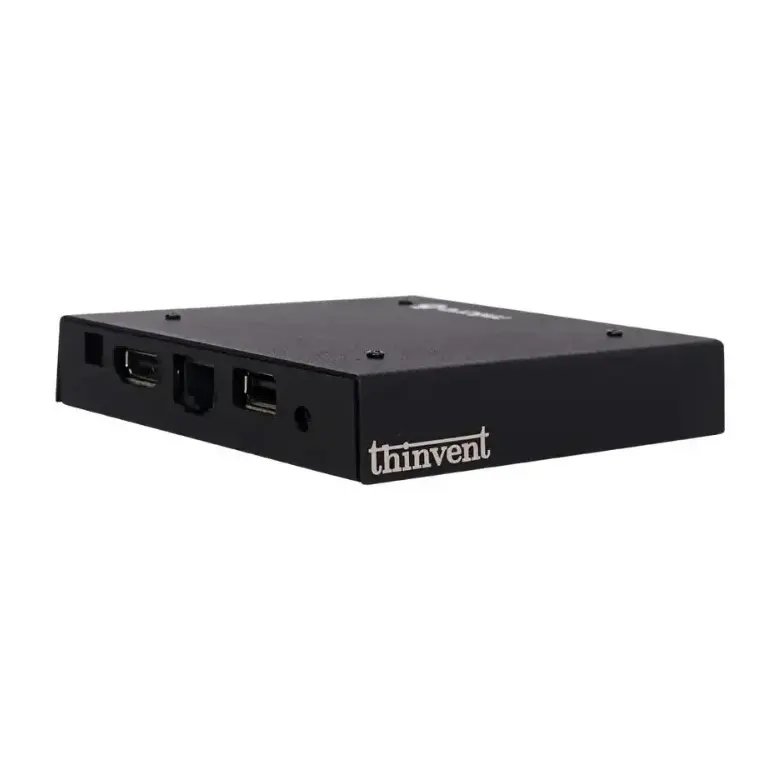
The Chromebox is a small form-factor PC that runs Google's ChromeOS. The closest Thinvent match is the Thinvent Treo Mini PC with Intel Core i5-1240P, which covers a similar Intel i5 class and supports up to 64 GB of RAM and 2 TB of SSD storage, with Thinux™ Embedded Linux as its standard operating system.
Google Chromebox vs Thinvent Treo Mini PC
| Google Chromebox (ASUS Chromebox 5a, Intel Core i5/i7) | Thinvent Treo Mini PC, Intel Core i5-1240P | Thinvent Treo Mini PC, Intel Core i5-1235U | |
|---|---|---|---|
| Processor | Intel Core i5 (up to i7) | Intel Core i5-1240P | Intel Core i5-1235U |
| Cores/Threads | Up to 10 cores | 12 cores | 10 cores |
| RAM | Up to 16 GB | Up to 64 GB | Up to 64 GB |
| Storage | Up to 256 GB | Up to 2 TB | Up to 2 TB |
| Form Factor | Mini PC | Mini PC | Mini PC |
| Operating System | ChromeOS | Thinux™ Embedded Linux (Windows 11 Pro, Windows 11 IoT Value, Ubuntu Linux, Without OS, DOS also available) | Thinux™ Embedded Linux (Windows 11 Pro, Windows 11 IoT Value, Ubuntu Linux, Without OS, DOS also available) |
| Wireless | Wi-Fi 6 / Wi-Fi 6E | Wi-Fi 5 (802.11ac), dual band | Wi-Fi 5 (802.11ac), dual band |
| Ethernet | 1 port | 2 ports, 1000 Mbps | 2 ports, 1000 Mbps |
| Displays | Up to 4 | HDMI, VGA | HDMI, VGA |
Key differences
-
The Treo Mini PC supports up to 64 GB of RAM, against a 16 GB maximum for the Chromebox.
-
The Treo Mini PC supports up to 2 TB of SSD storage, against a 256 GB maximum for the Chromebox.
-
The Treo Mini PC has two Ethernet ports, against one on the Chromebox.
-
The Treo Mini PC lets the buyer choose among Windows 11 Pro, Windows 11 IoT Value, Ubuntu Linux, Thinux™ Embedded Linux, Without OS and DOS. The Chromebox runs ChromeOS only.
-
The Chromebox has Wi-Fi 6 and can drive up to four displays. The Treo Mini PC has Wi-Fi 5 (802.11ac) and HDMI and VGA outputs.
-
The Chromebox runs ChromeOS and supports Google Play access. The Treo Mini PC runs Thinux™ Embedded Linux with Chromium and Mozilla Firefox browsers, RDP 10 and VNC shadowing.
Which one should you choose?
Choose the Chromebox if you want a ChromeOS device with Wi-Fi 6 and support for up to four displays. Choose the Thinvent Treo Mini PC if you need more RAM, more storage, a second Ethernet port, or a choice of operating system including Windows and Ubuntu Linux.