What Is a Central Processing Unit?
A central processing unit (CPU), also called a central processor, main processor, or simply processor, is the primary processor in a computer. Its electronic circuitry executes the instructions of a computer program. These instructions cover arithmetic, logic, control, and input/output (I/O) operations.
How a CPU Works
The CPU is the component that performs a computer's basic operations, such as processing data. It exchanges data with memory and peripherals, and it manages the other components of the system. Other hardware and software send their instructions to the CPU, which carries them out. Main memory, the control unit, and the arithmetic-logic unit are the core parts of a CPU.
Key CPU Specifications
The main specifications that describe a CPU are:
-
Cores: Each core can run instructions on its own. More cores allow more tasks to run at the same time.
-
Maximum frequency: The highest clock speed the processor can reach, shown in GHz.
-
Cache: Fast memory on the processor that stores data for quick access. Cache is shown in MB.
-
Generation and series: These identify the processor family and its performance tier.
Comparison of Processors in the Thinvent Range
| Processor | Brand | Cores | Max Frequency | Cache |
|---|---|---|---|---|
| Intel Core i3-1215U | Intel | 6 | 4.4 GHz | 10 MB |
| Intel Core i5-1240P | Intel | 12 | 4.4 GHz | 12 MB |
| Intel Core i7-1255U | Intel | 10 | 4.7 GHz | 12 MB |
| Intel Core 5 120U | Intel | 10 | 5.0 GHz | 12 MB |
| Intel Celeron N5095A | Intel | 4 | 2.9 GHz | 4 MB |
| AMD Ryzen 5 7430U | AMD | 6 | 4.3 GHz | 16 MB |
| ARM Cortex-A53 | ARM | 4 | 2.0 GHz | - |
Use Cases
CPUs run every type of computing task. Office work, data processing, machine control, and digital signage all depend on the processor. Industrial systems need CPUs that run continuously. Compact mini PCs need CPUs that deliver good performance in a small enclosure.
Thinvent Products Featuring CPUs
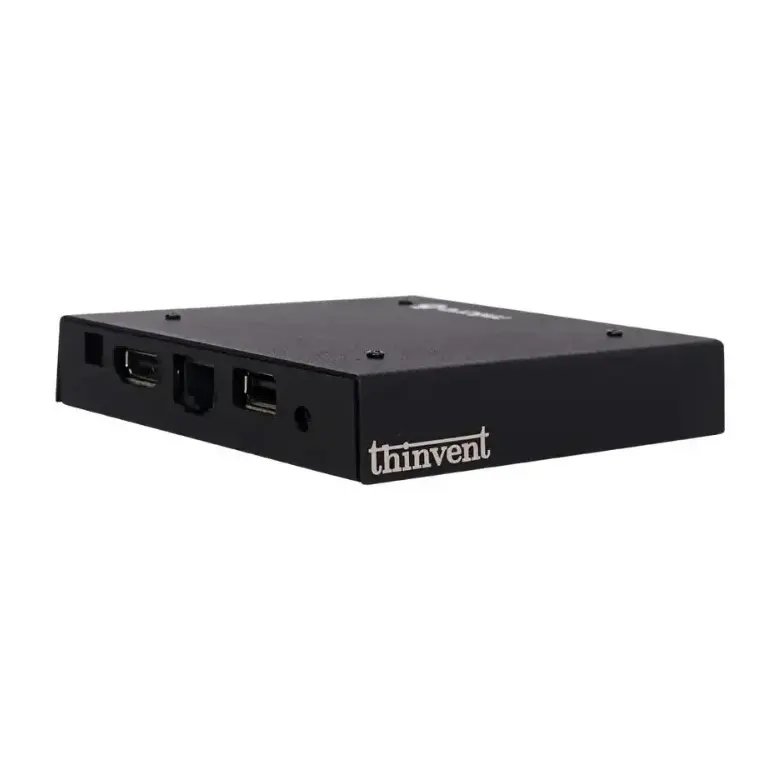
Thinvent builds industrial PCs, mini PCs, thin clients and all-in-one PCs with Intel, AMD and ARM processors. The Thinvent Industrial PC IPC5 is available with the Intel Core i5-1240P and the Intel Core i7-1255U. The Thinvent Industrial PC IPC3 uses the Intel Core i3-1215U. The Thinvent Aero Mini PC uses the Intel Core i3-1215U and the Intel Core 5 120U. The Thinvent Treo Mini PC uses the Intel Celeron N5095A and the AMD Ryzen 5 7430U. The Thinvent Micro 5R Thin Client uses the ARM Cortex-A53.