What to Look for in a Desktop PC
When choosing a desktop PC, the primary considerations are performance, reliability, and form factor. A desktop computer typically separates the main computing components (the tower or mini PC) from the monitor, keyboard, and mouse, allowing for easier upgrades and better thermal management. Key specifications include the processor (CPU) which determines overall speed, RAM for multitasking, and storage (SSD vs. HDD) for boot times and file access. For business and industrial environments, features like fanless cooling, industrial-grade components, and long-term availability are often more critical than raw gaming performance.
Key Specifications and Technical Details
Desktop PCs vary widely in their specifications. Entry-level models often use power-efficient processors like the Intel N100 or ARM Cortex-A53, which are ideal for basic tasks such as web browsing, office applications, and digital signage. Mid-range systems, powered by Intel Core i3 or i5 processors (e.g., i3-1215U or i5-1240P), offer a balance of performance and efficiency for more demanding applications like data processing, light CAD, or multi-monitor setups. High-performance desktops may feature Intel Core 5 or i7 processors with up to 12 cores and 16GB+ of RAM, suitable for virtualization, industrial automation, or AI inference at the edge.
Storage is another critical factor. Most modern desktop PCs use fast NVMe SSDs (128GB to 512GB or more), which significantly outperform traditional HDDs in boot times and application loading. RAM configurations typically range from 4GB for basic tasks to 16GB or 32GB for multitasking and professional workloads. Connectivity options such as HDMI, USB 3.2, USB-C, and dual Ethernet ports are important for peripheral integration and network reliability.
Use Cases and Applications
Desktop PCs serve a wide range of applications across different sectors:
-
Office and Business: For daily productivity tasks like email, spreadsheets, and video conferencing, a compact mini PC with an Intel N100 or i3 processor and 8GB RAM is sufficient.
-
Industrial Automation: Fanless industrial PCs (e.g., IPC series) with wide temperature tolerance and robust I/O are used for machine control, data acquisition, and SCADA systems.
-
Digital Signage and Kiosks: Low-power, fanless desktops with 24/7 reliability are ideal for running signage software or interactive kiosks.
-
Edge Computing: Systems with higher core counts (e.g., i5-1240P, 12 cores) can handle local data processing, video analytics, and IoT gateway functions.
Comparison Table: Desktop PC Options
| Model | Processor | RAM | Storage | Best For |
|---|---|---|---|---|
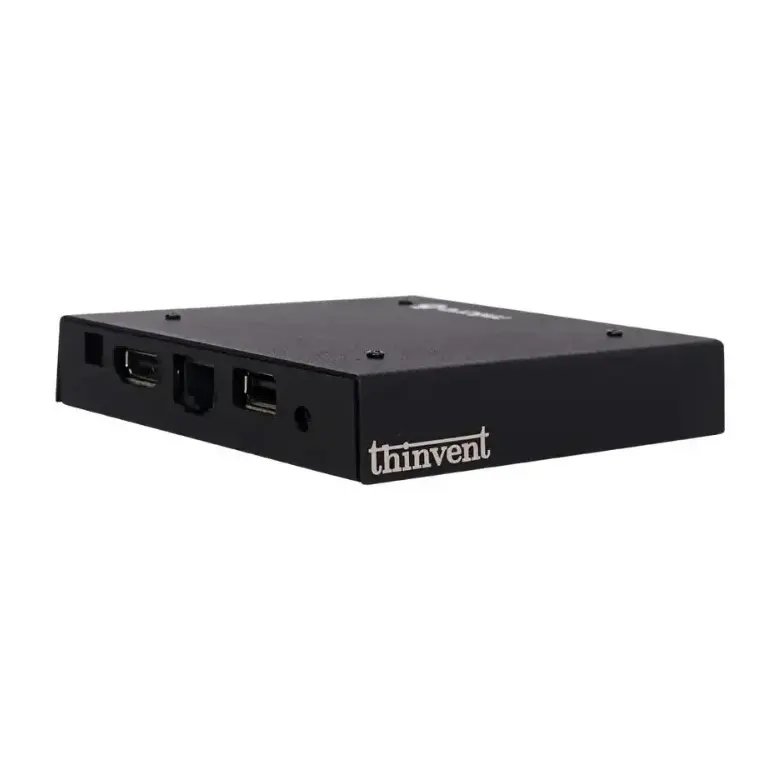
| Thinvent® Micro 5 | ARM Cortex A53, 4 cores | 2GB | 16GB eMMC | Basic kiosk, thin client |
| Thinvent® Treo N100 | Intel N100, 4 cores | 4GB | 128GB SSD | Office, light multitasking |
| Thinvent® Aero i3 | Intel i3-1215U, 6 cores | 8GB | 256GB SSD | Business, education |
| Thinvent® IPC5 | Intel i5-1240P, 12 cores | 16GB | 512GB SSD | Industrial, edge computing |
| Thinvent® Aero 120U | Intel Core 5 120U, 10 cores | 16GB | 512GB SSD | High-performance workstation |
Thinvent’s Desktop PC Solutions
Thinvent offers a comprehensive range of desktop PCs designed for reliability and longevity. Our product lineup includes:
-
Mini PCs: Compact and silent, ideal for space-constrained environments (e.g., Treo, Aero series).
-
Industrial PCs: Fanless, rugged designs for harsh industrial conditions (e.g., IPC series).
-
Thin Clients: Low-power, secure endpoints for virtual desktop environments (e.g., Micro series with ARM or Intel processors).
All Thinvent desktops are built with industrial-grade components, support for multiple OS options (Windows, Linux, Thinux), and are rigorously tested for 24/7 operation. Whether you need a basic office PC or a high-performance industrial workstation, Thinvent provides a tailored solution with global support and long-term availability.