The query "Computer Organization And Embedded Systems By Carl Hamacher" refers to a foundational textbook on computer architecture and embedded system design. This book covers the principles of how computers are organized at a hardware level and how these principles are applied to create dedicated embedded systems. For professionals and students applying these concepts, the practical implementation involves selecting appropriate hardware that meets specific requirements for reliability, real-time operation, power efficiency, and environmental resilience.
Embedded systems are specialized computing systems designed to perform dedicated functions, often as part of a larger mechanical or electrical system. Key technical considerations include:
-
Processor Architecture: Modern embedded systems often utilize efficient x86 processors (like Intel's low-power series) or ARM-based chips, balancing performance with thermal design power (TDP).
-
Form Factor: Designs range from compact, fanless Mini PCs and Thin Clients to ruggedized Industrial PCs and space-saving All-in-One units.
-
Operating Environment: Industrial and embedded computers must operate reliably in varied conditions, supporting wide temperature ranges, resistance to vibration, and often featuring fanless cooling for silent operation and dust resistance.
-
I/O and Connectivity: Essential interfaces include multiple Ethernet ports for network connectivity, USB ports for peripherals, HDMI/DisplayPort for visualization, and often serial ports (COM) for legacy industrial equipment.
These systems are deployed across numerous critical applications:
-
Industrial Automation & Control: Acting as PLCs or HMIs on factory floors.
-
Digital Signage & Kiosks: Powering interactive displays in retail and public spaces.
-
IoT Gateways: Aggregating and processing data from edge sensors.
-
Transportation & Logistics: Used in fleet management, ticketing systems, and onboard vehicle computers.
-
Healthcare: Found in medical imaging devices and diagnostic equipment.
| Feature | Typical Requirement for Embedded Systems | Commercial/Consumer PC Equivalent |
|---|---|---|
| Operating Temperature | Wide range (e.g., -20°C to 70°C) | Narrow range (e.g., 5°C to 35°C) |
| Reliability & Lifespan | High MTBF (Mean Time Between Failures), long-term availability | Shorter product cycles, consumer-grade components |
| Power Supply | Wide-range DC input (e.g., 9-36V), often with ignition power control | Standard AC power adapter |
| Expansion & I/O | Multiple LAN, COM, GPIO, M.2 for specific expansions (AI, PoE) | Standard USB, HDMI, limited expansion |
| Cooling | Fanless, sealed design for harsh environments | Active fan cooling for performance |
Thinvent Products for Embedded Systems
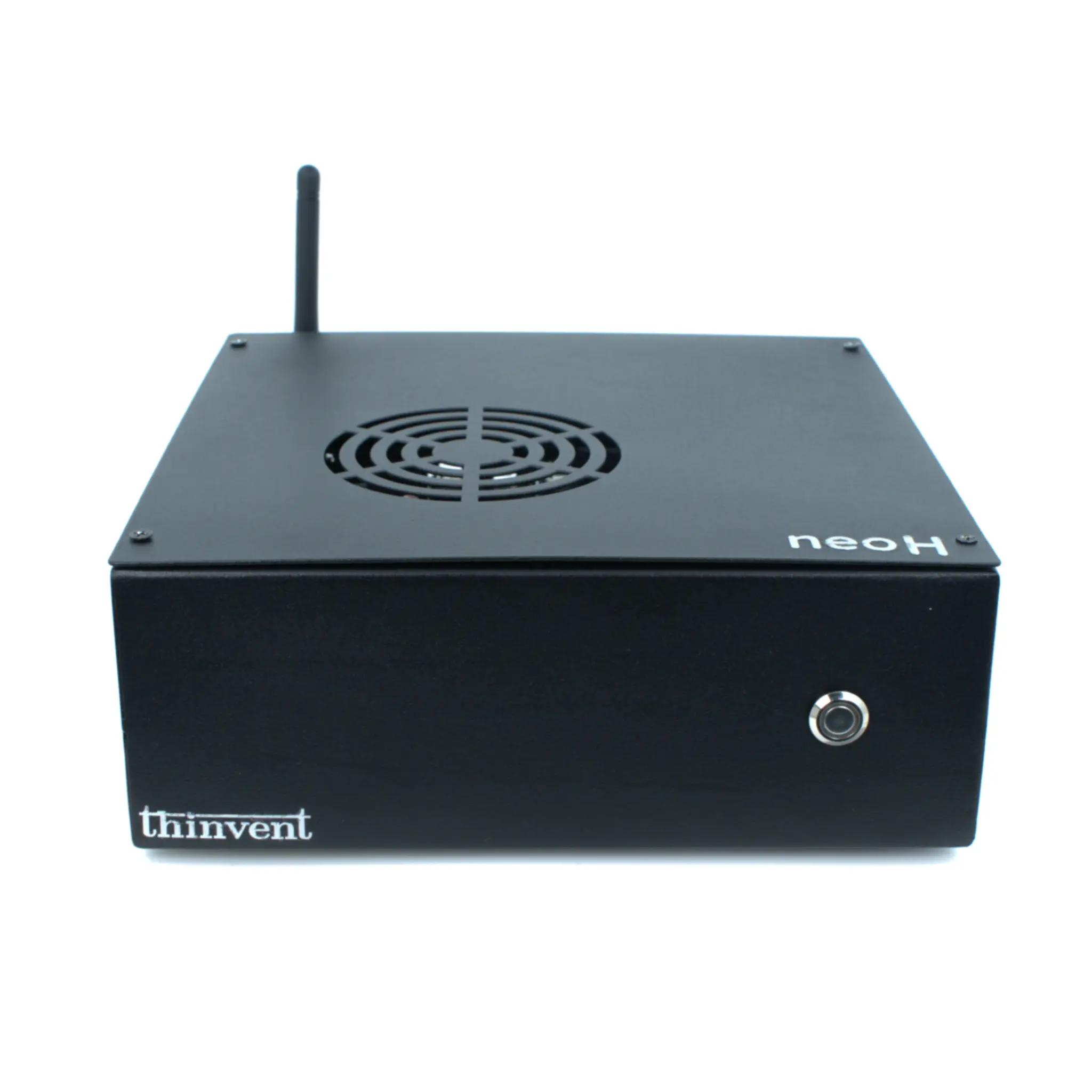
Thinvent's product portfolio is engineered to meet the rigorous demands of embedded and industrial computing outlined in foundational texts. Our systems are built for 24/7 operation, featuring robust, fanless designs with wide-temperature components suitable for challenging environments. We offer a range of form factors, from ultra-compact Mini PCs ideal for space-constrained IoT deployments to powerful Industrial PCs for machine vision and automation. Key product lines include fanless Mini PCs with efficient Intel processors, versatile Thin Clients for virtualized environments, and panel PCs for human-machine interface (HMI) applications. Each system can be configured with various operating systems, including Windows IoT, Linux distributions like Ubuntu, and our own Thinux™ embedded OS, providing a stable and secure platform for your dedicated applications.