What "Computer Price Samsung" Really Means
Shoppers who search for "computer price Samsung" are usually looking for a small, reliable desktop computer and trying to understand what a fair price looks like. Samsung is best known for displays, memory chips, solid-state storage and smartphones rather than for desktop mini PCs, so the search often reflects a broader question: what should a compact business or industrial computer cost, and what do you actually get at each price level? The honest answer is that price is driven almost entirely by the specification inside the box — processor, memory, storage, operating system and the quality of the enclosure — not by the badge on the front.
What Determines the Price of a Compact Computer
The single biggest cost driver is the processor. Entry-level Intel® processors such as the N100, N150 and J4125 are designed for always-on, low-power workloads and keep both the price and the electricity bill low. Mid-range chips like the Intel® Core™ i3 1215U or 1315U add more cores and higher clock speeds for heavier multitasking, while Intel® Core™ i5 parts such as the 1335U are aimed at demanding office and engineering software. Memory and storage come next: 8GB of RAM and a 128GB SSD is a typical entry configuration, while 16GB or 32GB with a 512GB or 1TB SSD raises the cost noticeably. Finally, the enclosure matters — a fanless, metal industrial chassis with wide-temperature components and DIN-rail or VESA mounting costs more to build than a plastic consumer box, but it survives dust, heat and years of continuous operation.
Typical Configuration Tiers
| Tier | Typical Processor | Memory | Storage | Best Suited To |
|---|---|---|---|---|
| Entry | Intel® N100 / N150 / J4125 | 8–16 GB | 128–256 GB SSD | Billing counters, kiosks, thin client sessions, digital signage |
| Mainstream | Intel® Core™ i3 1215U / 1315U | 16 GB | 256–512 GB SSD | Office productivity, POS, reception desks, light CAD |
| Performance | Intel® Core™ i5 1335U | 16–32 GB | 512 GB–1 TB SSD | Engineering workstations, multi-application control rooms, video walls |
Use Cases That Shape the Buying Decision
A computer used at a shop counter runs one billing application and a printer all day; it needs low power draw, no fan to clog with dust, and a stable operating system. A machine in a factory control cabinet needs fanless cooling, wide input voltage and the ability to run 24x7 without maintenance visits. A training lab or call centre needs many identical units that can be re-imaged quickly, which is why thin clients and all-in-one PCs with centralised management are popular. Matching the specification to the workload is what keeps total cost of ownership low — over-buying wastes money on day one, and under-buying costs far more in downtime later.
Operating System and Manageability
The operating system is part of the price and part of the reliability story. Microsoft Windows 11 Pro and Windows 11 IoT Enterprise add licence cost but bring domain join, BitLocker and long-term servicing. Ubuntu Linux 24.04 LTS and embedded Linux images reduce licence cost and are common in kiosk and industrial deployments. Many buyers also choose a "without OS" or FreeDOS unit so they can deploy their own image, which is often the cheapest and most controllable route for large rollouts.
Thinvent's Range of Compact and Industrial Computers
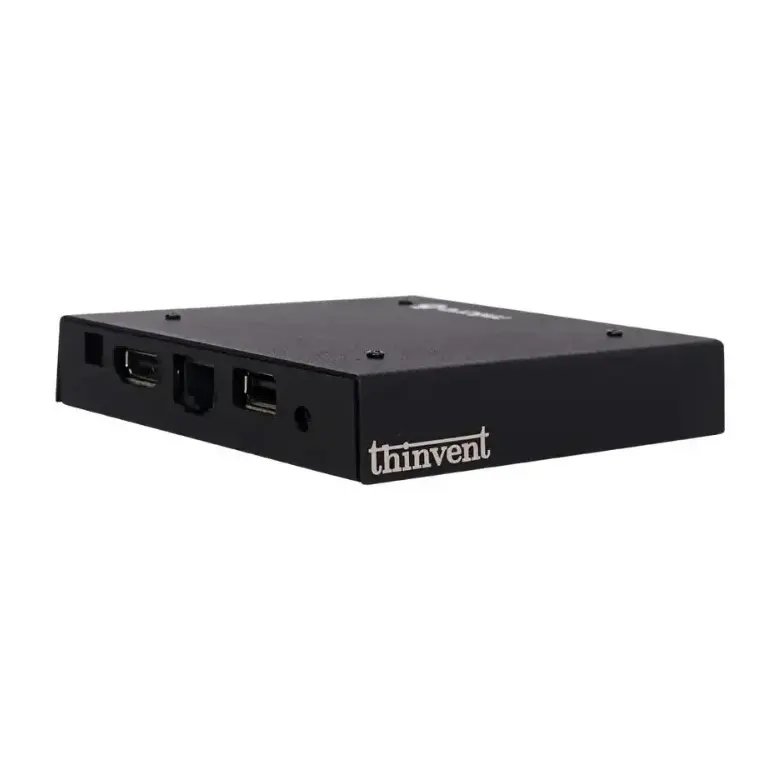
Thinvent designs and manufactures fanless mini PCs, thin clients, all-in-one PCs and industrial computers built for continuous duty in dusty, hot and space-constrained environments. Configurations span Intel® N-series and Intel® Core™ i3 and i5 processors, 4GB to 64GB of memory, SSD storage from 128GB upwards, single or dual Gigabit Ethernet, HDMI and USB-C connectivity, and a choice of Windows 11 Pro, Windows 11 IoT, Ubuntu Linux 24.04 LTS, embedded Linux, FreeDOS or no operating system. Every unit is tested for thermal performance and long-run stability, so the specification you order is the specification that keeps working after the warranty period ends.