What is a CPU for a PC?
A CPU (Central Processing Unit) is the primary computational engine of a personal computer, responsible for executing instructions from software and managing system operations. For industrial and embedded PCs, the CPU is selected not just for raw performance but for reliability, thermal efficiency, and long-term stability in demanding environments. Key specifications include the number of cores, clock speed (measured in GHz), cache memory, thermal design power (TDP), and the processor generation, which collectively determine its suitability for specific tasks.
Key Specifications and Technical Details
Modern industrial PC CPUs range from efficient, low-power processors for basic tasks to high-performance multi-core units for complex workloads. Important technical details to consider are:
-
Cores and Threads: More cores allow for better multitasking and parallel processing. Common configurations include 4-core, 6-core, and higher.
-
Clock Speed: Measured in GHz, this indicates how many cycles a CPU can execute per second. Many processors feature a base frequency and a higher "turbo" or "max" frequency for burst performance.
-
Cache: This is the CPU's onboard high-speed memory (e.g., 6 MB, 12 MB), which stores frequently accessed data to speed up processing.
-
Generation: Newer processor generations (e.g., 12th, 13th, 14th Gen Intel®) typically offer improved performance, power efficiency, and integrated graphics over older ones.
-
Integrated Graphics: Many modern CPUs include capable integrated GPUs, eliminating the need for a separate graphics card in many industrial applications.
Use Cases and Applications
The choice of CPU directly impacts the PC's application scope:
-
Basic Computing & Digital Signage: Efficient, low-power processors like the Intel® N-series (e.g., N100) are ideal for running kiosks, digital signage, and thin clients.
-
Industrial Automation & Control: Mid-range CPUs with 4-6 cores provide the necessary performance for PLCs, HMIs, and machine control systems with consistent reliability.
-
Edge Computing & AI Inference: Higher-performance processors with more cores and advanced instruction sets are required for data processing at the network edge, light AI tasks, and video analytics.
-
Rugged & Fanless Environments: Processors with a low Thermal Design Power (TDP) are essential for fanless, sealed industrial PCs used in harsh conditions where dust, vibration, or extreme temperatures are concerns.
Comparison of Common Industrial PC Processor Tiers
| Tier | Typical Series/Model | Core Count | Typical Use Case | Key Benefit |
|---|---|---|---|---|
| Entry-Level / Efficient | Intel® N95, N100, N150 | 4 | Digital Signage, Thin Clients, Basic Kiosks | Ultra-low power, fanless design, cost-effective |
| Mainstream / Balanced | Intel® Core™ i3, Celeron | 2-4 | General Industrial PCs, HMIs, Retail POS | Reliable performance for everyday tasks |
| Performance | Intel® Core™ i5 (e.g., 1335U) | 6-10 | Edge Servers, Automation Controllers, Medical Devices | Strong multi-threaded performance for heavier workloads |
| High Performance | Intel® Core™ i5/i7 (e.g., 1250P) | 12+ | Advanced AI Inference, Machine Vision, Data Gateways | Maximum computational power for demanding applications |
Thinvent PCs Featuring Advanced Processors
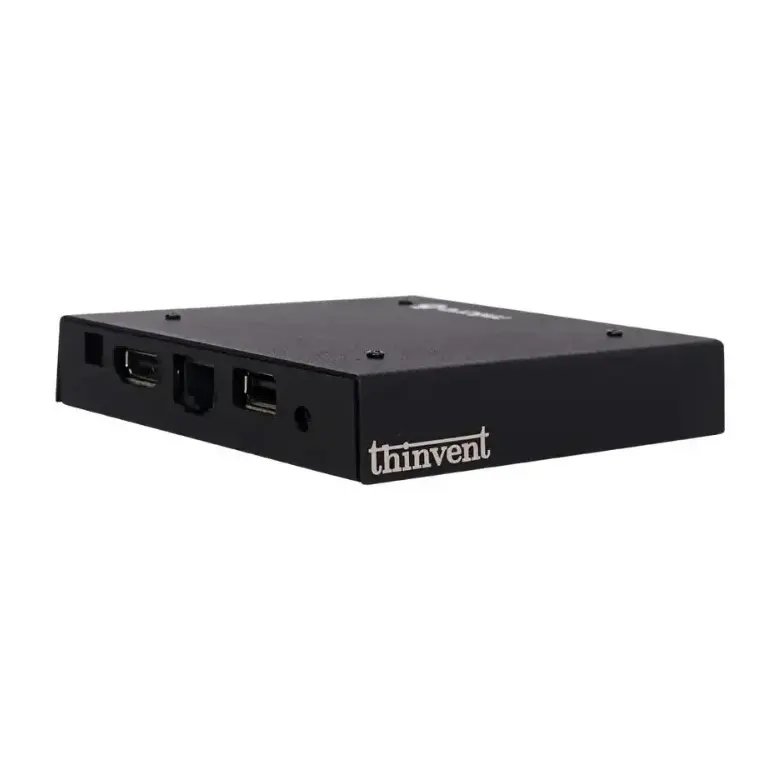
Thinvent's range of industrial computing solutions integrates these critical CPU technologies into robust form factors. Our product lines, including the Aero Mini PC series, utilize processors from the efficient Intel® N-series to powerful Intel® Core™ series, all selected for their reliability in industrial settings. These systems are engineered for fanless operation, wide temperature tolerance, and long-term availability, making them perfect for global deployments in automation, digital signage, transportation, and edge computing. Explore our catalog to find the perfect processing power matched with the durability required for your specific application.