What Are Industrial Computers?
Industrial computers are ruggedized computing systems designed to operate reliably in harsh environments, including factories, warehouses, outdoor installations, and transportation systems. Unlike commercial PCs, they feature extended temperature ranges, shock and vibration resistance, dust and moisture protection, and long-term availability. They are built for 24/7 continuous operation and often support industrial communication protocols, making them essential for automation, data acquisition, and control applications.
Key Types of Industrial Computers
Panel PCs / All-in-One Industrial Computers
These integrate a display, touchscreen, and computing components into a single sealed unit. They are commonly mounted on machinery or walls for Human-Machine Interface (HMI) applications. They typically feature IP65-rated front bezels for water and dust resistance, projected capacitive or resistive touchscreens, and wide-voltage power inputs.
Industrial Box PCs
These are fanless, compact computers without a built-in display, designed for DIN-rail or wall mounting in control cabinets. They prioritize passive cooling, low power consumption, and multiple I/O ports (COM, GPIO, LAN, USB) for connecting sensors, actuators, and PLCs. They are ideal for edge computing, data logging, and gateway functions.
Industrial Mini PCs
Similar to box PCs but even smaller, often using mobile-class processors like Intel N100 or ARM Cortex-A series. They are suitable for space-constrained environments such as digital signage, kiosks, and light industrial automation. Their low thermal design power (TDP) allows fanless operation with wide temperature support.
Rackmount Industrial Computers
Designed for 19-inch server racks in data centers or factory server rooms. They offer higher expandability with PCIe slots for additional I/O cards, GPUs, or motion control cards. They are used for machine vision, centralized control, and high-performance computing tasks.
Common Applications
-
Factory Automation: Controlling robotic arms, conveyors, and assembly lines using real-time operating systems and deterministic communication.
-
Machine Vision: Powering cameras and image processing algorithms for quality inspection, barcode reading, and object recognition.
-
Digital Signage & Kiosks: Driving interactive displays in retail, transportation hubs, and public spaces with reliable 24/7 operation.
-
Edge Computing: Processing data locally from IoT sensors to reduce latency and bandwidth usage before sending to the cloud.
-
Transportation & Logistics: In-vehicle computers for fleet management, warehouse management systems (WMS), and GPS tracking.
Comparison: Typical Industrial vs. Commercial Computer Specifications
| Feature | Industrial Computer | Commercial Desktop PC |
|---|---|---|
| Operating Temperature | -20°C to 70°C | 0°C to 35°C |
| Cooling | Fanless (passive) | Active fan cooling |
| Shock/Vibration | 50G shock, 5-500Hz vibration | Minimal tolerance |
| MTBF | 50,000+ hours | 30,000 hours |
| Power Input | 12-24V DC wide range | 110-240V AC |
| Lifespan | 5-10 years | 3-5 years |
| OS Support | Real-time, Linux, Windows IoT | Windows/macOS consumer |
Thinvent's Industrial Computer Portfolio
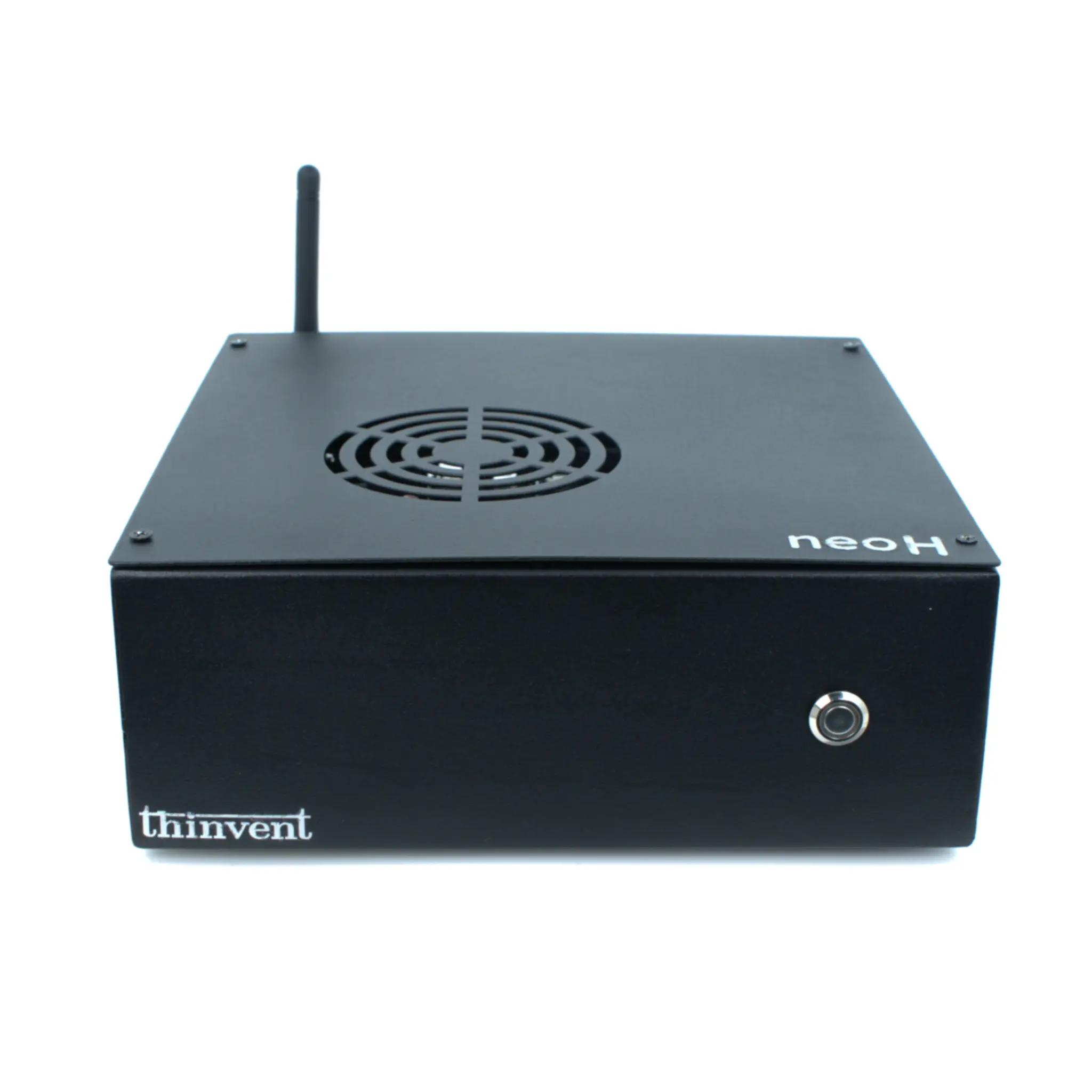
Thinvent offers a comprehensive range of industrial computers tailored to diverse applications. For basic edge computing and HMI tasks, the IPC1 and IPC3 series feature Intel N100 and Core i3 processors with fanless design and wide-temperature support. For higher performance in machine vision or data-intensive tasks, the IPC5 series with 12th Gen Core i5 processors provides 12 cores and up to 16GB RAM. For ultra-compact and low-power needs, the Micro series (Micro 5, Micro 6 Pro) leverages ARM Cortex processors with Thinux Embedded Linux for embedded applications. All models prioritize reliability, long-term availability, and flexible mounting options.