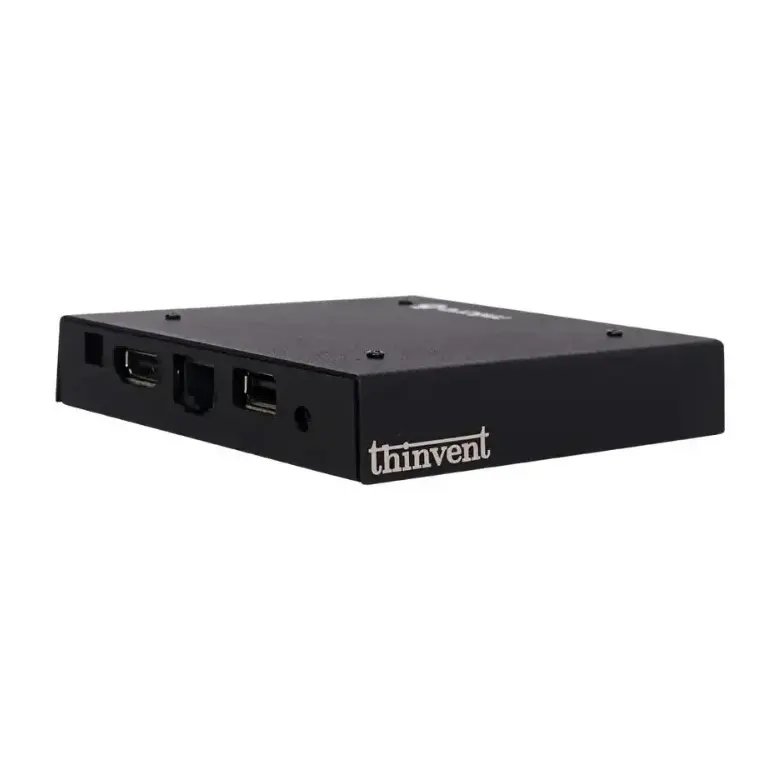
What Is a Barebone PC?
A barebone PC is a partially assembled computer that ships with the chassis, motherboard, cooling system and power supply already in place, but without some or all of the memory, storage and operating system. The buyer completes the build by adding RAM, an SSD and an OS. This approach is popular with system integrators, OEMs and IT teams who want control over component sourcing, branding and cost, or who need to standardise on a particular memory or storage part across a fleet.
Barebone systems appear across several product classes. Traditional desktop towers from vendors such as Dell (for example, the OptiPlex family) are sometimes sold or resold in barebone form, while compact mini PCs, thin clients and industrial computers are frequently offered as barebone units because their small, fixed chassis makes component choice straightforward. The core idea is the same in every case: the platform — chipset, I/O, expansion slots and thermal design — is fixed by the manufacturer, and the memory, storage and software layers are left to the integrator.
Key Specifications to Consider
When evaluating any barebone platform, these are the specifications that matter most:
| Specification | Why It Matters |
|---|---|
| Processor & chipset | Determines performance ceiling, supported instruction sets and driver availability |
| Memory slots & type | DDR4 vs DDR5, SO-DIMM vs DIMM, maximum capacity and channel configuration |
| Storage interface | M.2 NVMe, SATA M.2 or 2.5" bay — affects speed and upgrade flexibility |
| Expansion & I/O | USB, HDMI/DisplayPort, serial ports, Ethernet port count and speed |
| Thermal design | Fanless vs actively cooled — decides suitability for dusty or hot environments |
| OS support | Windows 11, Linux distributions, or embedded/industrial OS images |
| Mounting & power | VESA mounting, DIN rail options, DC input voltage range |
For industrial and commercial deployments, fanless designs are often preferred because the absence of a fan removes the most common mechanical failure point and prevents dust ingress into the chassis.
Use Cases and Applications
Barebone computers are used in a wide range of scenarios. System integrators build them into kiosks, digital signage players and point-of-sale terminals where the enclosure is custom but the compute platform is standard. Industrial automation teams deploy them as machine controllers, HMI hosts and data-logging nodes. IT departments use barebone thin clients to create standardised desktop images for virtual desktop infrastructure (VDI), where local storage and memory requirements are minimal and central management is the priority.
Educational institutions and laboratories also favour barebone units, since they can be configured with exactly the memory and storage needed for a given workload and refreshed incrementally as budgets allow. In every case, the ability to specify RAM, SSD and OS independently gives the integrator flexibility that a fully pre-built system does not.
Thinvent Barebone and Configure-to-Order Systems
Thinvent manufactures mini PCs, thin clients, industrial computers and all-in-one PCs that can be supplied in barebone or configure-to-order form. The Aero Mini PC platform, for example, is built around Intel processors with support for DDR4 memory and M.2 SSD storage, and is available with Windows 11 IoT, Windows 11 Professional, DOS or Thinux Embedded Linux depending on the deployment. For buyers comparing barebone options against pre-configured mini PCs and industrial systems, Thinvent's range offers a consistent hardware platform across form factors, with worldwide availability and support.