What Does "Drive for Home" Mean in Computing?
The phrase "drive for home" most commonly refers to storage for a home computer — the internal drive that holds your operating system, applications and personal files. In a home setting, that usually means a solid-state drive (SSD) rather than a mechanical hard disk, because SSDs start instantly, run silently, tolerate being moved around, and have no spinning parts to wear out. A practical home machine pairs a modest SSD for the OS with either cloud storage or an external drive for photos, videos and backups.
Choosing the Right Drive Size for a Home PC
For everyday home use — browsing, email, documents, video calls, streaming and light photo editing — 128 GB to 256 GB of SSD capacity is usually enough for the operating system plus a comfortable set of applications. If you keep a local media library, work with large photo or video files, or run several user accounts, 512 GB or 1 TB gives far more headroom. The table below shows typical home workloads and sensible storage choices.
| Home Workload | Suggested SSD | Typical RAM |
|---|---|---|
| Browsing, email, documents, streaming | 128 GB | 8 GB |
| Family PC, multiple user accounts, light photo editing | 256 GB | 8–16 GB |
| Media library, video editing, local backups | 512 GB–1 TB | 16 GB+ |
| Kiosk, digital signage, single-purpose appliance | 128 GB | 4–8 GB |
Why a Compact, Fanless PC Suits the Home
Home computers often live on a desk, in a study, or behind a television, where noise and dust are real concerns. A fanless mini PC has no moving parts in its cooling path, so it runs silently, draws little power, and does not pull household dust into the chassis. Small footprints also fit where a tower will not. Because these systems typically run on low-voltage external adapters, they can be left on all day without adding much to a power bill, which suits always-on roles such as a home media server, print server or backup target.
Practical Considerations Before You Buy
Check three things: the storage interface (SATA or NVMe), whether the drive is user-replaceable so you can upgrade later, and the operating system licence that ships with the machine. A system supplied without an OS (FreeDOS or "without OS") is a good fit if you plan to install Linux yourself, while Windows 11 Pro suits households that want remote desktop, BitLocker encryption and domain-free management. Also confirm the video outputs you need — one HDMI for a monitor, or two for a dual-screen desk setup — and whether you want wired Gigabit Ethernet for stable streaming and backups.
Thinvent Products for Home and Small Office
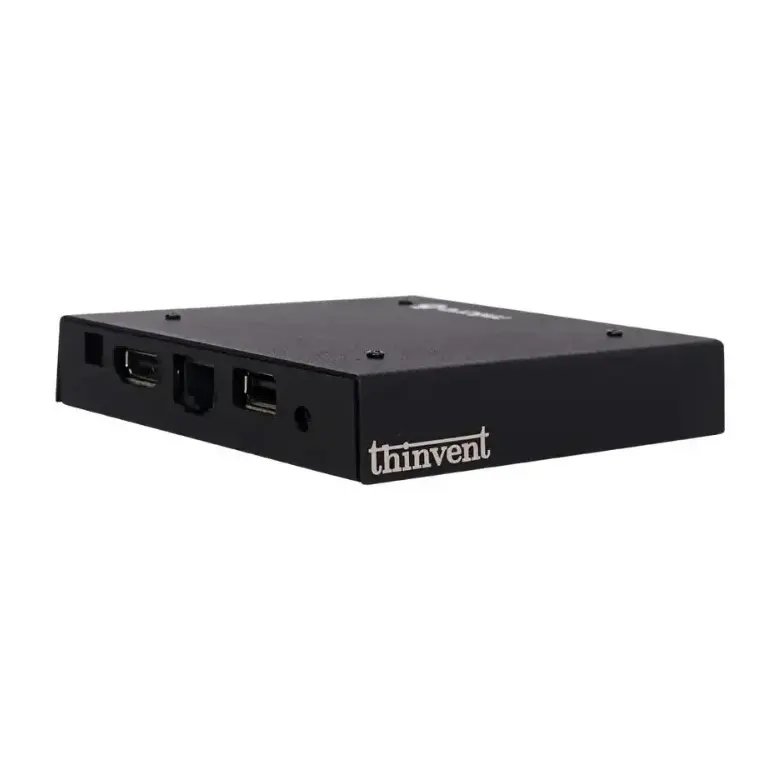
Thinvent builds compact, fanless systems that work well as home computers, media players, kiosks and small-office desktops. The Aero Mini PC family pairs Intel® processors with DDR4 memory and SSD storage, and is available with Windows 11 Pro, Windows 11 IoT, DOS/FreeDOS, or Thinux™ Embedded Linux — so you can match the drive and operating system to your exact home setup. Thinvent also offers thin clients, all-in-one PCs and industrial PCs, all designed for quiet, reliable, long-running operation.