What Does "End" Mean in Industrial Computing?
When buyers search for "end" in the context of industrial computers, they are usually asking one of a few things: which system is right for end-of-line production testing, what happens at the end of a product's lifecycle, or how to choose a machine that will keep running at the end of a long shift without slowing down. In every case, the answer points to the same priorities — stable thermals, a wide input voltage range, long-term component availability, and an operating system that can be locked down so nothing changes unexpectedly.
Designing for the End of the Line
On a factory floor, an industrial PC often sits at the end of a production line, running vision checks, label verification, torque logging, or final test benches. These stations cannot afford random reboots or thermal throttling. Fanless industrial PCs solve this by removing the single most failure-prone moving part — the cooling fan — and spreading heat through a milled aluminium chassis. With no vents pulling in shop-floor air, dust, metal filings and oil mist stay outside the enclosure, which is why fanless designs are the default choice for end-of-line and shop-floor deployments.
Key Specifications That Matter
| Specification | Typical Requirement | Why It Matters |
|---|---|---|
| Cooling | Fanless, aluminium heat-spreading chassis | No dust ingress, no fan failure, silent operation |
| Processor | Intel® Core™ i3 / Celeron®, 6–10 cores | Enough headroom for HMI, SCADA and database tasks |
| Memory | 8–16 GB DDR4 | Smooth multitasking across operator screens |
| Storage | 256 GB – 1 TB SSD | Shock resistance and fast boot on the line |
| Serial Ports | Up to 4 × DB9 RS-232/485 | PLCs, weighbridges, barcode scanners, legacy equipment |
| Power | 12 V DC adapter, wide-range input options | Works with industrial power supplies and battery backup |
| Mounting | DIN rail, VESA, wall bracket | Fits inside control cabinets and machine frames |
| Operating System | Windows 11 Pro, Windows 11 IoT, Linux, DOS | Matches the application stack and update policy |
Operating Systems and Lifecycle Planning
The "end" of a software lifecycle is just as important as the hardware. Windows 11 IoT Enterprise and embedded Linux builds such as Thinux™ let integrators freeze the OS image, disable unwanted updates, and roll out identical machines across many lines. Thin clients and all-in-one PCs extend this further by moving compute into the server room, so the device at the end of the line has no local data to lose and can be swapped in minutes. For legacy machinery that still expects DOS or a serial handshake, keeping a DOS or Linux image available means an old machine tool does not have to be retired just because its control PC failed.
Where These Systems Are Used
Typical deployments include end-of-line test and inspection stations, packaging and labelling cells, CNC and press monitoring, weighbridge terminals, warehouse thin-client stations, and kiosk or access-control points. In each case the requirement is the same: a computer that boots reliably every morning, survives heat, dust and vibration, and can be serviced without pulling the whole cabinet apart.
Thinvent Products Built for This
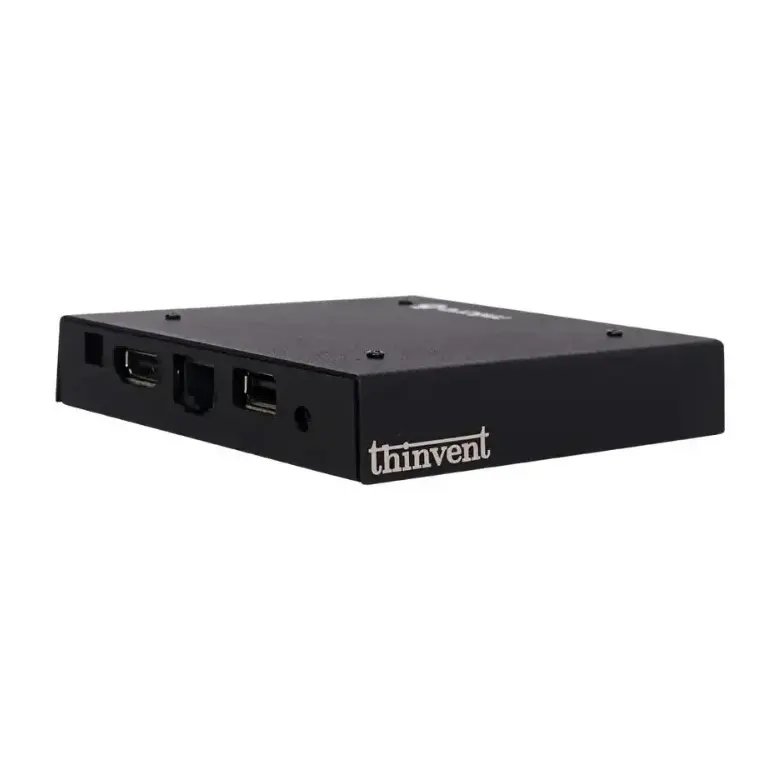
Thinvent's industrial PC range, including the IPC3 series, is designed around exactly these needs. The IPC3 pairs an Intel® Core™ i3-1215U processor (6 cores, up to 4.4 GHz, 10 MB cache) with 16 GB DDR4 memory and up to 1 TB of SSD storage in a fanless chassis, and is offered with Windows 11 Professional, Windows 11 IoT Value, Thinux™ Embedded Linux or DOS, with optional quad DB9 serial ports for connecting PLCs and legacy equipment. Alongside the IPC3, Thinvent manufactures mini PCs, thin clients and all-in-one PCs, so the same platform can be deployed at the machine, at the operator desk, or at the end of the line — all supported worldwide.