What Is a Touchscreen All-in-One PC?
An all-in-one (AIO) PC integrates the computer, display, and often the touch interface into a single unit. Adding a touch screen transforms it into an interactive terminal where users tap, swipe, and select directly on the display instead of relying on a separate keyboard and mouse. This makes AIO touch PCs ideal for point-of-sale counters, self-service kiosks, information desks, hospital reception areas, factory control rooms, and classroom or training environments where speed of interaction matters.
Touch panels used in commercial AIO systems are typically projected-capacitive (PCAP), supporting multi-touch gestures and offering high durability with a smooth glass surface. Resistive touch panels remain available for environments where operators wear gloves or use a stylus. Screen sizes for all-in-one touch PCs commonly range from around 21.5-inch to 23.8-inch Full HD (1920 × 1080) panels, a sweet spot that fits countertops, kiosk enclosures, and wall mounts while remaining readable at arm's length.
Key Specifications to Consider
When evaluating a touchscreen all-in-one PC, the processor, memory, and storage determine how smoothly it runs your applications, while the connectivity determines what peripherals and networks it can support.
| Feature | Typical Options | Why It Matters |
|---|---|---|
| Processor | Intel Celeron, N-series, Core i3/i5 | Handles POS software, kiosk apps, dashboards |
| Memory | 4 GB to 32 GB | Multitasking and browser-based apps |
| Storage | 128 GB to 1 TB SSD | Fast boot, quiet, shock-resistant |
| Display | 21.5" or 23.8" FHD, PCAP touch | Interactive, readable, durable |
| Ethernet | Gigabit, often dual-port | Stable wired networking, device segregation |
| USB | USB 3.2 Gen 2, USB-C | Scanners, printers, payment terminals |
| OS | Windows 11 Pro, Ubuntu, Linux, DOS | Compatibility with your software stack |
Fanless designs are especially valuable in touch deployments: with no moving parts, there is no dust intake, no fan noise in quiet customer-facing spaces, and fewer mechanical failures over years of continuous operation.
Where Touchscreen AIO PCs Are Used
-
Retail and hospitality: POS terminals, order kiosks, queue-management displays.
-
Banking and government: self-service counters, form-filling stations, token dispensers.
-
Healthcare: patient check-in, bedside information terminals, nurse-station dashboards.
-
Industry: HMI panels on the shop floor, machine control, production dashboards.
-
Education and corporate: interactive training stations, reception and visitor management.
In these settings, reliability and 24/7 uptime usually matter more than raw benchmark scores. A well-designed industrial AIO with a modest processor, adequate RAM, and an SSD will often outperform a consumer desktop that throttles in a hot, dusty environment.
Choosing Between a Touch AIO and a Separate PC
A separate mini PC or industrial PC paired with a touch monitor gives flexibility: you can place the computer away from the panel, service it independently, and mix and match components. An all-in-one touch PC, by contrast, reduces cabling, saves counter space, and simplifies installation. For kiosks and counters where space and tidy cabling are priorities, the AIO form factor usually wins; for control cabinets and machine integration, a separate industrial PC with a panel display is often the better fit.
Thinvent Products for Touch and Interactive Deployments
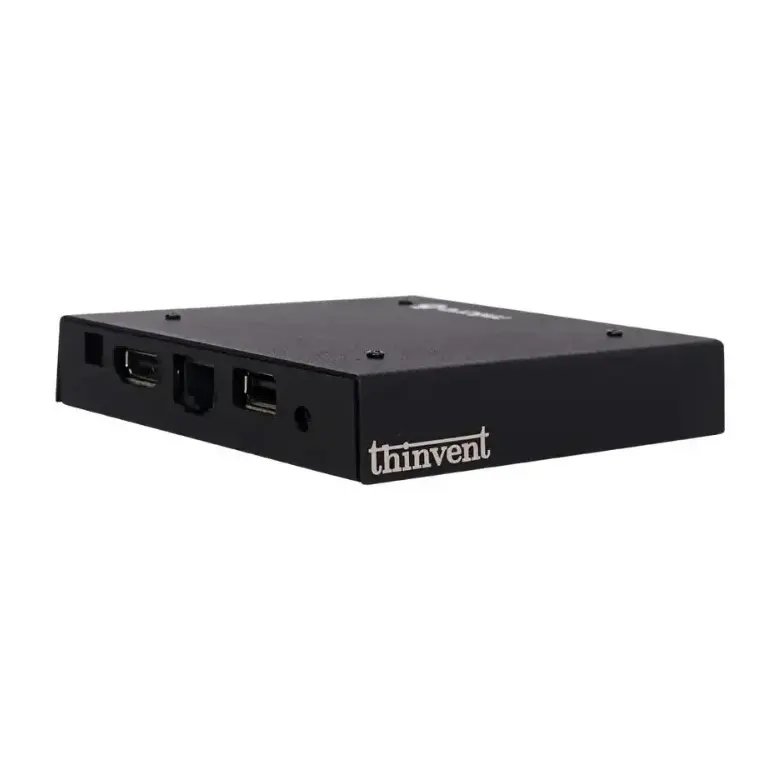
Thinvent manufactures all-in-one PCs, mini PCs, thin clients, and industrial computers built for continuous commercial and industrial use. Our all-in-one range includes touchscreen models in 21.5-inch and 23.8-inch sizes, powered by Intel processors and configurable with up to 32 GB memory and SSD storage up to 1 TB. For kiosk and control-panel builders who prefer a separate display, Thinvent industrial PCs such as the IPC3 series — with Intel Core i3-1215U processors, 16 GB DDR4 RAM, 1 TB SSD, dual Gigabit Ethernet, and multiple serial ports — pair cleanly with touch monitors and run Windows 11 Pro, Windows 11 IoT, Ubuntu Linux, or Thinux embedded Linux. Every Thinvent system is designed for long duty cycles, quiet fanless or low-noise operation, and simple remote management across global deployments.