What "jon" Likely Refers To
If you searched for "jon," you may be looking for a specific product name, brand, or model — and the closest match in industrial computing is often a fanless industrial PC or compact mini PC used in factories, kiosks, and edge deployments. Because "jon" is a short, ambiguous term, it can point to several things: a person's name, a product line abbreviation, or a typo for a model number. If you are looking for a particular industrial computer, thin client, or all-in-one PC, the specifications below will help you identify the right class of device.
Key Specifications to Look For
Industrial computers are specified very differently from office desktops. The most important attributes are the processor, memory, storage, thermal design, and I/O. Modern industrial mini PCs commonly use Intel® processors such as the Core™ i3-1215U (6 cores, up to 4.4 GHz, 10 MB cache) or efficient N-series chips like the N100 and N150. Memory typically ranges from 4 GB to 64 GB DDR4, and storage from 128 GB to 1 TB SSD. Fanless chassis designs matter because they survive dust, heat, and vibration without drawing in airborne contaminants.
| Attribute | Typical Industrial Range | Why It Matters |
|---|---|---|
| Processor | Intel® Celeron, N-series, Core™ i3/i5 | Deterministic performance for control and edge workloads |
| Cores | 4 to 12 | Multitasking, virtualisation, data buffering |
| Memory | 4 GB – 64 GB DDR4 | Headroom for SCADA, HMI, and database tasks |
| Storage | 128 GB – 1 TB SSD | Fast boot, shock resistance, no moving parts |
| Cooling | Fanless | Dust and heat tolerance, silent operation |
| Serial I/O | DB9 RS-232/RS-485 | PLC, sensor, and legacy equipment integration |
| Ethernet | Dual Gigabit | Network redundancy and segmentation |
Use Cases and Applications
Industrial computers are deployed where a standard desktop would fail. Common applications include factory automation and PLC gateways, SCADA and HMI terminals, digital signage and kiosks, machine vision, warehouse and logistics terminals, and edge gateways for IoT data collection. A device with quad DB9 serial ports is often chosen for legacy machine integration, while a dual-Ethernet model suits network segmentation between plant floor and enterprise systems. Operating system choice also matters: Windows 11 Pro and Windows 11 IoT Value are common for commercial software compatibility, while Ubuntu Linux 24.04 LTS and embedded Linux builds are preferred for long-term, licence-free deployments.
Choosing the Right Form Factor
Form factor determines where a system can physically live. Mini PCs are compact and mount behind displays or inside cabinets. Thin clients are optimised for virtual desktop infrastructure (VDI) and remote sessions. All-in-One PCs combine screen and compute for operator stations. Industrial PCs add wide-temperature tolerance, DIN-rail or wall mounting, and protected I/O. Matching the form factor to the environment — control cabinet, wash-down area, or office — is the single most important selection decision.
Thinvent's Products Featuring This Technology
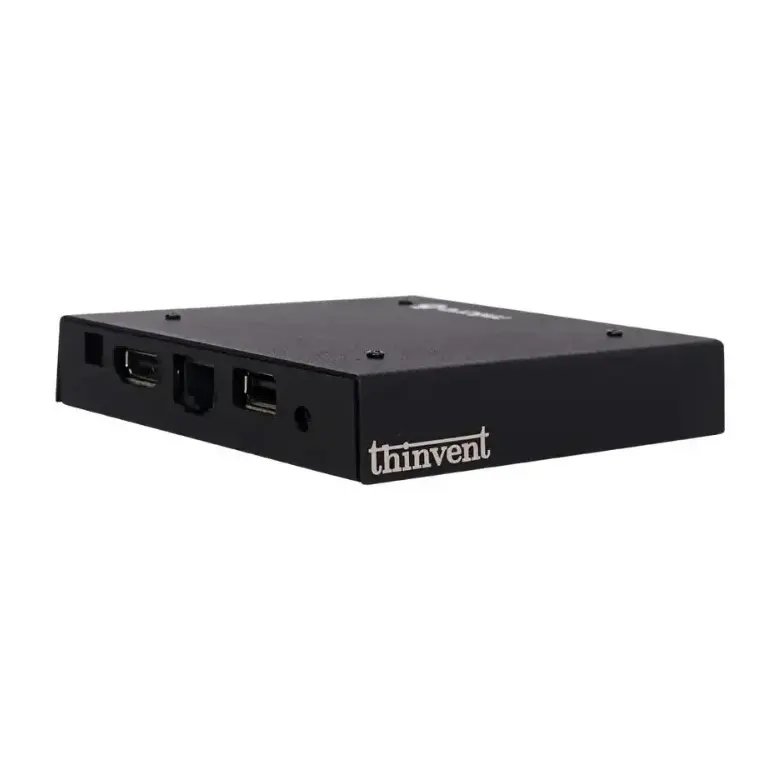
Thinvent manufactures industrial computers, mini PCs, thin clients, and all-in-one PCs designed for continuous operation in demanding environments. The Thinvent® Industrial PC IPC3, for example, pairs an Intel® Core™ i3-1215U processor (6 cores, up to 4.4 GHz, 10 MB cache) with 16 GB DDR4 RAM and a 1 TB SSD, and is available with Windows 11 Professional, Windows 11 IoT Value, DOS, or Thinux™ Embedded Linux. Configurations include quad DB9 serial variants for legacy equipment integration and fanless operation for dust- and heat-exposed sites. Explore Thinvent's range to find the model that matches your application.