What Is a Local CPU?
A local CPU refers to a central processing unit that handles data processing directly on the device itself, rather than relying on cloud servers or remote computing resources. This architecture is essential for applications requiring low latency, data privacy, offline operation, and real-time decision-making. Local CPUs power edge computing devices such as industrial computers, thin clients, and mini PCs deployed in retail, healthcare, manufacturing, and smart infrastructure.
Key Benefits of Local Processing
Running applications locally eliminates network dependency, reducing response times to milliseconds. It also enhances security by keeping sensitive data on-site, which is critical for finance, defense, and patient records. Additionally, local CPUs can operate reliably in environments with limited or intermittent internet connectivity. Fanless designs further improve durability in dusty, hot, or vibration-prone settings.
Typical Use Cases
-
Digital signage – plays content locally without streaming delays.
-
Point-of-sale (POS) systems – ensures transactions remain fast even if the network is down.
-
Industrial automation – processes sensor data in real time on the factory floor.
-
Healthcare terminals – handles patient data within hospital networks.
-
Edge AI inference – runs lightweight AI models locally on devices like the Intel N5095A.
Technical Considerations for a Local CPU
When selecting a local CPU system, prioritize:
| Feature | Importance |
|---|---|
| Processor cores & threads | More cores enable parallel local processing (e.g., 4 cores in N5095A). |
| RAM capacity | Sufficient memory (16 GB or more) allows smooth multitasking. |
| Storage type & speed | SSD ensures fast local data access (128 GB or larger). |
| I/O connectivity | USB, HDMI, and Ethernet ports for peripherals and networks. |
| Power efficiency | Low TDP fanless designs (e.g., 15W) suit 24/7 operation. |
Thinvent Products Featuring Local CPU Technology
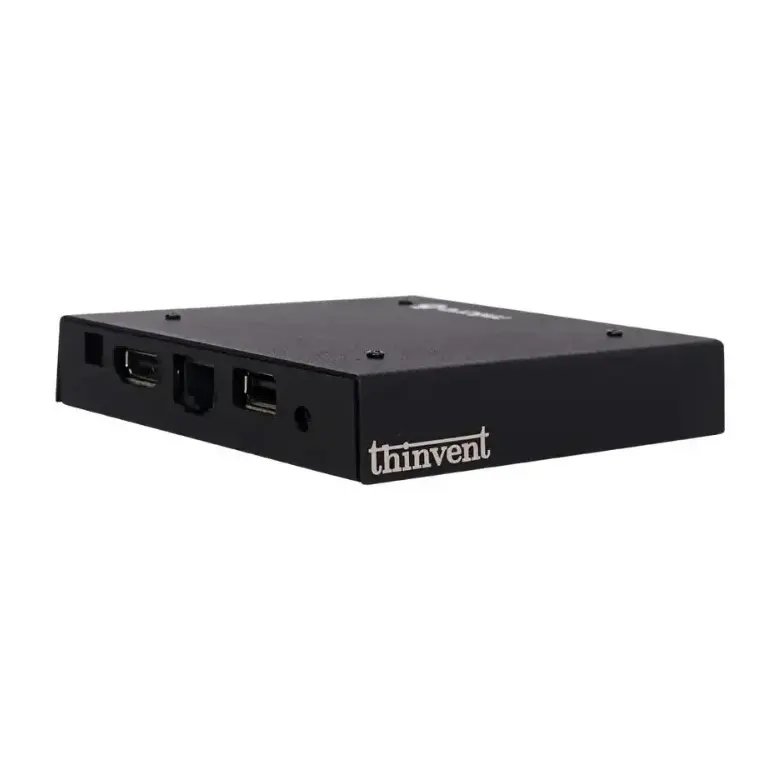
Thinvent’s Aero Mini PC series is purpose-built for local processing workloads. Each unit is powered by the Intel® Celeron® N5095A (4 cores, up to 2.9 GHz, 4 MB cache), with 16 GB DDR4 RAM and 128 GB SSD. The fanless design ensures silent, dust-resistant operation suitable for embedded environments. Available with Windows 11 IoT, Windows 11 Pro, Ubuntu Linux, or Thinux™ Embedded Linux, these mini PCs offer flexible local computing for digital signage, kiosks, thin client deployments, and more.