What Are Mechatronics Companies?
Mechatronics companies design and build systems that combine mechanical engineering, electronics, control theory, and embedded software into a single integrated discipline. Their products range from CNC machines, robotics, and packaging lines to automated assembly cells, motion controllers, and industrial test rigs. What ties all of these together is a need for a computing platform that can run reliably on the factory floor, interface with sensors and actuators, and stay in service for years without constant attention.
The Computing Requirements Behind Mechatronics Systems
A mechatronics system typically layers three things: a mechanical structure, a control layer (PLCs, motion controllers, drives), and a supervisory layer that handles HMI, data logging, vision, and connectivity to MES or SCADA. That supervisory layer is where an industrial computer earns its place. Mechatronics engineers look for fanless designs that survive dust, vibration, and temperature swings; wide-voltage DC inputs that tolerate noisy factory power; serial ports (RS-232/RS-485) for legacy controllers and instruments; multiple Ethernet ports for network segmentation; and a real-time-capable or long-term-supported operating system.
| Requirement | Why It Matters in Mechatronics | Typical Spec |
|---|---|---|
| Fanless cooling | No dust ingress, no fan failure in 24/7 lines | Passive heatsink chassis |
| Serial interfaces | PLCs, drives, weigh scales, barcode readers | RS-232 / RS-485, DB9 |
| Dual Ethernet | Separates machine network from plant network | 2 × Gigabit |
| Wide DC input | Tolerates brownouts and industrial PSUs | 12V / 9–36V DC |
| Long-life OS | Machine builders ship one image for years | Windows 11 IoT, Linux |
Where Industrial PCs Fit in Mechatronics
In a typical machine, the industrial PC sits between the operator and the control hardware. It renders the HMI, runs the recipe and traceability database, captures machine-vision images, streams OEE data to the plant network, and hosts the engineering tools used during commissioning. Because machine builders often standardise on one compute platform across many machine variants, the PC must scale from a compact mini PC on a small cell to a multi-serial industrial box on a complex line. Processor choice usually lands in the Intel® Core™ i3 or Celeron/N-series range — enough performance for HMI, logging, and light vision, without the power and heat of a workstation chip.
Choosing a Platform for Mechatronics OEMs
Machine builders tend to value three things above raw speed: consistency (the same board and drivers across a product family), connectivity (enough serial, USB, and Ethernet to match the machine's I/O), and longevity (a supply and OS support window that matches the machine's service life). Fanless industrial PCs with 6-core Intel® Core™ i3 processors, 16GB DDR4, and NVMe/SATA SSD storage handle HMI, database, and gateway duties comfortably, while quad-DB9 variants cover machines that still talk to multiple serial devices.
Thinvent Products for Mechatronics Applications
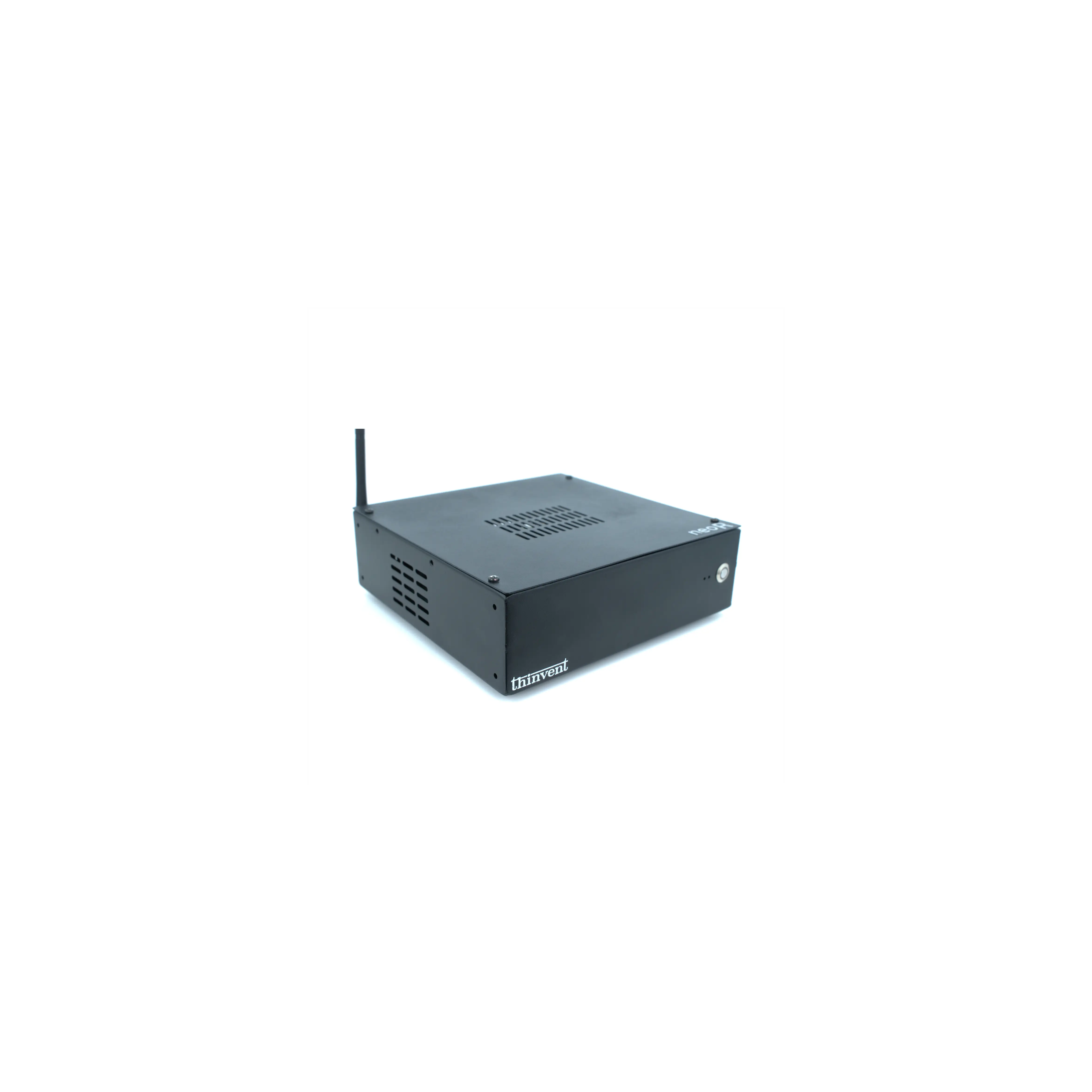
Thinvent's industrial PC range is built for exactly this environment. The IPC3 series pairs a 6-core Intel® Core™ i3-1215U processor with 16GB DDR4 RAM and up to 1TB SSD in a fanless chassis, with options for quad DB9 serial ports, no-WiFi configurations for secure plants, and a choice of Windows 11 Professional, Windows 11 IoT Value, FreeDOS, or Thinux™ Embedded Linux. For lighter machine cells, Thinvent mini PCs and thin clients provide compact, low-power compute for HMI and data-terminal roles, while all-in-one PCs serve as operator stations on the line.