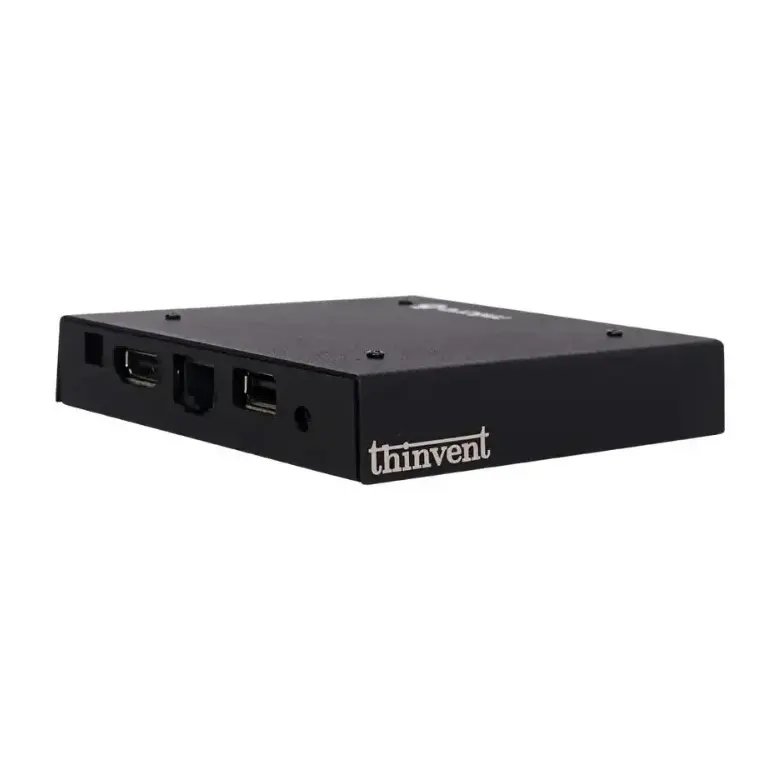
What Is a Mini PC?
A mini PC is a complete desktop computer built into a compact chassis — often small enough to mount behind a monitor or tuck inside a control cabinet. Unlike a traditional tower, a mini PC integrates the processor, memory, storage and I/O on a small board, drawing far less power and generating far less heat. The result is a machine that boots quickly, runs quietly (or completely silently when fanless), and fits into spaces where a full-size desktop simply will not go.
Mini PCs are commonly used as office desktops, thin client endpoints for virtual desktop infrastructure (VDI), digital signage players, kiosk controllers, point-of-sale terminals, and industrial control nodes on factory floors. Because they consume only a fraction of the power of a tower PC, they also lower electricity and cooling costs when deployed in large numbers.
Key Specifications to Consider
When choosing a mini PC, the specification that matters most depends on the workload. Light tasks such as browsing, billing and thin client sessions run comfortably on Intel Celeron or N-series processors with 4–8 GB of RAM and a 128–256 GB SSD. Demanding workloads — CAD, video processing, multi-application industrial control, or running several virtual machines — benefit from Intel Core i3 or i5 processors, 16–32 GB of RAM and 512 GB–1 TB of NVMe storage.
| Specification | Light Use | Mainstream | Demanding |
|---|---|---|---|
| Processor | Intel N100 / N150 / J4125 | Intel Core i3 (12th–13th Gen) | Intel Core i5 (12th–14th Gen) |
| Cores | 4 | 6–10 | 10–12 |
| Memory | 4–8 GB | 16 GB | 32–64 GB |
| Storage | 128–256 GB SSD | 512 GB SSD | 1 TB SSD |
| Typical use | Thin client, signage, kiosk | Office, industrial HMI, POS | CAD, virtualization, edge analytics |
Cooling design is equally important. Fanless mini PCs use the chassis itself as a heatsink, so they have no moving parts to draw in dust or fail. This makes them the preferred choice for dusty workshops, hot environments and any location where a fan failure would mean downtime.
Connectivity, Mounting and Operating Systems
A well-designed mini PC offers dual display outputs (HDMI and/or DisplayPort), multiple USB 3.2 Gen 2 ports, Gigabit Ethernet — often two ports for separating control and corporate networks — and optional USB-C. Industrial models add serial ports (RS-232/RS-485 via DB9) for connecting PLCs, weighing scales, barcode scanners and legacy machinery, plus wide-voltage DC inputs and DIN-rail or VESA mounting.
Operating system choice is flexible: Microsoft Windows 11 Pro for standard business software, Windows 11 IoT for long-term servicing, Ubuntu Linux 24.04 LTS or embedded Linux for headless and appliance-style deployments, or no OS at all for customers who image their own systems.
Where Mini PCs Are Deployed
-
Manufacturing and process control — HMI panels, machine monitoring, data logging on the shop floor.
-
Retail and hospitality — POS terminals, self-service kiosks, menu boards.
-
Healthcare and laboratories — quiet, dust-resistant terminals at nursing stations and instrument benches.
-
Logistics and warehousing — forklift-mounted terminals, barcode and RFID stations.
-
IT infrastructure — thin client endpoints, digital signage, firewall and edge gateway roles.
Thinvent's Range
Thinvent manufactures mini PCs, thin clients, industrial PCs and all-in-one computers for customers worldwide. The range spans compact Intel N-series and Celeron models for everyday desktop and thin client duty, through Intel Core i3 and i5 systems such as the IPC3 series with 12th Generation processors, up to 16 GB DDR4 memory and 1 TB SSD storage. Options include fanless cooling, dual Gigabit Ethernet, quad DB9 serial ports, VESA and DIN-rail mounting, and a choice of Windows 11 Pro, Windows 11 IoT, Linux or no operating system — so you can match the exact configuration to your deployment.