What Does "Mini ITX PC with Integrated Graphics" Mean?
A Mini ITX PC is a computer built around the Mini-ITX mainboard form factor (170 × 170 mm), the smallest standard motherboard size in common use. When paired with a processor that includes integrated graphics (an iGPU built into the CPU die rather than a separate add-in card), the result is a compact, low-power, highly reliable system with no discrete GPU to install, cool, or fail. This is the architecture behind most industrial mini PCs, thin clients, and all-in-one computers.
Integrated graphics are not a compromise for everyday and industrial workloads. Modern Intel processors handle 4K video decode, multi-display output, 2D/3D acceleration, and hardware-accelerated transcoding entirely on-die. Because the GPU shares the processor package, there is no PCIe slot to populate, no extra power connector, and no fan dedicated to a graphics card — which is exactly why fanless Mini-ITX systems are possible at all.
Why Integrated Graphics Suit Compact and Fanless Designs
A discrete graphics card typically needs 75–300 W, its own cooling, and substantial physical space. Integrated graphics draw a few watts from the same power budget as the CPU. That difference lets a Mini-ITX system run from a small 12 V adapter, operate silently with passive cooling, and fit behind a monitor or inside a sealed enclosure.
| Consideration | Integrated Graphics (iGPU) | Discrete Graphics Card |
|---|---|---|
| Power draw | Shared with CPU, typically a few watts | 75 W and above, separate rail |
| Cooling | Covered by CPU heatsink, fanless possible | Dedicated fans or large heatsink |
| Physical size | No additional card or slot | Requires space and PCIe slot |
| Displays | 2–4 outputs from onboard ports | Limited by card's ports |
| Failure points | Fewer moving parts | Extra fan, extra connector |
| Typical use | Digital signage, kiosks, thin clients, office, control rooms | Gaming, CAD, GPU compute |
Typical Workloads for Mini-ITX Integrated-Graphics Systems
These systems excel wherever space, silence, dust tolerance, and long service life matter more than raw 3D throughput:
-
Digital signage and video walls — hardware decode of H.264/H.265 at 4K across multiple HDMI outputs.
-
Thin client and VDI deployments — light local rendering with the heavy work done on a server.
-
Industrial HMI and control cabinets — DIN-rail or panel mounting, wide-temperature operation, no fans to clog with dust.
-
Kiosks, POS, and self-service terminals — compact chassis that fit inside a cabinet.
-
Office and back-office desktops — dual-display productivity, video conferencing, and browser-based applications.
Choosing the Right Processor for a Compact Build
For a Mini-ITX system with integrated graphics, the processor choice sets the ceiling on displays, memory, and responsiveness. Intel's U-series and N-series parts are common in this segment: they combine an iGPU, memory controller, and I/O on one package with modest thermal output. Look for the number of display outputs, maximum supported memory, and whether the platform offers dual Gigabit Ethernet and multiple USB 3.2 ports — all of which are determined by the board and chipset, not by a graphics card.
Thinvent's Compact Integrated-Graphics Range
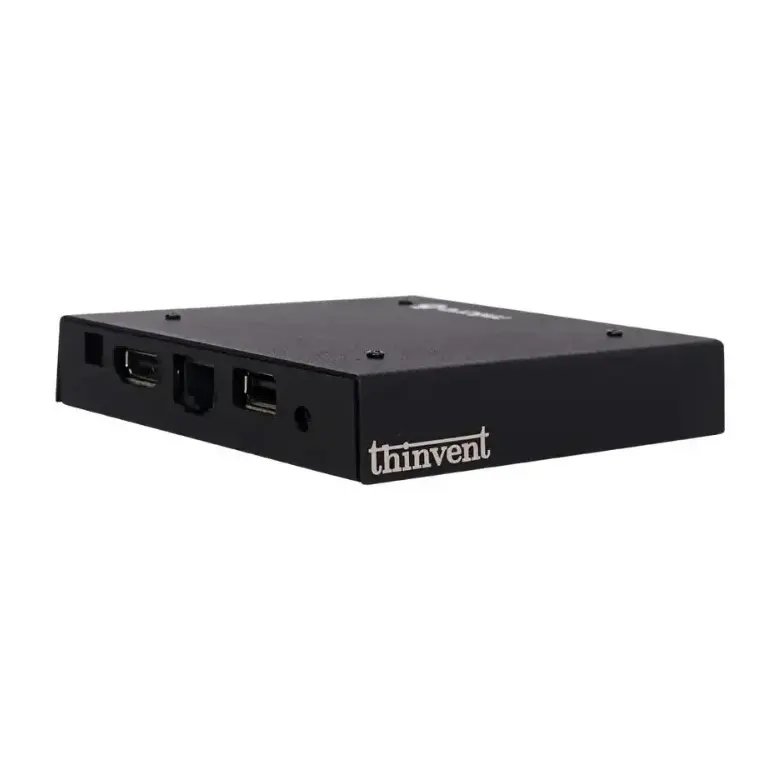
Thinvent builds Mini-ITX-class systems around Intel processors with integrated graphics, designed for continuous operation in industrial and commercial environments. The IPC3 industrial PC pairs an Intel Core i3-1215U (6 cores, up to 4.4 GHz, 10 MB cache) with 16 GB DDR4 and up to 1 TB SSD, and is available with Windows 11 Pro, Windows 11 IoT, Thinux embedded Linux, or without an OS. Thinvent's mini PCs, thin clients, and all-in-one PCs share the same approach: fanless or low-noise cooling, dual Gigabit Ethernet options, multiple HDMI outputs driven by integrated graphics, and a chassis small enough to mount almost anywhere. All are supplied worldwide with long-life availability for embedded and industrial projects.