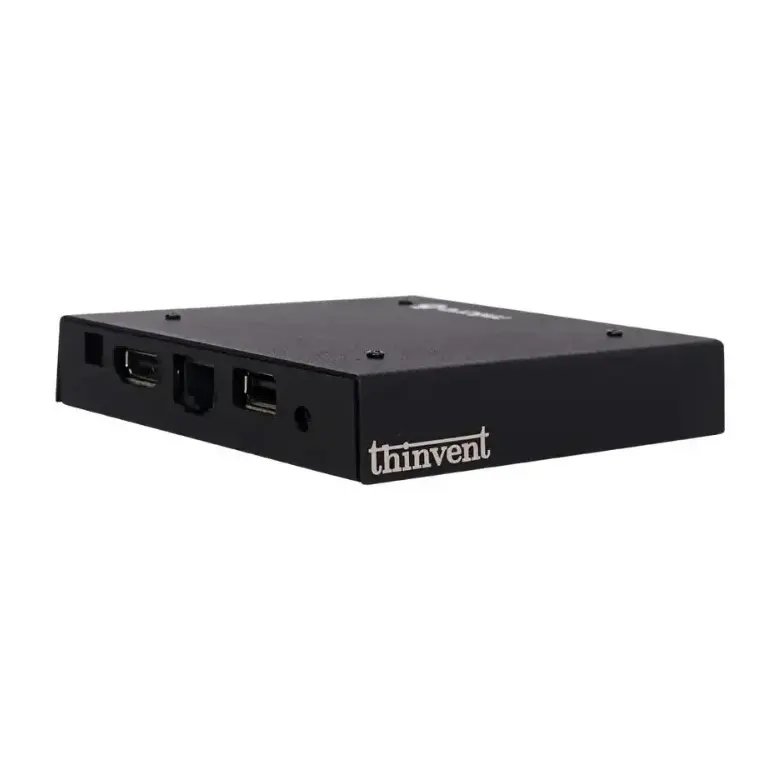
The Minisforum G1 is a mini PC built around an AMD Ryzen 9 processor, with up to 16 cores, up to 96 GB of DDR5 RAM, and dual M.2 SSD slots. The closest Thinvent match is the Thinvent Treo Mini PC with AMD Ryzen 5 7430U, a mini PC with 6 cores and up to 64 GB of RAM. Thinvent's Treo line uses the AMD Ryzen 5 7000 Series in this configuration.
Minisforum G1 vs Thinvent Treo Mini PC
| Minisforum G1 | Thinvent Treo Mini PC, AMD Ryzen 5 7430U | Thinvent Treo Mini PC, AMD Ryzen 5 7530U | |
|---|---|---|---|
| Processor | AMD Ryzen 9 (series; model per listing: 8945HX) | AMD Ryzen 5 7430U | AMD Ryzen 5 7530U |
| Cores/Threads | Up to 16 cores | 6 cores, up to 4.3 GHz | 6 cores, up to 4.5 GHz |
| RAM | Up to 96 GB DDR5 | Up to 64 GB DDR4 | Up to 64 GB DDR4 |
| Storage | Up to 8 TB (dual M.2 expansion) | Up to 2 TB SSD | Up to 2 TB SSD |
| Form Factor | Mini PC | Mini PC | Mini PC |
| Operating System | Not confirmed | Windows 11 Pro (choice of Windows 11 IoT Value, Ubuntu Linux, Thinux Embedded Linux, Without OS, DOS) | Windows 11 Pro (choice of Windows 11 IoT Value, Ubuntu Linux, Thinux Embedded Linux, Without OS, DOS) |
| Wireless | Wi-Fi 7 | Wi-Fi 5 (802.11ac), dual band | Wi-Fi 5 (802.11ac), dual band |
| Ethernet | 5 Gb Ethernet | 1000 Mbps | 1000 Mbps |
Key differences
-
The Minisforum G1 has a higher core count, with up to 16 cores against 6 cores in the Thinvent Treo.
-
The Minisforum G1 supports up to 96 GB of RAM. The Thinvent Treo supports up to 64 GB.
-
The Minisforum G1 has up to 8 TB of storage through dual M.2 slots. The Thinvent Treo supports up to 2 TB SSD.
-
The Thinvent Treo has a choice of operating systems, including Windows 11 Pro, Windows 11 IoT Value, Ubuntu Linux, Thinux Embedded Linux, and no OS. We could not confirm the operating system bundled with the Minisforum G1.
-
The Thinvent Treo lists a VESA mount and a 19V 3A adapter. The Thinvent Treo has 2 USB 3.2 Gen 1 ports and 4 front USB 2.0 ports.
-
The Minisforum G1 is a gaming-oriented system with a discrete NVIDIA RTX 5060 graphics card. The Thinvent Treo has no discrete graphics card in its listed features.
Which one should you choose?
Choose the Minisforum G1 for high-core-count workloads, large RAM configurations, or systems that need a discrete RTX 5060 GPU and very large storage. Choose the Thinvent Treo Mini PC for a 6-core AMD Ryzen 5 mini PC with up to 64 GB of RAM, a choice of operating systems, and a VESA-mountable chassis.