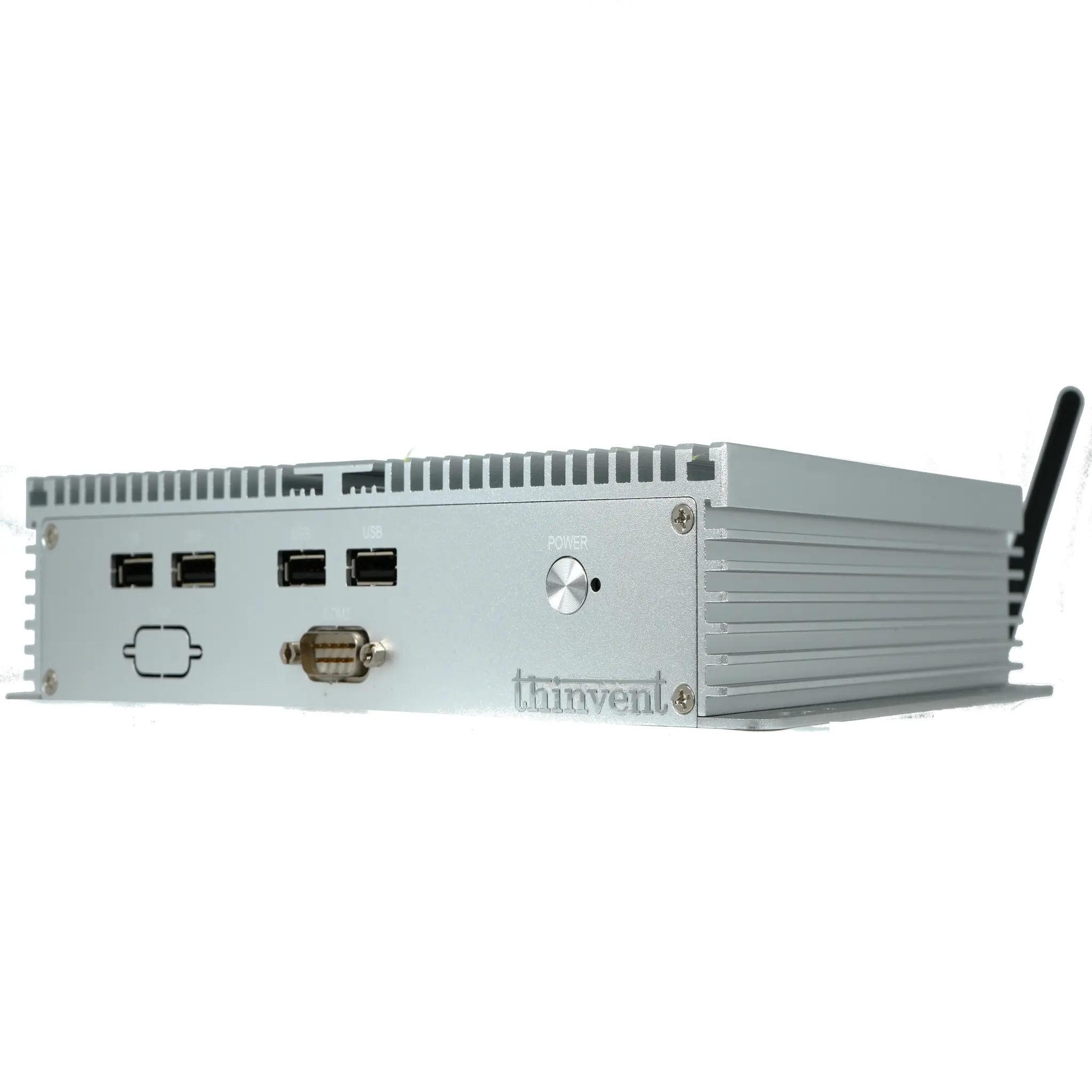
The Moxa UC-8112-LX is a DIN-rail industrial computer built on an ARM Cortex-A8 processor, with 512 MB of DDR3 RAM, 8 GB of eMMC storage and Linux Debian 9 pre-installed. The closest Thinvent match is the Thinvent VR thin client, which runs an ARM Cortex-A53 processor with Thinux™ Embedded Linux and a 16 GB SSD. Thinvent also has industrial PCs with higher RAM and storage limits if you need more capacity.
Moxa UC-8112-LX vs Thinvent VR Thin Client
| Moxa UC-8112-LX | Thinvent VR Thin Client | |
|---|---|---|
| Processor | Arm Cortex-A8, 1 GHz | ARM Cortex A53, 4 cores (Rockchip RK3528) |
| Cores/Threads | Not confirmed | 4 cores |
| RAM | 512 MB DDR3 | 2 GB |
| Storage | 8 GB eMMC | 16 GB |
| Form Factor | DIN-rail industrial computer | Thin Client |
| Operating System | Linux Debian 9 | Thinux™ Embedded Linux |
| Ethernet | 2 ports | Not confirmed |
| Wireless | Mini PCIe socket for cellular | Wi-Fi 6 (802.11ax), dual band, Bluetooth 5 |
Key differences
-
The Thinvent VR has 2 GB of RAM against the Moxa's 512 MB, which gives it four times the memory.
-
The Thinvent VR includes built-in Wi-Fi 6 and Bluetooth 5. The Moxa uses a Mini PCIe socket for cellular modules.
-
The Moxa UC-8112-LX has a DIN-rail mount and 2 Ethernet ports. The Thinvent VR does not have a DIN-rail mount.
-
The Thinvent industrial PCs in the IPC1, IPC3 and IPC5 lines offer RAM up to 64 GB and SSD storage up to 2 TB, far above the Moxa's limits, for workloads that need more capacity.
-
The Moxa is an ARMv7 Cortex-A8 design with a 1 GHz clock. The Thinvent VR uses a quad-core Cortex-A53.
Which one should you choose?
Choose the Moxa UC-8112-LX if you need a DIN-rail mounted computer with 2 Ethernet ports and cellular expansion through a Mini PCIe socket. Choose the Thinvent VR Thin Client if you need more RAM, built-in Wi-Fi 6 and Bluetooth, and a quad-core processor. For higher performance, the Thinvent IPC1 or IPC5 industrial PCs are the better fit.