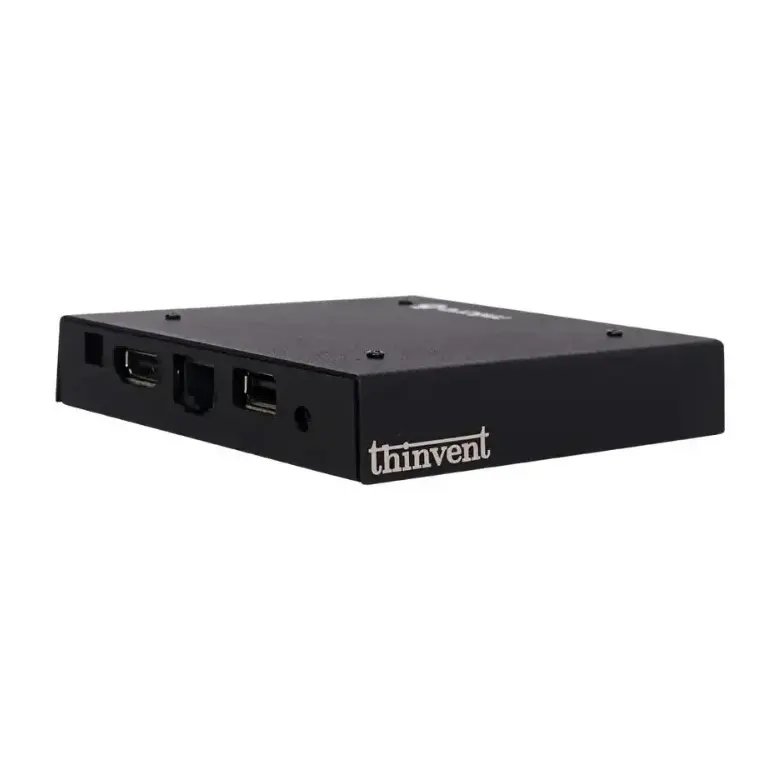
Modern thin clients are streamlined computing devices designed to connect to centralized servers or cloud-based virtual desktops. They process minimal data locally, relying on the server for the bulk of computing, storage, and application management. This architecture delivers significant business efficiency by reducing hardware costs, simplifying IT management, enhancing security, and lowering energy consumption. Ideal for task-based workflows, thin clients provide a consistent, secure, and manageable user experience across an organization.
Key Specifications and Architecture
The core of a modern thin client lies in its efficient hardware and optimized software stack. Common specifications include low-power ARM or Intel processors (like the Cortex A55 or Intel N100), 2GB to 8GB of RAM, and compact eMMC or SSD storage (16GB to 512GB). They run lightweight, secure operating systems such as Thinux™ Embedded Linux, Ubuntu Linux, or Windows IoT. Connectivity is focused on display outputs (HDMI), network interfaces (Ethernet, optional Wi-Fi), and USB ports for peripherals. This lean configuration ensures silent, fanless operation and minimal maintenance.
Primary Use Cases and Applications
Thin clients are deployed in environments where centralized control, security, and cost-effectiveness are paramount.
-
Corporate Desktops & Call Centers: For employees accessing cloud applications, CRM software, and virtual desktops (VDI).
-
Education & Digital Classrooms: Providing a standardized, locked-down computing environment for students and teachers.
-
Healthcare & Hospitality: Secure access to patient records or hotel management systems from kiosks and reception desks.
-
Industrial & Retail: Powering digital signage, point-of-sale (POS) systems, and manufacturing HMIs with reliable, 24/7 operation.
-
Remote & Branch Offices: Enabling easy deployment and centralized IT management for distributed workforces.
Thin Client vs. Mini PC: A Quick Comparison
While both are compact, their purposes differ significantly.
| Feature | Modern Thin Client | Mini PC / Industrial PC |
|---|---|---|
| Primary Role | Access device for remote desktops/apps | Standalone, localized computing |
| Processing Power | Low to moderate (ARM, Intel N-series) | Moderate to high (Intel Core i3/i5/i7) |
| Local Storage | Minimal (16GB-64GB eMMC) | Substantial (128GB+ SSD) |
| Management | Centralized, from a server console | Individual device management |
| Total Cost of Ownership | Lower (hardware, energy, IT overhead) | Higher |
| Best For | Standardized tasks, VDI, cloud apps | Local applications, design, data processing |
Thinvent's Modern Thin Client and Mini PC Solutions
Thinvent offers a comprehensive range of devices that cater to both pure thin client and enhanced mini PC requirements, providing flexibility for diverse business needs.
Our Thinvent® Micro Series (Micro 5 Wifi, Micro 6 Pro) are quintessential thin clients, built with power-efficient ARM processors, Thinux™ OS, and compact storage. They are perfect for cost-effective VDI and cloud access terminals.
For scenarios requiring more local processing or flexibility, our Thinvent® Treo Mini PC and IPC1 with the Intel N100 processor offer a balance, capable of running lightweight OSes for either thin client or standalone duties.
When performance is critical, our Thinvent® Industrial PC (IPC3, IPC5) and Aero Mini PC series, featuring Intel Core i3, i5, and the latest Core Ultra processors, provide robust standalone computing power. These devices are ideal for industrial automation, digital signage, edge computing, or as powerful hosts for virtualization and multi-session environments, blending the lines between a high-performance endpoint and a managed node.