What Makes a Network PC Reliable for Industrial Use?
A network PC for industrial applications is a computing system designed to operate continuously in demanding environments — factory floors, control cabinets, production cells, kiosks and remote sites — while staying connected to plant networks, MES/ERP systems and SCADA platforms. Unlike an office desktop, an industrial network PC must tolerate wide temperature ranges, dust, vibration, electrical noise and 24/7 duty cycles without frequent servicing. Reliability here is not a single feature but the sum of several design decisions: fanless cooling, a wide-input power supply, industrial-grade storage, rugged connectors and a long-life operating system.
Key Technical Characteristics
The most important reliability factors in an industrial network PC are:
-
Fanless thermal design. Removing the fan eliminates the single most common mechanical failure point and stops the chassis from drawing dust into the electronics. Heat is dissipated through a metal chassis instead, which also reduces noise and maintenance.
-
Wide-range DC input. Industrial power rails are rarely clean. A PC rated for a wide DC input (commonly 12 V with tolerance for surges and dips) plus protection circuitry keeps running through brownouts and transients.
-
Industrial storage. SSDs with high endurance ratings and power-loss protection are preferred over consumer drives, especially where the system writes logs, counters or database records continuously.
-
Legacy and industrial I/O. Many plants still run RS-232/RS-485 serial devices, PLCs and meters. Multiple DB9 serial ports, dual Ethernet and isolated digital I/O are often more valuable than raw CPU speed.
-
Dual Ethernet. Two Gigabit ports allow network segmentation — for example, one port to the plant control network and one to the corporate IT network — without an external switch.
-
Long-life OS and driver support. Windows 11 IoT, embedded Linux and DOS/FreeDOS options let integrators lock down a known-good software image for years.
Typical Industrial Network PC Applications
| Application | Why a network PC fits |
|---|---|
| SCADA / HMI terminals | Continuous operation, dual Ethernet, serial links to PLCs |
| Production data collection | Reliable logging to MES/ERP over the plant network |
| Machine vision gateways | Stable compute with no moving parts in dusty cells |
| Digital signage and kiosks | Fanless, silent, compact, long unattended runtime |
| Edge gateway / protocol conversion | Dual NICs, serial ports, embedded Linux |
| Test and measurement benches | Repeatable I/O, wide DC input, industrial mounting |
Choosing the Right Configuration
For light gateway and HMI duties, a low-power Intel Celeron or N-series processor with 8 GB RAM is usually sufficient. For multi-tasking workloads — running an HMI, a database and a vision or analytics service at once — a 12th generation Intel Core i3 such as the i3-1215U (6 cores, up to 4.4 GHz, 10 MB cache) with 16 GB DDR4 and a 1 TB SSD offers a strong balance of performance, power draw and longevity. Pay attention to mounting (DIN rail or VESA), ingress protection, operating temperature range and the exact serial/network port count your installation requires before specifying.
Thinvent's Industrial Network PCs
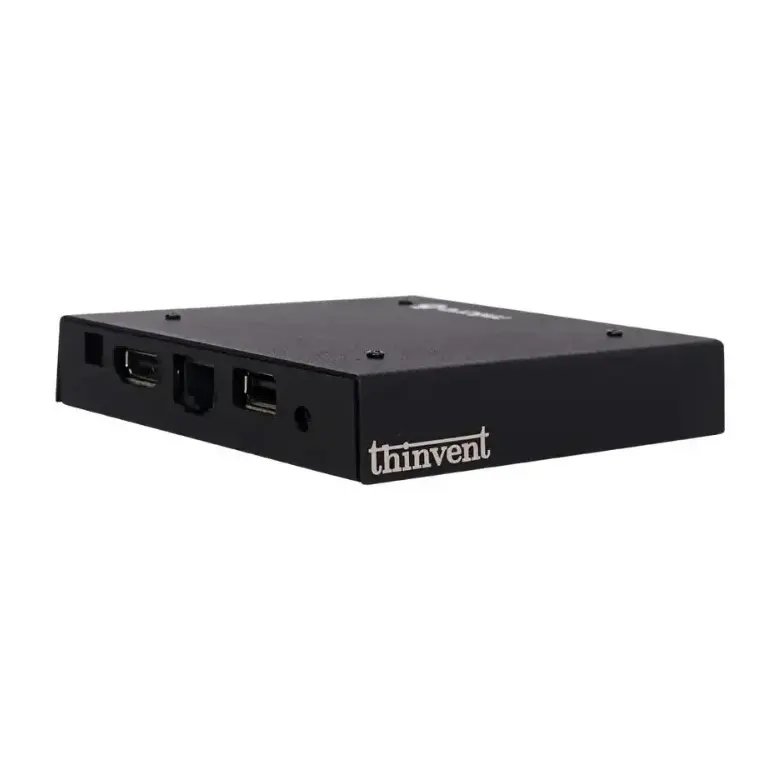
Thinvent manufactures fanless industrial computers, mini PCs, thin clients and all-in-one PCs built for exactly these environments. The Thinvent IPC3 series pairs 12th generation Intel Core i3-1215U processing with up to 16 GB DDR4 RAM and 1 TB SSD storage, and is available with dual Ethernet, optional quad DB9 serial ports, and a choice of Windows 11 Pro, Windows 11 IoT, DOS or Thinux™ embedded Linux. Every unit is designed for continuous, maintenance-light operation, making Thinvent systems a dependable foundation for industrial networking, automation and edge deployments worldwide.