What "One by One" Means for Industrial Computer Selection
Choosing industrial computing hardware "one by one" means evaluating each candidate system on its own merits — processor, memory, storage, I/O, thermal design and operating system — rather than picking a whole product family on brand reputation alone. Deployments in factories, kiosks, retail counters, logistics hubs and laboratories each have a different bottleneck: one site may be limited by serial ports, another by fanless operation in a dusty enclosure, a third by the need to run a specific OS image. Reviewing units individually lets you match the exact specification to the exact job.
Key Specifications to Check on Each Unit
| Specification | Why It Matters | Typical Options |
|---|---|---|
| Processor | Determines responsiveness and multi-tasking headroom | Intel Celeron, N-series, Core i3/i5 (7th–14th gen) |
| Cores / Threads | Parallel workloads, virtualisation, data logging | 4, 6, 10, 12 cores |
| Memory | Browser tabs, SCADA/HMI software, databases | 4 GB to 64 GB DDR4/DDR5 |
| Storage | OS image, local logging, edge buffering | 128 GB to 1 TB SSD |
| Cooling | Dust, heat, noise, moving-part failure | Fanless (passive) or active cooling |
| Ethernet | Network redundancy and segmentation | Single or dual Gigabit ports |
| Serial / USB | PLCs, meters, scanners, legacy equipment | DB9 RS-232/RS-485, USB 3.2 Gen 2, USB-C |
| Operating System | Application compatibility | Windows 11 Pro/IoT, Ubuntu Linux, FreeDOS, without OS |
A practical method is to list the mandatory interfaces first, then work upward through CPU and RAM until the workload is comfortably covered. Over-specifying wastes budget and power; under-specifying shows up later as dropped frames, slow HMI screens or failed remote sessions.
Use Cases Where Per-Unit Evaluation Pays Off
-
Factory automation: an IPC with multiple DB9 serial ports can talk to PLCs, weighbridges and older controllers directly, avoiding USB-to-serial adapters that add failure points.
-
Digital signage and kiosks: small form factor mini PCs with dual HDMI outputs drive two displays from one compact box.
-
Thin client / VDI fleets: low-power thin clients boot from a central image, reducing per-desk maintenance and power draw.
-
Edge data collection: fanless industrial PCs sit inside sealed cabinets where airflow is limited and dust ingress must be minimised.
-
Laboratory and medical benches: quiet, fanless operation matters where acoustic noise or airborne particles are a concern.
Deployment and Longevity Considerations
Industrial buyers usually plan in multi-year cycles, so check that the chosen platform has a stable supply of spare units, standard 12 V or wide-range DC input, and mounting options such as DIN rail or VESA. Where a system will run 24/7, passive cooling and solid-state storage remove the two most common mechanical failure points. For software, confirm driver availability for the exact OS revision you intend to ship, especially if you standardise on Linux or an embedded image.
Thinvent Products Built for Unit-by-Unit Selection
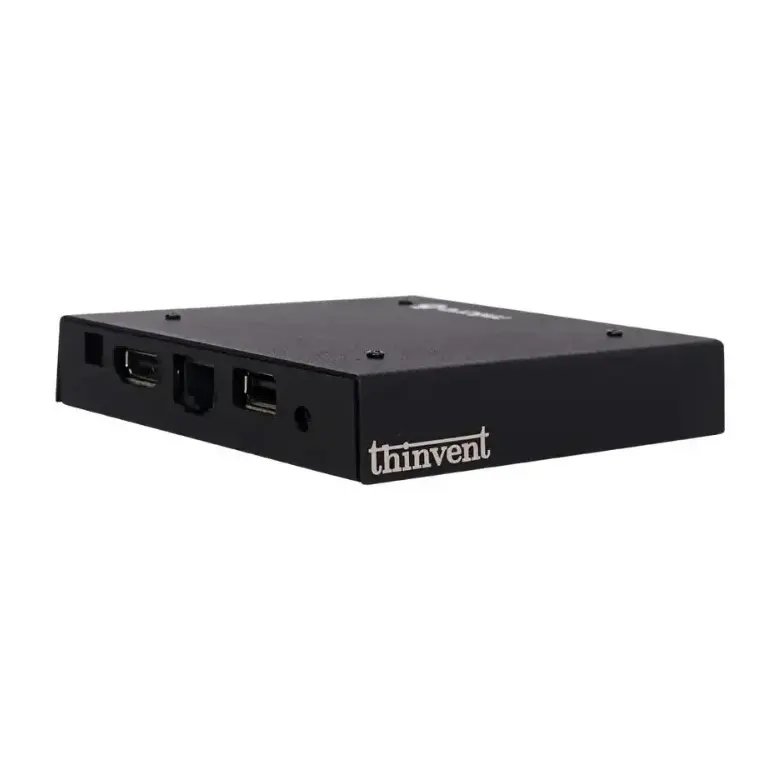
Thinvent manufactures industrial computers, mini PCs, thin clients and all-in-one PCs for customers worldwide, with configurations that can be compared and matched individually. The IPC3 industrial PC family, for example, pairs an Intel Core i3-1215U processor (6 cores, up to 4.4 GHz, 10 MB cache) with 16 GB DDR4 RAM and a 1 TB SSD on a 12 V 10 A adapter, and is available in variants with quad DB9 serial ports and a choice of Windows 11 Professional, Windows 11 IoT Value, DOS, or Thinux Embedded Linux. Fanless mini PCs, ARM-based thin clients and all-in-one units round out the range, so each requirement can be met with a specific model rather than a compromise. ---DESCRIPTION