What Are Industrial Computers?
Industrial computers are specialized computing systems engineered for reliability, durability, and continuous operation in demanding business and commercial environments. Unlike standard office PCs, they are built with robust components, often feature fanless designs for silent and dust-resistant operation, and support a wide range of operating systems tailored for specific applications. They are the backbone of modern business infrastructure where uptime, stability, and performance are non-negotiable.
Key Specifications and Technical Details
Industrial PCs (IPCs) and business-focused mini PCs are defined by their core components and build quality. Key specifications include:
-
Processors: Ranging from power-efficient ARM-based processors (like Cortex A53/A55) for lightweight tasks to high-performance Intel Core processors (i3, i5, and newer generations like the 14th Gen Core 5 120U) for compute-intensive applications.
-
Memory & Storage: Configurations vary from 2GB/16GB eMMC for thin clients to 16GB DDR4 RAM with 512GB SSDs for heavy-duty workstations.
-
Design & Durability: Often compact, with VESA mount compatibility for space-saving deployment. Many models operate without moving fans (fanless), making them ideal for dusty or sensitive environments.
-
Operating Systems: Support for embedded Linux (Thinux™), Ubuntu Linux, and Windows IoT/Pro versions, allowing for software flexibility and long-term stability.
Primary Use Cases and Applications
These computers are deployed across various sectors due to their reliability:
-
Digital Signage & Kiosks: Powering interactive displays, menu boards, and information terminals in retail, hospitality, and public spaces.
-
Thin Client & VDI Solutions: Devices like the Micro series are perfect for centralized computing environments, providing secure, manageable, and cost-effective access to virtual desktops.
-
Industrial Automation & Control: Running SCADA systems, PLC programming, and machine vision applications on factory floors.
-
Edge Computing & IoT Gateways: Processing data locally in smart buildings, transportation, and logistics networks.
-
Office & Professional Workstations: High-performance mini PCs like the Aero series deliver desktop-level power for business software, CAD, and financial applications in a compact form factor.
Comparison of Common Industrial PC Types
| Feature | Thin Client / Basic Mini PC | Performance Mini PC | Industrial Workstation PC |
|---|---|---|---|
| Typical Processor | ARM Cortex A53/A55, Intel N-Series | Intel Core i3/i5 (U-Series) | Intel Core i5/i7 (P-Series/H-Series) |
| Best For | Web browsing, VDI, digital signage | Office applications, light CAD, POS systems | Data analysis, engineering software, automation |
| Key Advantage | Ultra-low power, silent, cost-effective | Balanced performance & size | Maximum processing power & expandability |
| Example Model | Thinvent Micro 6 Pro | Thinvent Aero Mini PC | Thinvent Industrial PC IPC5 |
Thinvent's Range of Industrial Computing Solutions
Thinvent offers a comprehensive portfolio of industrial and business computers designed to meet diverse operational needs. Our product lines include:
-
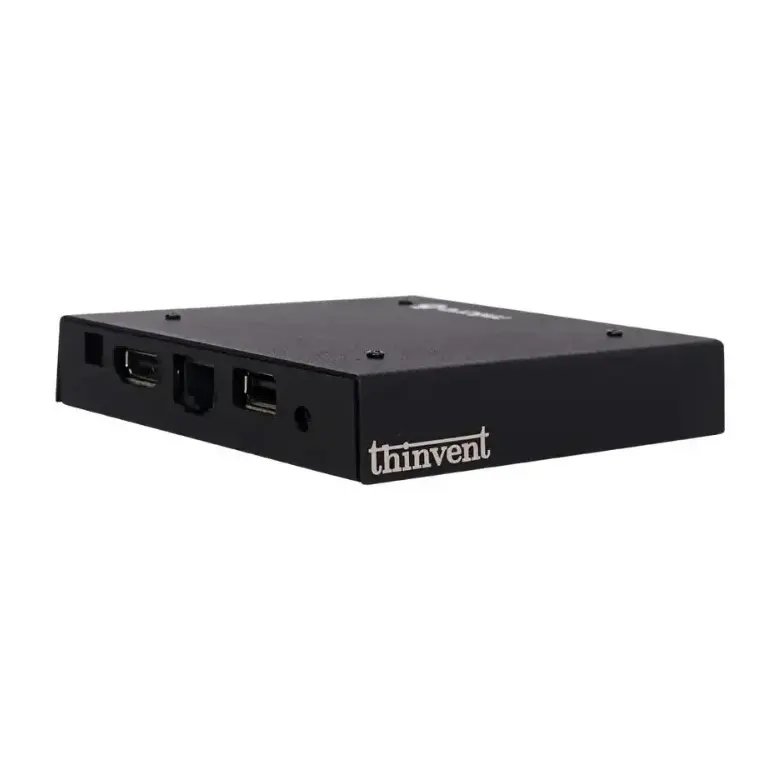
Thinvent Micro Series: Energy-efficient thin clients and mini PCs based on ARM architecture, perfect for lightweight, always-on applications like digital signage and terminal access.
-
Thinvent Treo & Aero Series: Compact yet powerful mini PCs featuring Intel processors, suitable for space-constrained offices, retail POS, and professional workspaces requiring reliable Windows or Linux performance.
-
Thinvent Industrial PC (IPC) Series: Rugged, high-performance systems built for 24/7 operation in challenging environments. These units, such as the IPC5 with a 12th Gen Intel Core i5 processor, are engineered for industrial automation, machine control, and demanding edge computing tasks.
Each Thinvent product is developed with a focus on longevity, stable performance, and seamless integration into your business infrastructure, supported by a choice of operating systems to match your software ecosystem.