How to Compare PCs Meaningfully
Comparing PCs is not about picking the one with the biggest number on the box. A meaningful comparison weighs four things against your actual workload: the processor (cores, clock speed and cache), memory and storage, the form factor and thermal design, and the operating system and connectivity that ship with the machine. A 6-core Intel® Core™ i3-1215U running at up to 4.4 GHz with 10 MB of cache and 16 GB of DDR4 RAM will comfortably handle office productivity, POS, kiosk and light industrial control work — but the same silicon performs very differently in a sealed, fanless chassis than in a ventilated tower. Always compare like with like.
The Specifications That Actually Matter
Start with the processor family and generation. Intel's N-series (such as the N100 and N150) and Celeron parts are efficient, low-power choices for thin clients, digital signage and basic kiosks. The Intel Core i3 and i5 lines, from 10th through 14th generation, add more cores, higher clocks and larger caches for multitasking, data logging and virtualisation. Memory is the next lever: 4 GB or 8 GB suits a single-application thin client, 16 GB is the practical baseline for a Windows desktop or industrial HMI, and 32 GB or 64 GB is where you want to be for virtual machines or heavy database work. Storage follows the same logic — 128 GB for a locked-down client, 256 GB to 512 GB for general use, 1 TB or more for local data collection.
Form Factor and Environment
Form factor is where comparisons most often go wrong. A mini PC is built for desks and meeting rooms. A thin client is optimised to connect to a remote session with minimal local processing. An all-in-one PC folds the computer into the display, saving space in retail and reception areas. An industrial PC is engineered for the factory floor: wide-temperature operation, fanless cooling, vibration tolerance, DIN-rail or panel mounting, and serial ports such as DB9 for legacy equipment. Two Gigabit Ethernet ports, dual HDMI, USB-C and multiple USB 3.2 Gen 2 ports are the connectivity checkpoints worth comparing across any shortlist.
A Practical Comparison Framework
| Criterion | What to Check | Typical Fit |
|---|---|---|
| Processor | Brand, series, generation, cores, cache | N-series/Celeron for clients; i3/i5 for industrial and desktop |
| Memory | 4–8 GB entry, 16 GB mainstream, 32–64 GB heavy | Match to OS and application count |
| Storage | 128 GB – 1 TB SSD | Local data and logging needs |
| Form Factor | Mini PC, Thin Client, All-in-One, Industrial PC | Environment and mounting |
| Cooling | Fanless vs active | Dust, heat and noise sensitivity |
| OS | Windows 11 Pro, Ubuntu Linux 24.04 LTS, FreeDOS, Without OS | Software compatibility and licensing |
| I/O | Ethernet ports, HDMI, USB, serial | Peripherals and legacy equipment |
Operating Systems and Longevity
The operating system is part of the comparison, not an afterthought. Windows 11 Pro suits standard business and industrial software; Windows 11 IoT and embedded Linux builds such as Thinux™ are designed for appliances that must run unattended for years. Ubuntu Linux 24.04 LTS is a strong choice for open-source stacks, while FreeDOS or a no-OS configuration lets integrators deploy their own image. Whichever you choose, compare total cost of ownership over the deployment life — power draw, serviceability, spare-part availability and thermal headroom matter more than a small difference in benchmark scores.
Thinvent's Range for Every Comparison
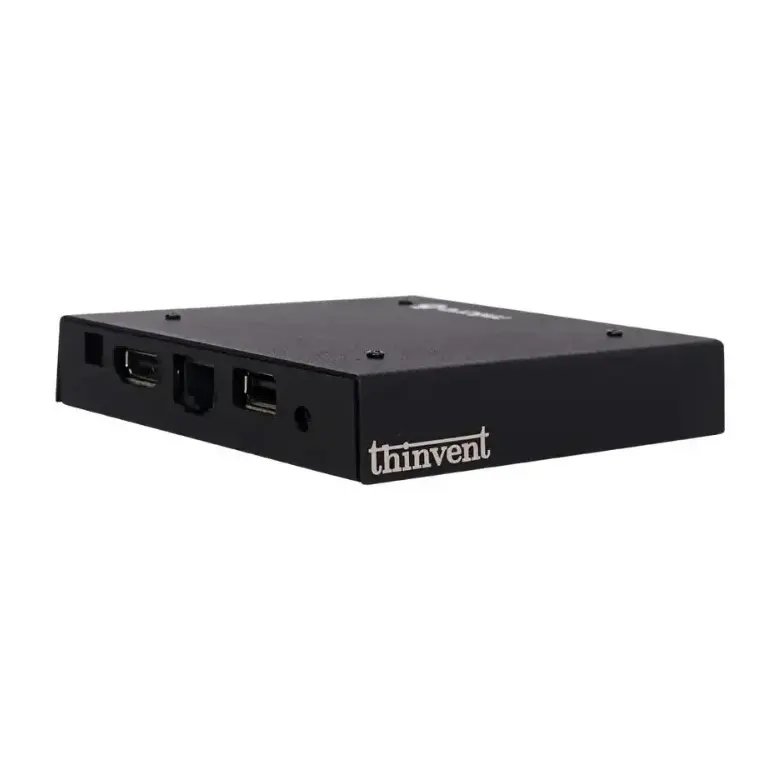
Thinvent manufactures industrial computers, mini PCs, thin clients and all-in-one PCs built around these exact trade-offs. The IPC3 industrial PC pairs an Intel® Core™ i3-1215U (6 cores, up to 4.4 GHz, 10 MB cache) with 16 GB DDR4 RAM and a 1 TB SSD in a fanless chassis, available with Windows 11 Pro, Windows 11 IoT Value, DOS, Thinux™ Embedded Linux, and optional quad DB9 serial ports for legacy equipment. Across the wider range you can compare Intel and ARM processor options, N-series and Core i3/i5 configurations, 4 GB to 64 GB memory, 128 GB to 1 TB storage, and mini PC, thin client, all-in-one and industrial form factors — so you can match the specification to the workload rather than the other way round.