What to Compare When Choosing a Mini PC
Comparing mini PCs comes down to a handful of specifications that determine whether a machine will feel fast or sluggish, whether it can run your software, and whether it will still be working five years from now. The most important are the processor (CPU), the amount of RAM, the type and capacity of storage, the operating system, and the physical design, particularly whether the unit is actively cooled with a fan or fanless. Secondary factors such as Ethernet ports, HDMI outputs, USB ports and wireless connectivity matter just as much once you know exactly what the PC will be plugged into.
Processor: The Single Biggest Differentiator
The CPU decides how quickly applications open, how many browser tabs stay responsive, and whether video plays smoothly. Intel's entry-level N-series and Celeron processors, such as the N5095A, are quad-core parts running up to around 2.9 GHz with a modest cache. They are designed for low power draw and silent operation, and they handle office suites, web-based applications, point-of-sale software, digital signage and thin-client sessions without difficulty. Stepping up to Core i3 or i5 processors with 10 or 12 cores brings noticeably more headroom for multitasking, local databases, light content editing and heavier virtualisation workloads.
| Specification | Entry Level | Mid Range | Higher Performance |
|---|---|---|---|
| Processor series | Intel Celeron / N-series | Intel Core i3 | Intel Core i5 |
| Typical cores | 4 | 6 to 10 | 10 to 12 |
| Typical memory | 4 to 8 GB | 8 to 16 GB | 16 to 32 GB |
| Typical storage | 128 GB SSD | 256 to 512 GB SSD | 512 GB to 1 TB SSD |
| Best suited to | Office apps, kiosks, thin clients | Multitasking, light server roles | Demanding business workloads |
Memory, Storage and Operating System
RAM is what allows several programs to run at once. 4 GB is the practical minimum for a modern desktop OS, 8 GB is comfortable for everyday business use, and 16 GB or more is advisable if the machine will run virtual machines, large spreadsheets or database tools. Storage matters in two ways: capacity and technology. Solid state drives respond far faster than mechanical hard disks and have no moving parts to wear out, so a 128 GB SSD will feel quicker than a 1 TB spinning disk for everyday tasks. Choose the operating system deliberately as well. Windows 11 Pro adds domain join, BitLocker and remote desktop hosting that Windows 11 Home lacks, Linux suits kiosk and appliance deployments, and a machine supplied without an OS or with FreeDOS is the right choice when you plan to image your own build.
Cooling, Ports and Long-Term Reliability
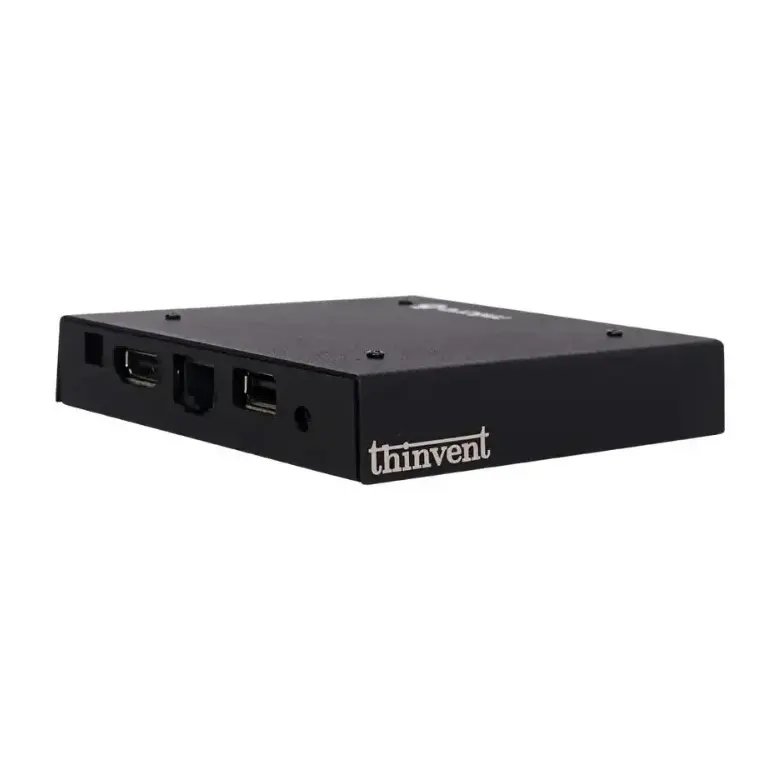
Fanless designs use the chassis itself as a heatsink, which removes the fan as a failure point and eliminates the dust ingress that eventually clogs actively cooled systems in workshops, warehouses and dusty retail environments. When comparing port layouts, count what you actually need: dual Gigabit Ethernet ports for network separation or failover, two HDMI outputs for dual displays, USB 3.2 Gen 2 for fast peripherals, and USB-C for modern docking. A mini PC with the right ports built in avoids a tangle of adapters and is easier to service in the field.
Thinvent Products Featuring These Technologies
Thinvent builds mini PCs, industrial computers, thin clients and all-in-one PCs around exactly these considerations. The Aero Mini PC family pairs Intel processors with configurable memory and SSD storage, fanless chassis options for dusty or space-constrained sites, and a choice of Windows 11 IoT, Windows 11 Pro, Linux or no operating system at all. Industrial models add wide-temperature operation and robust mounting, thin clients are tuned for centralised virtual desktop deployments, and all-in-one units integrate screen and compute in a single unit for counters and kiosks. Compare the specifications above against your workload, and Thinvent's range will have a configuration that fits.