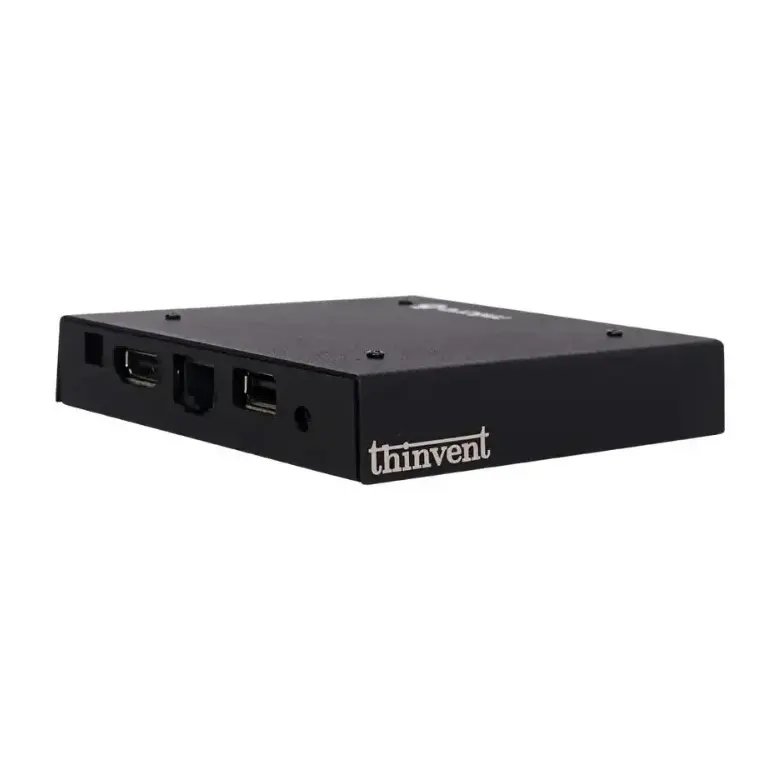
What is a PC on a Stick?
A PC on a Stick, also known as a Compute Stick or Mini PC Stick, is a fully functional computer condensed into a form factor barely larger than a USB flash drive. It is designed to plug directly into an HDMI port on a monitor, TV, or digital signage display, instantly transforming it into a smart, connected workstation or kiosk. This ultra-compact design eliminates the need for a traditional desktop tower, offering a powerful computing solution for environments where space, power consumption, and simplicity are critical.
Key Specifications and Technical Details
These devices typically feature low-power, fanless processors (like Intel's N-series) to manage heat dissipation within their tiny chassis. They come equipped with onboard RAM and SSD storage, along with essential connectivity ports such as USB and sometimes Ethernet via adapters. Their primary power is often drawn through the HDMI connection or a separate micro-USB/USB-C power adapter. Key technical considerations include:
-
Processor: Energy-efficient Intel Celeron or Intel Processor N-series (e.g., N95, N100).
-
Memory & Storage: Soldered LPDDR4/LPDDR5 RAM (4GB to 16GB) and eMMC or M.2 SSD storage (128GB to 512GB).
-
Connectivity: HDMI output, USB ports (2.0/3.0), microSD card slot, and often built-in Wi-Fi and Bluetooth.
-
Power: Low Thermal Design Power (TDP), usually under 10W, enabling silent, fanless operation.
Use Cases and Applications
The extreme portability and minimal footprint of stick PCs make them ideal for a variety of embedded and display-centric applications:
-
Digital Signage & Kiosks: Perfect for driving content on retail displays, menu boards, or information kiosks discreetly behind a screen.
-
Thin Clients & VDI: Serve as lightweight endpoints for accessing virtual desktops in offices, call centers, or educational labs.
-
Media Centers: Transform any HDMI-equipped TV into a smart TV for streaming, light gaming, and web browsing.
-
Space-Constrained Industrial Settings: Deploy in control panels, manufacturing equipment, or IoT gateways where traditional PCs won't fit.
-
Education & Mobility: Easy to deploy, secure, and transport between classrooms or workstations.
Comparison: Stick PC vs. Traditional Mini PC
| Feature | PC on a Stick | Traditional Mini PC (e.g., Thinvent Aero) |
|---|---|---|
| Form Factor | Extremely compact (USB stick size) | Small box (typically 0.5-2 liters) |
| Installation | Plugs directly into HDMI port | Requires separate HDMI cable |
| Port Expansion | Limited, often requires hubs | More native ports (USB, Ethernet, serial) |
| Performance | Optimized for low-power, basic tasks | Supports more powerful processors for demanding applications |
| Cooling | Passive (fanless) only | Can support active cooling for higher TDP CPUs |
| Ideal For | Digital signage, basic computing, media | General office use, industrial computing, edge servers |
Thinvent's Compact Computing Solutions
While Thinvent specializes in robust, fanless Mini PCs and Industrial PCs that offer greater expandability and performance headroom, our product philosophy aligns with the core benefits of stick PCs: reliability, space-saving design, and efficient operation. Our Aero Mini PC series, for example, provides a slightly larger but far more versatile and powerful alternative. Built with industrial-grade components and featuring a wide range of I/O options, these systems are engineered for 24/7 operation in demanding environments—from factory floors to smart retail—where the compactness of a stick PC is desired, but the ruggedness and connectivity of a more substantial system are required.