What Are Industrial PC Tower Form Factors?
Industrial PC tower form factors refer to the standardized physical designs and chassis configurations of computing systems built for industrial environments. Unlike consumer desktops, these towers prioritize durability, reliability, and adaptability to harsh conditions such as extreme temperatures, dust, vibration, and continuous operation. The "tower" designation typically describes a vertically oriented, standalone chassis that offers ample internal space for expansion cards, additional storage, and specialized industrial I/O interfaces. These form factors are engineered to meet specific industry standards for mounting, cooling (often fanless for reliability), and connectivity, ensuring seamless integration into manufacturing floors, automation systems, and control rooms.
Key Specifications and Design Considerations
Industrial PC towers are defined by several critical specifications that differentiate them from commercial counterparts. Key aspects include:
-
Chassis Material & Build: Often constructed from heavy-gauge steel or aluminum with reinforced edges for shock and vibration resistance.
-
Cooling Systems: Many utilize fanless designs with passive heat sinks to eliminate moving parts, reducing failure points and allowing operation in dusty environments.
-
Expansion Capabilities: Multiple PCI or PCIe slots are common for adding data acquisition cards, serial port cards, or GPU cards for machine vision.
-
Power Supply: Designed with industrial-grade, wide-range AC/DC power supplies (e.g., 12V-24V DC input) to handle voltage fluctuations.
-
Operating Temperature Range: Typically rated for extended ranges, such as -10°C to 60°C or wider, ensuring stability in non-climate-controlled settings.
-
Mounting Options: Include standard rack-mount (19-inch), wall-mount, or desktop placement with VESA or DIN rail compatibility.
Primary Use Cases and Applications
The robust design of industrial PC towers makes them indispensable across various sectors:
-
Factory Automation & Process Control: Serving as the central controller for PLCs, SCADA systems, and HMI stations on the production line.
-
Machine Vision & Inspection: Housing powerful processors and GPUs to run image analysis software for quality control.
-
Digital Signage & Kiosks: Driving multiple displays in public spaces, transportation hubs, and retail environments, often in fanless configurations for silent operation.
-
Edge Computing & IoT Gateways: Collecting, processing, and transmitting data from sensors and equipment at the network edge.
-
Test & Measurement: Used in laboratories and field testing setups where reliability and precise I/O connectivity are paramount.
Comparison of Common Industrial Form Factors
While towers are a primary category, understanding related form factors is useful:
| Form Factor | Typical Size / Orientation | Key Features | Best For |
|---|---|---|---|
| Industrial Tower | Vertical, Standalone Chassis | High expandability, robust cooling, multiple drive bays | Central control stations, servers, high-performance computing |
| Rackmount | Horizontal, 19" Standard Width | Designed for server racks, high density, efficient cable management | Data centers, telecom, multi-system installations |
| Box PC / Mini PC | Compact, Small Footprint | Fanless operation, low power consumption, versatile mounting | Space-constrained automation, embedded systems, kiosks |
| Panel PC | All-in-One with Integrated Display | Touchscreen HMI, sealed front panel (IP65 rated), space-saving | Operator interfaces, control panels, interactive kiosks |
Thinvent's Industrial Computing Solutions
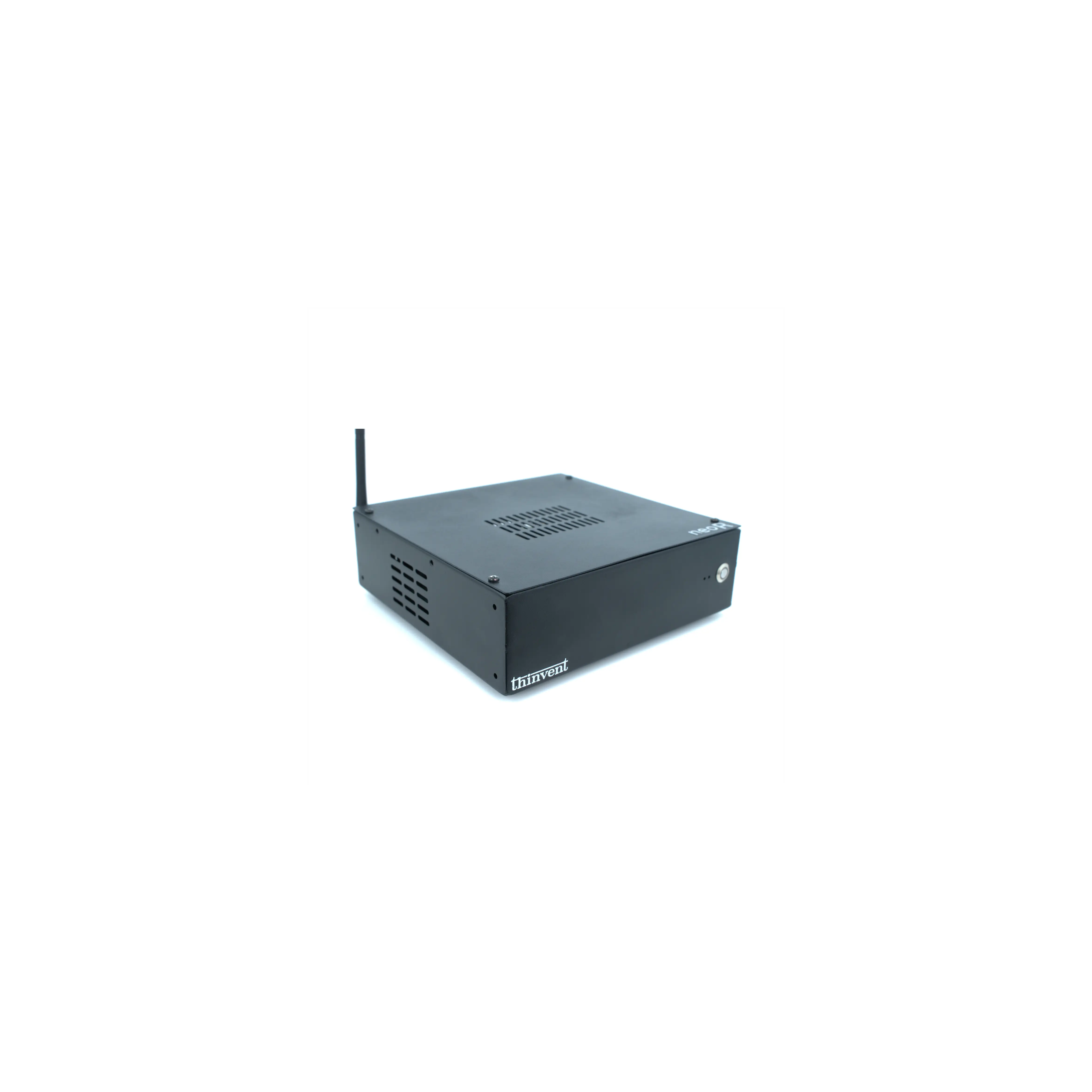
Thinvent offers a comprehensive range of industrial computing solutions that embody the principles of robust tower and compact form factors. Our product lineup is designed for reliability and performance in demanding applications.
For High-Performance Industrial Control: The Thinvent Industrial PC IPC5 features a 12th Gen Intel® Core™ i5-1240P processor (12 cores, up to 4.4 GHz) with 16GB RAM and 512GB SSD, delivering the power needed for complex automation, data analysis, and machine vision tasks.
For Efficient & Ruggedized Operations: The Thinvent Industrial PC IPC3 with an Intel® Core™ i3-1215U processor and the Thinvent Industrial PC IPC1 with an Intel® N100 processor provide a balance of performance and efficiency. These systems are ideal for process monitoring, IoT gateways, and digital signage, offering fanless reliability in compact designs.
For Ultra-Compact & Low-Power Edge Applications: Our Thinvent Micro series (Micro 5 Wifi Thin Client and Micro 6 Pro Mini PC) utilize ARM® processors for exceptional energy efficiency. With onboard RAM and eMMC storage, these units are perfect for thin client deployments, lightweight edge computing, and kiosks