What Is a Railway CMS?
A railway CMS (Content Management System) is a centralized software platform used to manage, schedule, and distribute passenger information across a rail network — coach display boards, platform screens, announcement systems, ticketing counters, and station signage. Staff typically access it through a web-based login portal from a workstation or terminal on the station network, which means the client machine must be reliable, secure, and available around the clock.
"Railway CMS login" usually refers to signing in to this portal from a station PC or terminal. The login itself is a web application; the practical question is what hardware runs it reliably in a station environment where dust, heat, vibration, and continuous operation are normal.
What the Client Hardware Needs to Handle
A CMS login workstation is usually a browser-based client, but in practice it also runs local display software, announcement scheduling tools, serial-connected peripherals, and sometimes a local database or cache. That workload benefits from:
-
A modern multi-core processor for smooth browser and display rendering
-
16 GB RAM or more to keep multiple windows and services responsive
-
SSD storage for fast boot and quick logins after power interruptions
-
Legacy serial (DB9/RS-232) ports for connecting to older station equipment and controllers
-
Wired Gigabit Ethernet, since station networks are almost always cabled
-
A fanless, dust-tolerant chassis that survives 24×7 duty in non-air-conditioned rooms
Typical Railway CMS Deployment Scenarios
| Scenario | Hardware Role | Key Requirement |
|---|---|---|
| Station master / control room | CMS login workstation | Dual display, reliable Ethernet |
| Platform display controller | Local content player | Fanless, wide-temperature operation |
| Ticketing and enquiry counter | CMS + ticketing client | Serial ports, stable uptime |
| Coach / depot information node | Display driver | Compact, vibration-tolerant |
| Signage and announcement hub | Multi-screen controller | Multiple HDMI outputs |
Why Fanless Industrial PCs Suit Station Environments
Consumer desktops draw air through unfiltered fans, which clogs quickly in dusty station buildings and rail-adjacent rooms. A fanless industrial PC with a sealed chassis and wide-temperature components avoids that failure mode entirely. It also tolerates the electrical noise and intermittent power conditions common on site, and can be panel- or DIN-mounted in tight control cabinets. For CMS login terminals that must be available at every shift change, this translates directly into fewer service calls.
Thinvent Products for Railway CMS Terminals
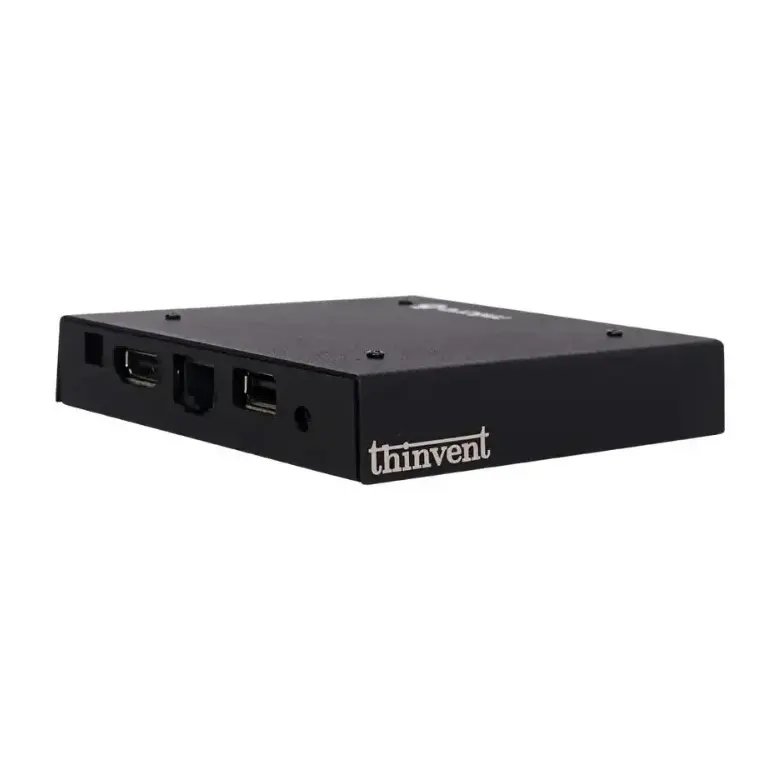
Thinvent builds industrial computers, mini PCs, thin clients and all-in-one PCs suited to transport and infrastructure deployments. The Thinvent® Industrial PC IPC3, for example, pairs an Intel® Core™ i3-1215U processor (6 cores, up to 4.4 GHz, 10 MB cache) with 16 GB DDR4 RAM and up to 1 TB SSD, in a fanless chassis. Variants are available with quad DB9 serial ports for legacy station equipment, and with Windows 11 Pro, Windows 11 IoT, DOS, or Thinux™ Embedded Linux depending on your CMS software requirements. For display-heavy stations, Thinvent all-in-one PCs provide an integrated screen and compute unit for platform and counter use.