What Does "Rugged" Mean in Industrial Computing?
Rugged computers are systems engineered to keep working where ordinary commercial PCs fail — on factory floors, in vehicles, at remote sites, and in extremes of heat, cold, dust, vibration and humidity. The term covers a broad family of devices: rugged tablets, vehicle-mounted computers, handhelds, panel PCs and box-style industrial computers. Vendors in this space, such as RuggON, Ruggtek and Rugged Science, build tablets and vehicle terminals to standards like MIL-STD-810H for shock and vibration, with IP65/IP66 sealing against dust and water ingress. OnLogic likewise offers a portfolio of rugged computers aimed at industrial IoT and edge AI deployments.
Where Rugged Computers Are Used
The applications are typically mission-critical and unforgiving of downtime: public safety and emergency response, logistics and transportation fleets, mining, smart agriculture, industrial automation, and military or ground-control systems. In these settings a computer may run 24×7 in a sealed cabinet, on a forklift, in a truck cab, or on a production line where airborne metal dust and coolant mist are constant. Reliability, wide-temperature operation, and a fanless design (no moving parts to draw in contaminants) matter far more than raw clock speed alone.
Key Technical Considerations
When specifying a rugged or industrial system, buyers usually weigh the following:
| Consideration | Why It Matters | Typical Rugged Approach |
|---|---|---|
| Cooling | Fans pull in dust and fail first | Fanless, passive heatsink chassis |
| Ingress protection | Dust, water, washdown | IP-rated sealed enclosures |
| Shock & vibration | Vehicles, machinery, drops | MIL-STD-810 tested designs |
| Operating temperature | Unheated sheds, hot plant rooms | Wide-temp components |
| I/O & legacy ports | PLCs, scales, sensors, serial devices | Multiple COM/DB9, dual Ethernet, digital I/O |
| Power input | Vehicle and industrial DC rails | Wide-range DC input, 12V/24V options |
| Longevity | 5–10 year deployment cycles | Long-lifecycle components, stable supply |
For fixed installations — control cabinets, kiosks, machine cells, edge gateways — a box-style industrial PC with fanless cooling and generous serial and Ethernet connectivity is often the most cost-effective rugged solution, complementing the tablets and vehicle terminals used by mobile workers.
Choosing Between Rugged Tablets and Industrial Box PCs
Rugged tablets and handhelds suit field workers who need a screen in hand: inspections, surveying, warehouse picking, and vehicle-mounted navigation. Industrial box PCs, by contrast, are mounted inside cabinets or on machinery and connect to existing monitors, HMIs and control networks. Many deployments combine both — a fanless industrial PC at the edge collecting data from serial devices and PLCs, and rugged tablets on the floor displaying and acting on that data. Matching processor performance, memory and storage to the workload (SCADA, MES, vision, or simple data logging) keeps the total cost of ownership low over a long service life.
Thinvent's Industrial and Rugged-Grade Computers
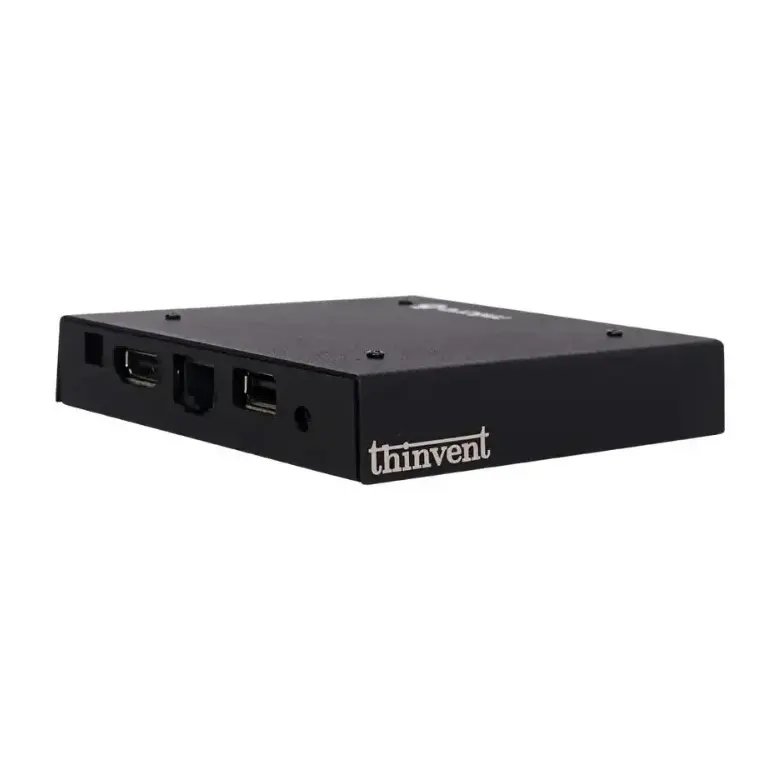
Thinvent builds fanless industrial computers, mini PCs, thin clients and all-in-one PCs designed for continuous operation in demanding environments. Our Industrial PC range, including the IPC3 series, pairs Intel® Core™ processors such as the i3-1215U (6 cores, up to 4.4 GHz, 10 MB cache) with up to 16GB DDR4 RAM and 1TB SSD storage, and offers options including dual Ethernet, HDMI, USB 3.2 Gen 2, USB-C, and quad DB9 serial ports for legacy industrial equipment. Operating system choices span Windows 11 Pro, Windows 11 IoT Value, DOS, and Thinux™ Embedded Linux, so the same hardware platform can be tailored to factory automation, kiosks, digital signage, edge data collection and thin-client VDI estates. With sealed fanless chassis and wide DC power input options, Thinvent systems are built to keep running where dust, heat and vibration are part of everyday life.