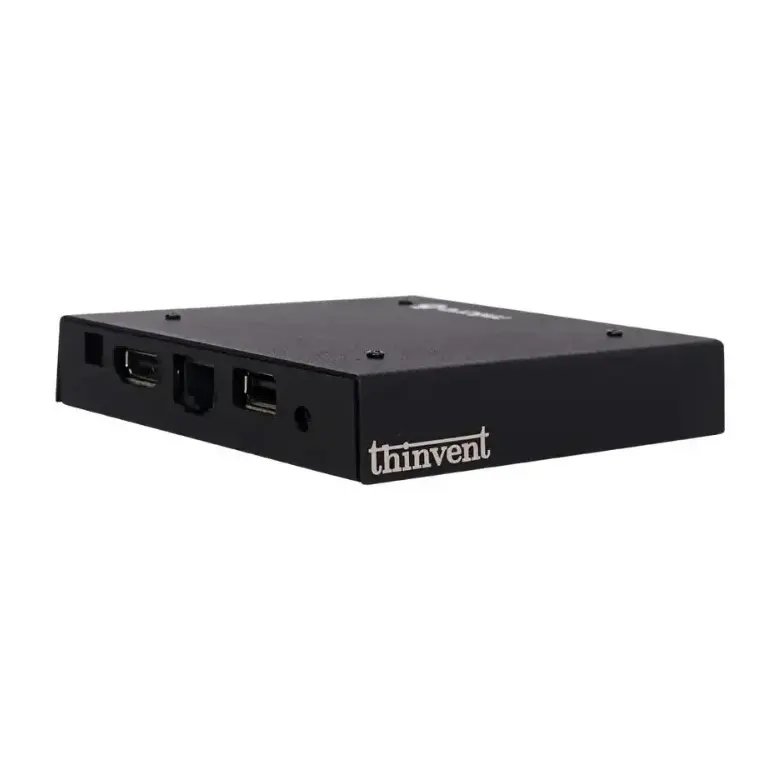
What Is a Thin Client Solution?
A thin client solution is a computing architecture in which the endpoint device — the client — handles only input, display and network communication, while all processing, storage and application execution take place on a central server, virtual desktop infrastructure (VDI), or cloud environment. Because the heavy lifting happens remotely, the endpoint can be small, fanless, low-power and highly reliable. Organisations adopt thin client solutions to centralise management, tighten data security, extend hardware life, and cut both energy costs and IT support effort.
How a Thin Client Solution Works
The client connects over Ethernet to a host such as a Windows Server with Remote Desktop Services, a VDI platform, or a hosted desktop service, and renders the session locally. Typical requirements are modest: a low-power Intel or ARM processor, 4–8 GB of RAM for a standard desktop session, and a small SSD or flash module for the operating system. Connectivity matters more than raw compute — Gigabit Ethernet, dual Ethernet ports for redundant or segmented networks, multiple HDMI outputs for dual-display productivity, and USB 3.2 Gen 2 and USB-C ports for peripherals. The operating system is usually a locked-down Windows IoT or Linux build so that users cannot install unauthorised software.
Thin Client vs. Thick Client vs. Zero Client
| Attribute | Thin Client | Thick (PC) Client | Zero Client |
|---|---|---|---|
| Local processing | Minimal | Full | None (protocol only) |
| Local storage | Small SSD/flash | Large SSD/HDD | None |
| Management | Centralised | Per-device | Centralised |
| Power draw | Low | High | Very low |
| Best for | VDI, cloud apps, kiosks | Local compute-heavy work | Fixed VDI estates |
Where Thin Client Solutions Are Used
Thin client solutions are common in call centres, banks and financial back offices, hospitals and clinics, retail point-of-sale, education labs, government offices, and manufacturing shop floors. In industrial settings the same architecture is used for SCADA, HMI and MES terminals, where a fanless industrial PC or all-in-one panel PC runs a thin session or a locked-down local application. Serial-equipped models with DB9 ports remain useful for connecting legacy PLCs, weighbridges, barcode scanners and instrumentation alongside modern Ethernet and USB devices.
Choosing the Right Thin Client Hardware
Start with the workload: office and browser-based tasks run comfortably on Intel Celeron or N-series processors with 4–8 GB of RAM, while multi-application or multi-display users benefit from Core i3 or i5 silicon with 16 GB. Confirm your display and peripheral requirements — HDMI count, USB-C, serial ports — and decide whether you need dual Ethernet for network redundancy. Fanless, ventless chassis are preferable in dusty or hot environments because they remove the single most failure-prone mechanical part. Finally, pick an operating system that matches your management stack: Windows 11 Pro or IoT, Ubuntu Linux, or a vendor-tuned embedded Linux.
Thinvent Products for Thin Client Solutions
Thinvent builds a complete range of endpoints for thin client and centralised computing deployments. The Thinvent thin client line delivers compact, fanless devices with Gigabit Ethernet, dual-display support and a choice of Windows or Linux images. The IPC3 industrial PC pairs an Intel Core i3-1215U processor (6 cores, up to 4.4 GHz, 10 MB cache) with 16 GB DDR4 RAM and a 1 TB SSD, and is available with Windows 11 Pro, Windows 11 IoT, DOS or Thinux™ Embedded Linux — including quad DB9 serial variants for industrial and legacy connectivity. Thinvent mini PCs and all-in-one PCs cover space-constrained desks, kiosks and control rooms, all managed centrally and built to run continuously in demanding environments.