What Are High-Performance Industrial Computers?
High-performance industrial computers are specialized computing systems engineered to handle demanding, mission-critical tasks in challenging environments. Unlike standard desktop PCs, these systems prioritize reliability, durability, and sustained performance under conditions involving extreme temperatures, dust, vibration, and continuous 24/7 operation. They are the backbone of modern industrial automation, data processing, and edge computing applications where failure is not an option.
Key Specifications and Technical Details
These computers are defined by robust components designed for industrial workloads. Key specifications include:
-
High-Core-Count Processors: Utilizing multi-core CPUs from Intel Core i-series (e.g., i3, i5, i7) and efficient ARM architectures to manage parallel processing tasks.
-
Ample Memory and Fast Storage: Configurations with 8GB to 16GB+ of DDR4 RAM and high-speed SSD storage (256GB to 512GB+) ensure smooth multitasking and rapid data access.
-
Industrial-Grade Design: Often featuring fanless cooling for silent, dust-proof operation, wide-range power input (e.g., 12V-24V DC), and extended operating temperature ranges.
-
Rich Connectivity: Multiple I/O ports (HDMI, USB, COM) and options for WiFi, enabling integration with a vast array of industrial machinery, sensors, and networks.
Primary Use Cases and Applications
High-performance industrial computers are deployed across diverse sectors:
-
Factory Automation & Control: Acting as the brain for PLCs, SCADA systems, and robotic control units on the production floor.
-
Machine Vision & AI Inference: Processing high-resolution camera feeds in real-time for quality inspection, defect detection, and robotic guidance.
-
Digital Signage & Kiosks: Driving multiple high-definition displays in public spaces, retail environments, and transportation hubs.
-
Edge Computing Gateways: Aggregating, processing, and analyzing data from IoT sensors at the network edge before sending insights to the cloud.
-
Thin Client & VDI Hosts: Providing a secure and manageable endpoint for virtual desktop infrastructure in offices and call centers.
Performance Comparison: ARM vs. x86 Architectures
The choice between ARM-based and Intel x86-based systems depends on the application's power, performance, and software requirements.
| Feature | ARM-Based Systems (e.g., Cortex A55) | Intel x86-Based Systems (e.g., Core i5, N100) |
|---|---|---|
| Core Philosophy | Power efficiency, low heat, cost-effective | High performance, broad software compatibility |
| Typical Use Case | Lightweight computing, digital signage, basic thin clients, kiosks | Data-intensive processing, machine vision, automation, virtualization |
| Performance Profile | Excellent for dedicated, lightweight tasks | Superior for multi-threaded, complex computations |
| Power Consumption | Very Low (often 5V-12V adapters) | Moderate to High (12V+ adapters) |
| Software Ecosystem | Linux-based (Thinux, Ubuntu), Android | Full Windows 11/10, Linux distributions |
Thinvent's High-Performance Industrial Computing Solutions
Thinvent offers a comprehensive portfolio of industrial-grade computers designed to meet the spectrum of demanding tasks. Our range includes:
-
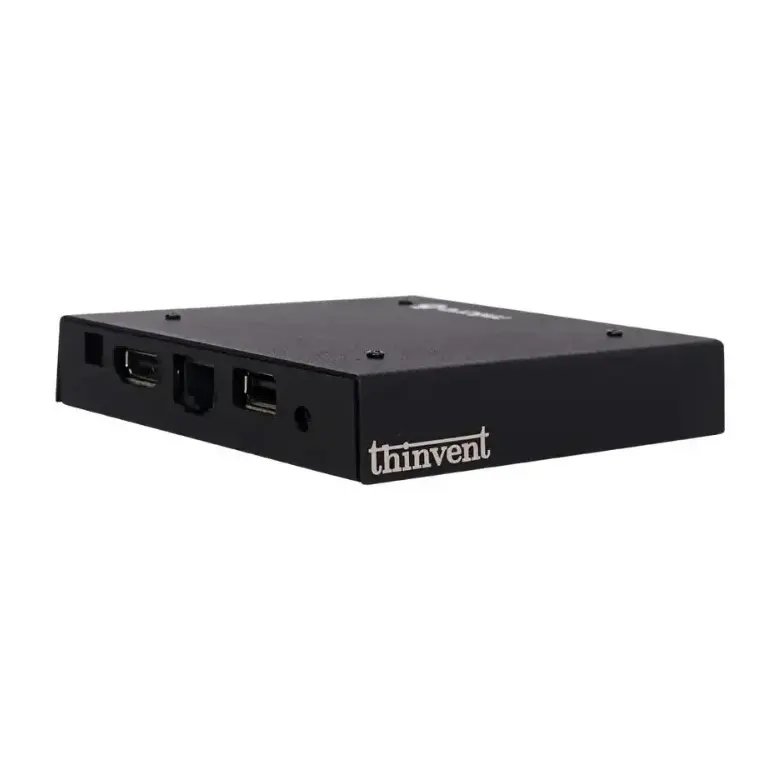
Thinvent Micro Series: Ultra-compact, fanless systems powered by efficient ARM processors, ideal for space-constrained, lightweight applications like digital signage and basic thin client setups.
-
Thinvent Treo & IPC Series: Versatile mini PCs and industrial computers featuring Intel processors like the N100, i3, and i5. These balance performance and efficiency for edge computing, automation, and kiosk deployments.
-
Thinvent Aero & High-End IPC Series: Our most powerful solutions, equipped with Intel Core i5 and i7 processors, high-speed RAM, and large SSDs. Built for the most demanding workloads, including advanced machine vision, AI at the edge, and industrial control systems.
All Thinvent systems are built for reliability with industrial components, support wide operating temperatures, and come with flexible operating system options including Thinux™ Embedded Linux, Ubuntu, and Windows IoT/Pro, ensuring a perfect fit for your specific industrial challenge.