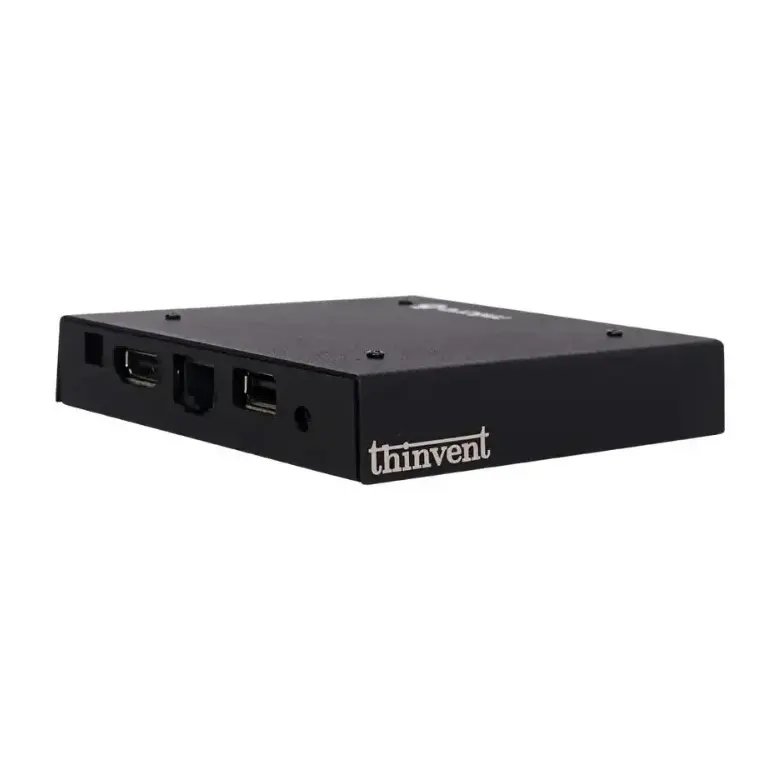
Direct Answer: How Does Mini PC Size Compare to a Supercomputer?
Traditional supercomputers are massive, room-filling systems with thousands of processors, high‑speed interconnects, and dedicated cooling. However, recent innovations like NVIDIA’s Project Digits (a desktop AI supercomputer the size of a small bag) and ASUS Ascent GX10 (a stackable mini‑PC‑sized AI supercomputer) have blurred the line. These compact “supercomputers” deliver petaFLOPS‑level performance in a footprint comparable to a typical mini PC. Yet, standard mini PCs like the Thinvent® Aero are general‑purpose systems built for reliability, low power, and space efficiency, not for supercomputing workloads.
Key Specifications and Technical Differences
The table below highlights the fundamental differences between a supercomputer, a minicomputer, and a mini PC:
| Feature | Supercomputer (e.g., Project Digits) | Minicomputer | Mini PC (e.g., Thinvent Aero) |
|---|---|---|---|
| Size | Bag‑sized to room‑sized | Small cabinet (~desktop size) | Palm‑sized (~0.5–1.5L) |
| Processing Power | PetaFLOPS (10¹⁵ operations/sec) | MegaFLOPS–GigaFLOPS | GigaFLOPS |
| Core Count | Thousands of cores | 2–8 cores | 2–16 cores |
| Primary Use | AI training, scientific simulation | Departmental computing, database | Edge computing, thin client, office |
| Power Consumption | Kilowatts to megawatts | 100–500W | 10–65W |
| Cooling | Liquid / rack‑level | Fan‑based | Fanless (often) |
A mini PC cannot match a supercomputer’s raw compute for HPC or AI; its strength lies in compact form factor, silent operation, and low energy for everyday tasks and embedded applications.
Use Cases and Applications
-
Traditional Supercomputers: Weather modeling, genomic research, nuclear simulations, large‑scale AI training.
-
Compact AI Supercomputers (e.g., Project Digits): On‑desk AI