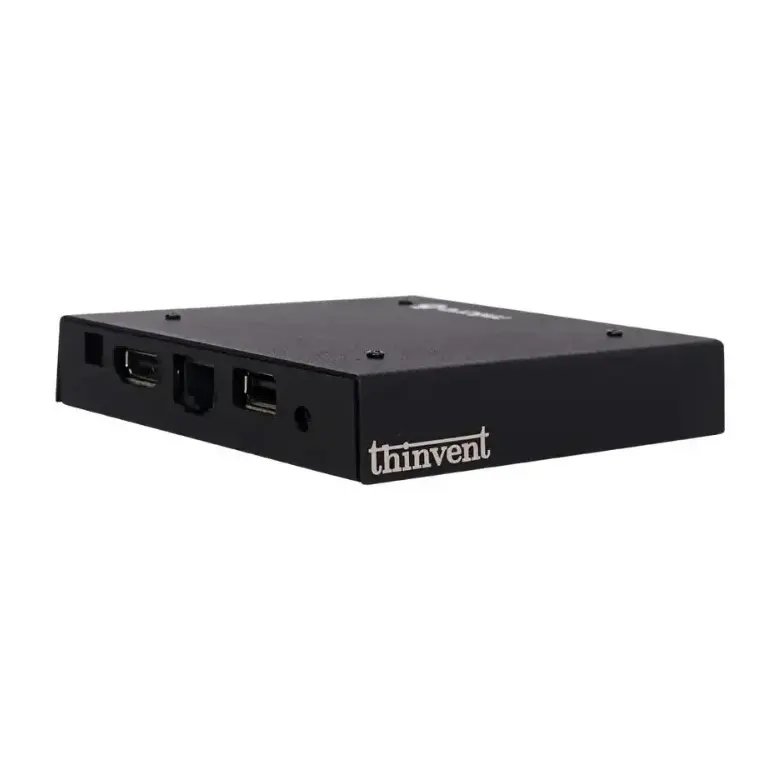
The Asus Tinker Board is a single-board computer with a Rockchip RK3288 processor and up to 2 GB of RAM, sized and pinned to be compatible with Raspberry Pi 2 and 3 models. The closest Thinvent match is the Thinvent Micro 6 Pro Mini PC, which runs on an ARM Cortex A55 processor and has 4 GB of RAM and 32 GB of storage. The Thinvent Micro 5R Thin Client is the nearest match for the Tinker Board's 2 GB of RAM.
Asus Tinker Board vs Thinvent Micro 6 Pro and Micro 5R
| Asus Tinker Board | Thinvent Micro 6 Pro Mini PC | Thinvent Micro 5R Thin Client | |
|---|---|---|---|
| Processor | Rockchip RK3288 | Amlogic S905X3 (ARM Cortex A55) | Rockchip RK3528 (ARM Cortex A53) |
| Cores | Not confirmed | 4 | 4 |
| Max frequency | 1.8 GHz | 1.9 GHz | 2.0 GHz |
| RAM | Up to 2 GB | 4 GB | 2 GB |
| Storage | Not confirmed | 32 GB eMMC | 16 GB eMMC |
| Form Factor | Single-board computer | Mini PC | Thin Client |
| Operating System | Not confirmed | Thinux™ Embedded Linux | Thinux™ Embedded Linux |
| Wireless | Not confirmed | Wi-Fi, dual antenna, dual band | Wi-Fi 6 (802.11ax), dual band, Bluetooth 5 |
| Cooling | Not confirmed | Fanless passive cooling | Fanless passive cooling |
| Video output | 4K video | HDMI | HDMI 2.0 |
Key differences
-
The Thinvent Micro 6 Pro Mini PC has 4 GB of RAM, twice the 2 GB maximum of the Tinker Board.
-
The Thinvent Micro 6 Pro Mini PC has 32 GB of eMMC storage, and the Micro 5R Thin Client has 16 GB. We could not confirm the Tinker Board's storage capacity.
-
Both Thinvent products use fanless passive cooling and ship with Thinux™ Embedded Linux.
-
The Thinvent Micro 6 Pro Mini PC has a 1.9 GHz processor. The Tinker Board runs at 1.8 GHz, so the two are close in clock speed.
-
The Tinker Board supports 4K video output. We could not confirm the video output of the Thinvent Micro 6 Pro, which lists an HDMI port. Thinvent Micro 5R has HDMI 2.0.
-
The Tinker Board is a bare single-board computer, which suits DIY and hobbyist builds. The Thinvent products are housed Mini PCs and a Thin Client, with aluminium housings and VESA-ready designs.
Which one should you choose?
Choose the Asus Tinker Board for DIY and hobbyist projects that need the Raspberry Pi-compatible board layout and GPIO pinout. Choose the Thinvent Micro 6 Pro Mini PC for a housed, fanless ARM system with 4 GB of RAM and Thinux™ Embedded Linux. Choose the Thinvent Micro 5R Thin Client for a compact, fanless ARM device with Wi-Fi 6 and Bluetooth 5 that runs on 2 GB of RAM.