What Is the UMS9230H and Why It Appears in eMMC Discussions
The UMS9230H is the internal part number for the UNISOC Tiger T612, a mobile SoC (system-on-chip) designed for Android smartphones and tablets. According to processor databases, the UMS9230H/Tiger T612 is paired in real devices with 4 GiB of RAM and either 64 GB or 128 GB of onboard storage, running Google Android 11. That onboard storage is eMMC — embedded MultiMediaCard flash soldered directly onto the board.
This combination matters because it explains a common search pattern. Engineers, buyers and repair technicians often look up a chipset part number together with "GB eMMC" when they are trying to identify how much storage a device has, whether a firmware image will fit, or what class of flash performance to expect. The UMS9230H is a mobile-oriented part, so it is not a processor you would normally specify for an industrial computer — but the storage technology it uses, eMMC, absolutely is.
What eMMC Actually Is
eMMC is a managed NAND flash package: a flash die plus a controller, sealed in a single BGA chip and soldered to the mainboard. It typically appears in capacities of 8, 16, 32, 64, 128 and 256 GB, and it presents itself to the operating system as a simple block device — no separate host controller tuning, no cable, no connector wear.
| Attribute | eMMC | SATA/NVMe SSD | microSD card |
|---|---|---|---|
| Form | Soldered BGA chip | 2.5" or M.2 module | Removable card |
| Typical capacity | 8–256 GB | 128 GB–4 TB+ | 8–512 GB |
| Shock/vibration resistance | High (no connector) | Moderate | Low (socket) |
| Field-replaceable | No | Yes | Yes |
| Cost per GB | Low | Moderate | Low–moderate |
| Best suited to | OS + application image | Large data, databases | Logging, transfer |
The trade-off is straightforward. eMMC is compact, cheap, immune to connector vibration and mechanically very robust — which is exactly why it dominates phones, tablets, single-board computers and many embedded systems. It is also slower than a modern NVMe SSD and cannot be upgraded in the field, so it suits workloads where the operating system and application are fixed and the data footprint is modest.
Where eMMC-Backed Systems Fit
eMMC is a sensible choice for thin clients, kiosk terminals, digital signage players, POS terminals, access-control panels and gateway devices. In these roles the software image is written once, updates are pushed occasionally, and the machine may run for years in a dusty shop floor, a warehouse or an outdoor cabinet. With no spinning platters and no removable media, an eMMC-based system tolerates vibration, wide temperature swings and power cuts far better than a mechanical drive.
The practical design rule is to keep the write load light. Log rotation, read-mostly operating systems and stateless configurations all extend eMMC life considerably. Where a deployment needs heavy local writes — video recording, large databases, long-term data retention — a system with a replaceable SATA or NVMe SSD is the better engineering answer.
Choosing Between eMMC and SSD
If your application is a fixed-function terminal, a browser-based thin client, or an industrial controller with modest storage needs, eMMC gives you the smallest, toughest and most cost-effective footprint. If you need capacity above a few hundred gigabytes, sustained write throughput, or the ability to swap storage in the field, specify an SSD. Many industrial deployments use both: eMMC for the operating system and an SSD for data.
Thinvent Products Featuring This Technology
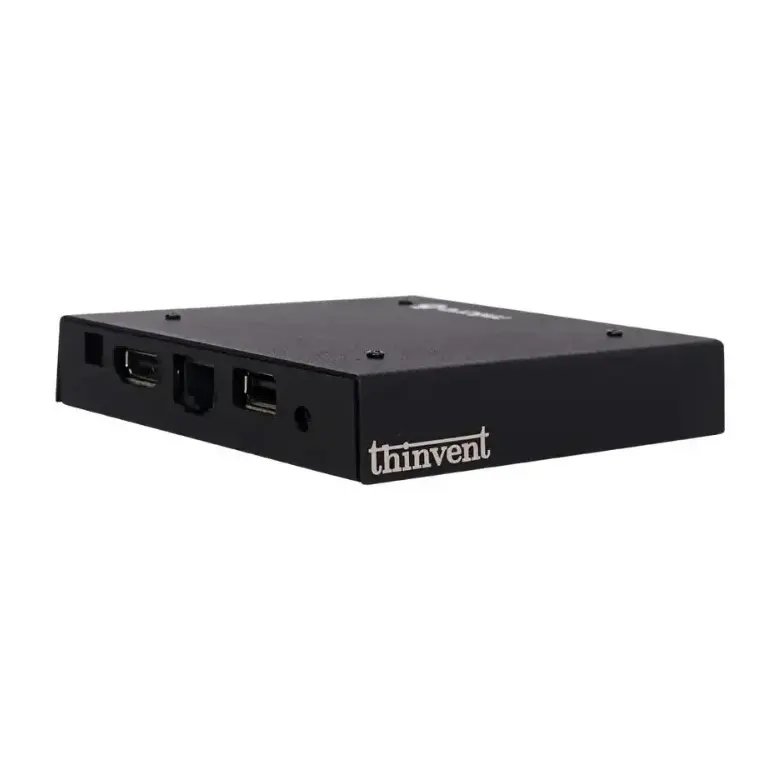
Thinvent builds both approaches into its range. Our thin clients and all-in-one PCs are available with embedded flash storage for fixed-function, high-reliability deployments, while our industrial PCs and mini PCs support larger SSD configurations for data-heavy workloads. Every Thinvent system is designed for continuous operation — fanless cooling options, wide input voltage support, and chassis built for dusty, hot or vibration-prone environments — so you can match the storage technology to the job rather than the other way round.